All lessons
Handwriting · 1800‑1880

Capital letters that fool everyone: I and J, L and S, T and F

Many wrong index entries start with one capital letter. A Virginia judge writing his will in 1806 or a census taker in 1860 wrote I and J with the same big looped stroke, made L and S from nearly the same curve, and gave T and F the same wavy cap. To a modern eye, Isaac becomes Jsaac, Lawyer becomes Sawyer, and Frank becomes Trank.

The fix is not to stare harder at the capital. Read the rest of the word first, compare the capital with other capitals the same writer made on the same page, and ask which reading makes a real name, place or job. The examples below come from a real 1806 will and from census pages of 1860 and 1870.
Letter by letter

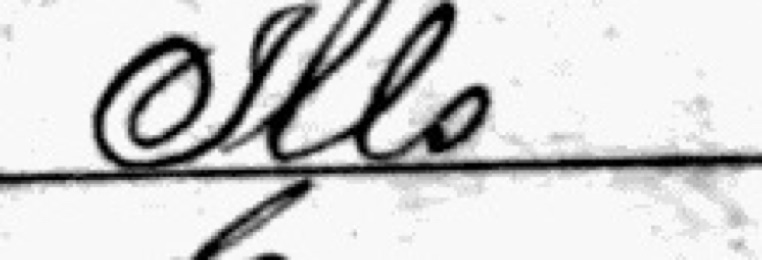
Census entry in a birthplace column: the abbreviation Ills, written with a large looped capital I
I This I opens with a big oval loop on the left, then a tall stem. It sits on the line and has no tail below it. On this page the same writer's J (next example) looks almost identical, so the clue is the word: "Ills" is the usual abbreviation for Illinois.U.S. Census Office, assistant marshal; National Archives microfilm, Public domain
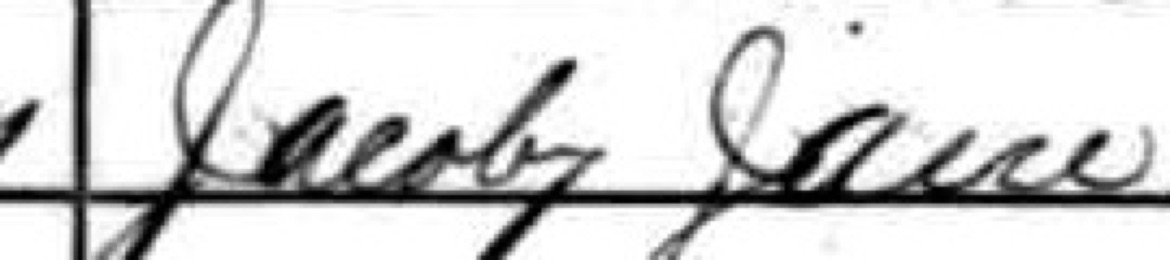
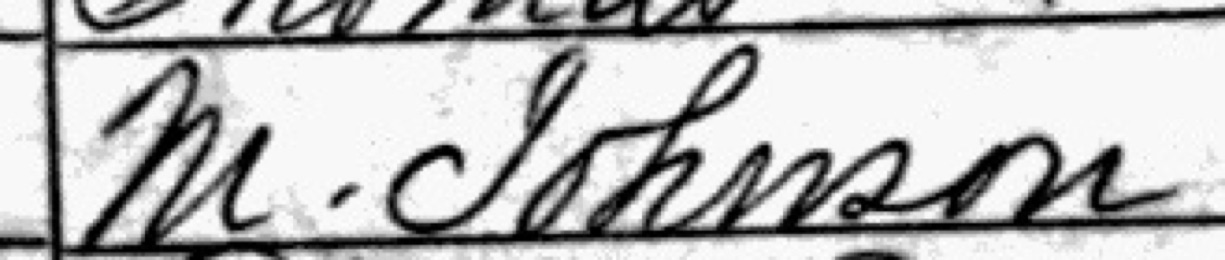
Census name entry M. Johnson, the capital J drawn like a tall looped I
J Here is the same writer's capital J in Johnson. It has the same looped start and tall stem as his I. Only the word tells you it is a J: "Iohnson" is not a name, Johnson is.U.S. Census Office, assistant marshal; National Archives microfilm, Public domain
Handwritten words to Thomas Jefferson in an 1806 will, with a looped T and a J shaped like an I
T and J Two traps in one line. Wythe's T in Thomas is a stem with a curly hat that hangs over the next letters. His J in Jefferson is a tall loop that stays on the line with no tail, the same shape he used for the word I. Read it as Jefferson because "Iefferson" is not a name.George Wythe, Public domain
Census name entry Abraham Lincoln, with a capital L that looks like an S
L The L in Lincoln starts high, comes down, and ends in a flat loop lying on the line. Many readers see an S here. The surname Lincoln (and the occupation Lawyer on the same line) settles it.U.S. Census Office, assistant marshal; National Archives microfilm, Public domain
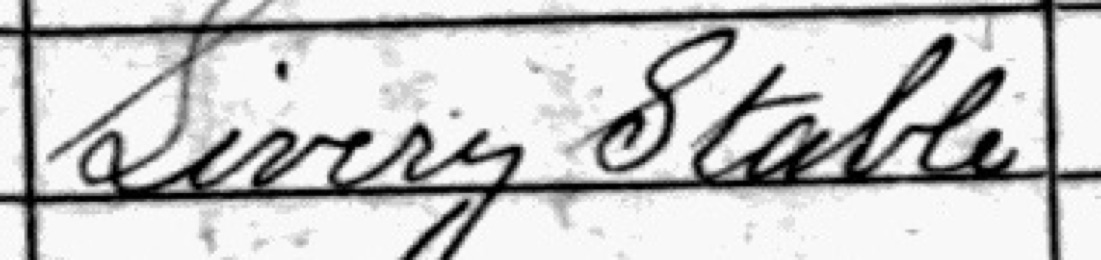
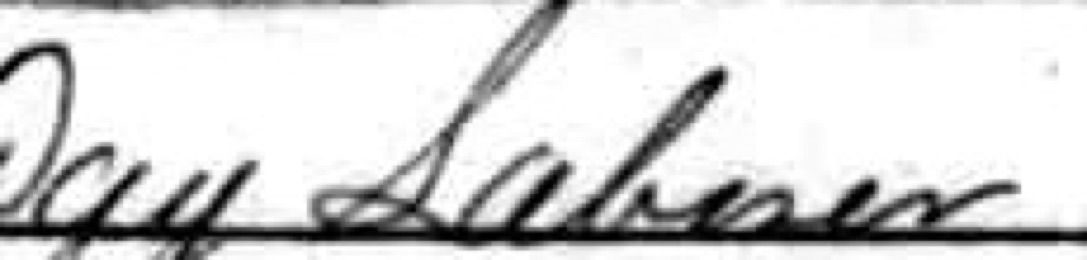
Census occupation Livery Stable, showing a capital L and a capital S side by side
L and S Both letters in one crop: "Livery Stable". The L of Livery has its loop flat on the line and runs straight into the next letter. The S of Stable has a small loop at the top and a big round belly that closes at the bottom left. Put a suspected L next to a known S from the same page and compare.U.S. Census Office, assistant marshal; National Archives microfilm, Public domain
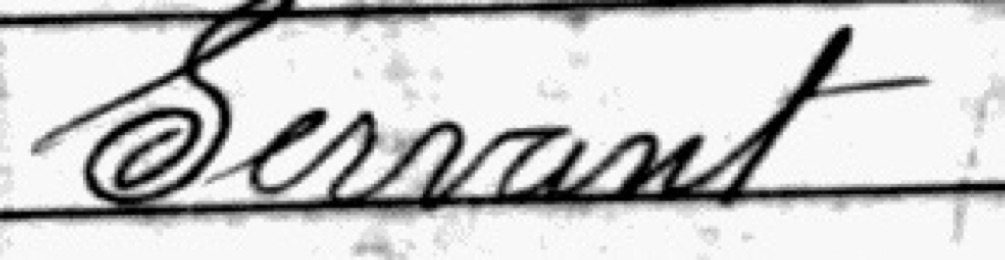
Census occupation Servant, written with a large looped capital S
S A capital S from the same writer. Notice the small loop at the top and the large closed curve at the bottom. Compare it with the L in Lincoln: the L has no top loop.U.S. Census Office, assistant marshal; National Archives microfilm, Public domain
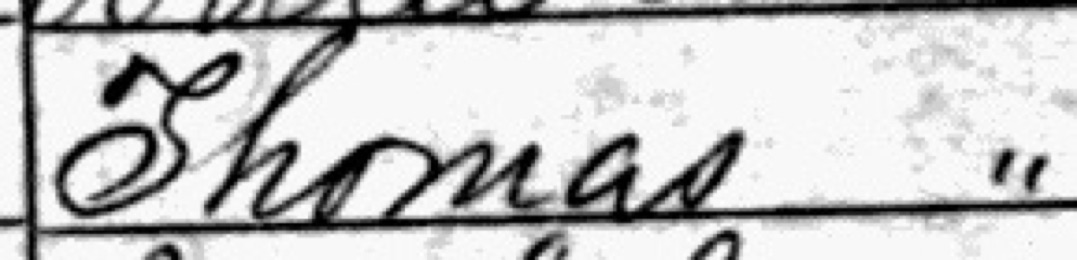
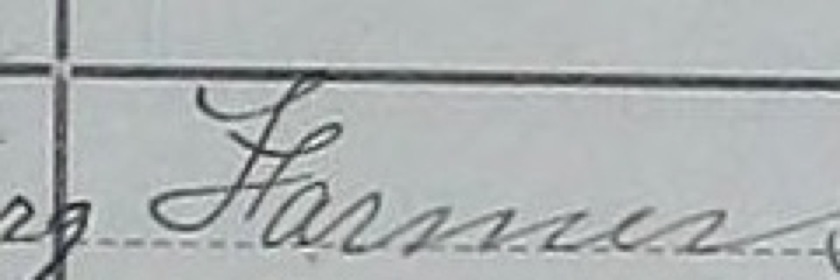
Census given name Thomas, with a looped capital T
T This T is a wavy cap stroke over a stem that curls to the left at the bottom. It looks very much like the writer's S and F. In names, T and F are the pair that trips readers most.U.S. Census Office, assistant marshal; National Archives microfilm, Public domain
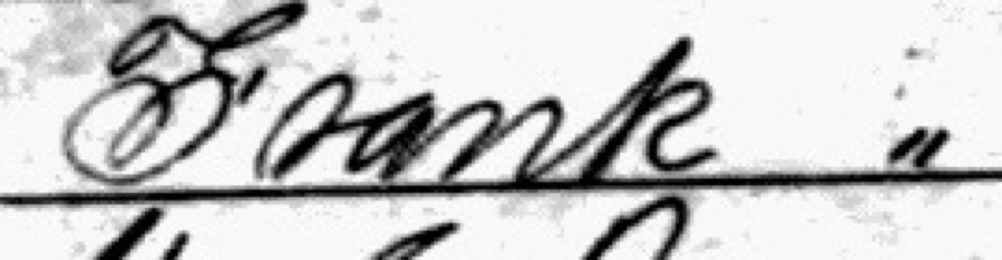
Census given name Frank, a capital F with a short crossing stroke at the middle of the stem
F The F in Frank is built like the T, with one extra mark: a short stroke at about the middle, on the right of the stem or crossing it. That little stroke is often the only difference between F and T, so look for it before you decide.U.S. Census Office, assistant marshal; National Archives microfilm, Public domain

Now you read it

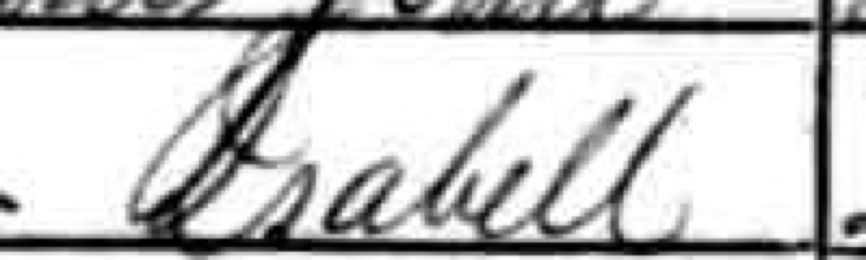
Census given name written with a large looped capital letter followed by sabell
What is this woman's first name?
Tips
  • Read the rest of the word first, then decide what the capital must be.
  • Collect capitals from the same page: find a word you are sure of (a state, a month, a common job) and use it as your key.
  • Check whether the letter drops below the line. Some writers gave J a tail and I none, but many gave both the same shape.
  • Before you decide between T and F, look for a small stroke across the middle of the stem.
  • When searching indexes, try both readings: Isaac and Jsaac, Lemuel and Semuel, Thomas and Fhomas.
Next lesson