All lessons
Handwriting · 1780‑1900

Reading signatures and marks

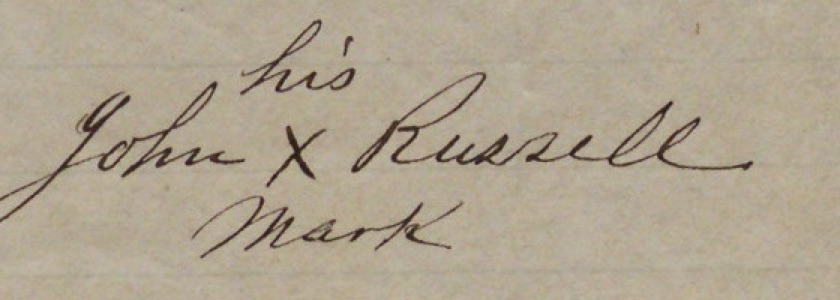
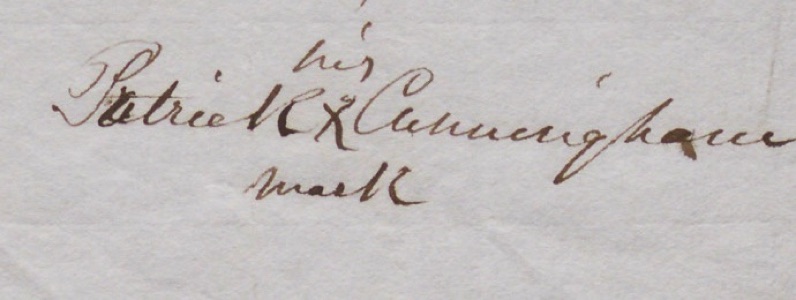
Many of our ancestors could not write, or could not write well. The law still needed their consent, so they "made their mark": usually a cross, sometimes an initial or a little symbol. Someone else (the clerk, the merchant, a witness) wrote the name around it, with "his" or "her" above the mark and "mark" below. Read it as one phrase: John, his mark, Russell.

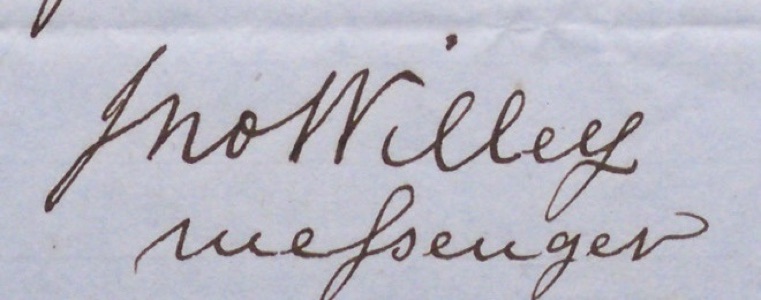
Real signatures have their own puzzles: big capital loops, flourishes under the name, and abbreviated first names like Jno. And many signatures you find are not originals at all. Wills, deeds and marriage bonds were copied into record books by a county clerk, who copied the marks too. A cross in a will book shows that the original was signed by mark. It is not your ancestor's own pen stroke, and it can even be a clerk's error.
Letter by letter

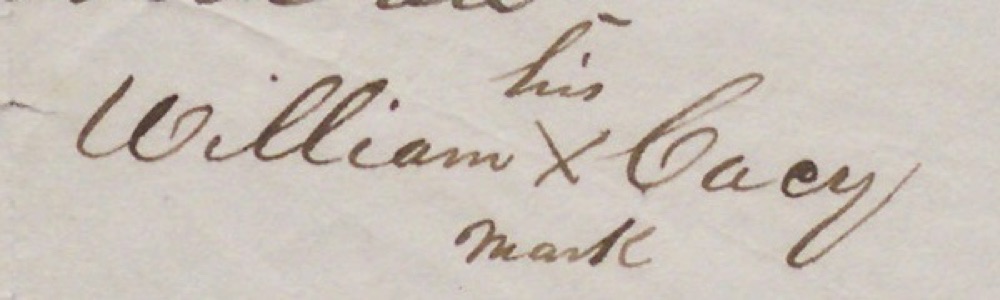
Signature William his X mark Cary
The classic mark: his X mark The cross in the middle is the only stroke William Cary made himself. His name, "his" and "mark" were written by the man who drew up the receipt. The name is split in two around the cross.William Cary; Missouri Historical Society (Missouri History Museum), via DPLA, Public domain
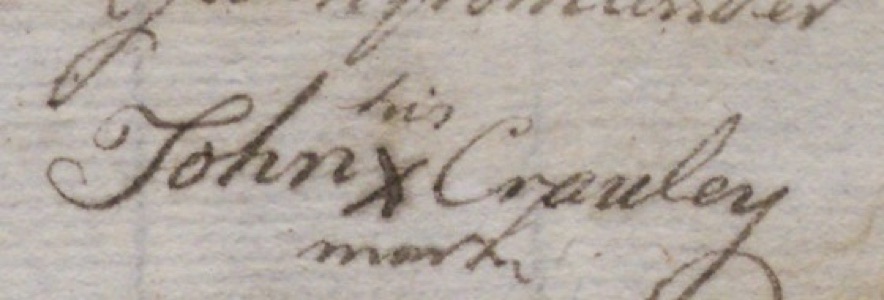
Signature John his X mark Crauley (cataloged as Crowley)
A mark from 1780 The same pattern 55 years earlier: John, a cross, Crauley, with "his" above and "mark" below. Note how the clerk's capital J looks like a T with a long tail. The clerk spelled the surname Crauley; the archive catalogs it as Crowley, so search both.John Crowley; Missouri Historical Society (Missouri History Museum), via DPLA, Public domain
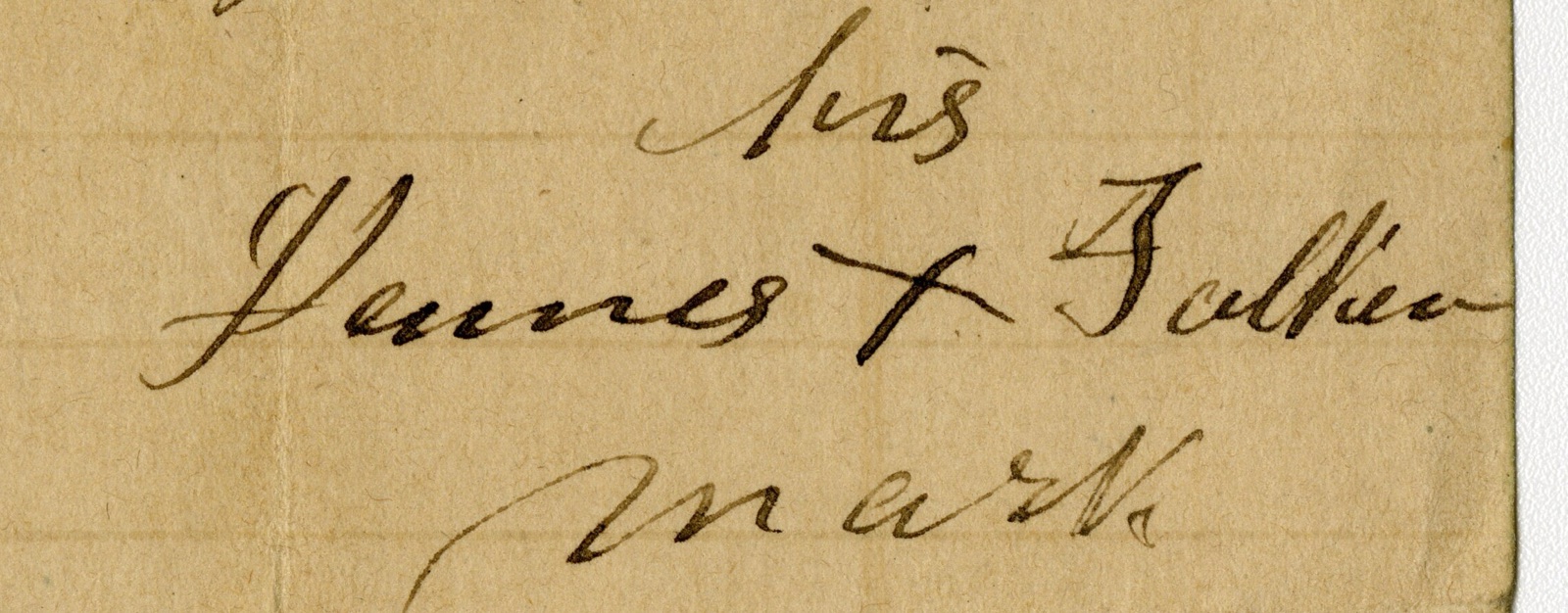
Signature his James cross Fuller mark, in large brown ink
A mark that is not an X James Fuller's mark is a plain cross, more like a plus sign than an X. Marks can be crosses, circles, initials or small drawings. Whatever the shape, "his" and "mark" around it tell you it is a mark.James Fuller; Missouri Historical Society (Missouri History Museum), via DPLA, Public domain
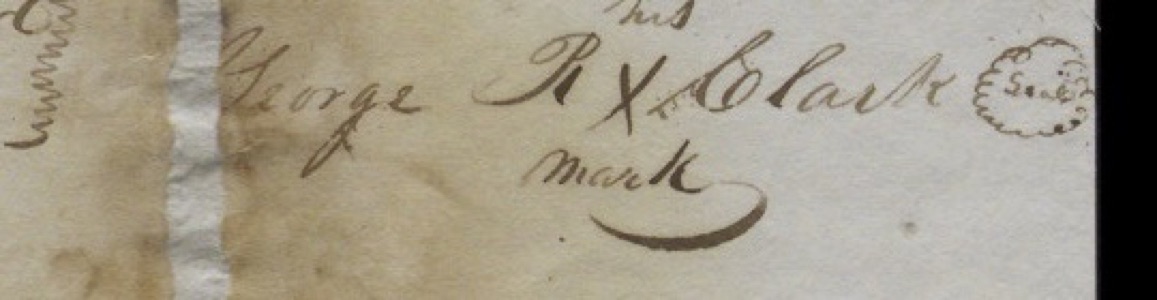
Copied signature George R. his X mark Clark, with a drawn seal
A copied mark: careful! This is a later handwritten copy of George Rogers Clark's 1815 will. The copyist wrote "his mark" even though Clark, a famous general, could certainly write (the museum's own catalog points this out). A mark in a copy tells you what the copyist wrote, not what your ancestor did.Copy of the will of George Rogers Clark; Missouri Historical Society (Missouri History Museum), via DPLA, Public domain
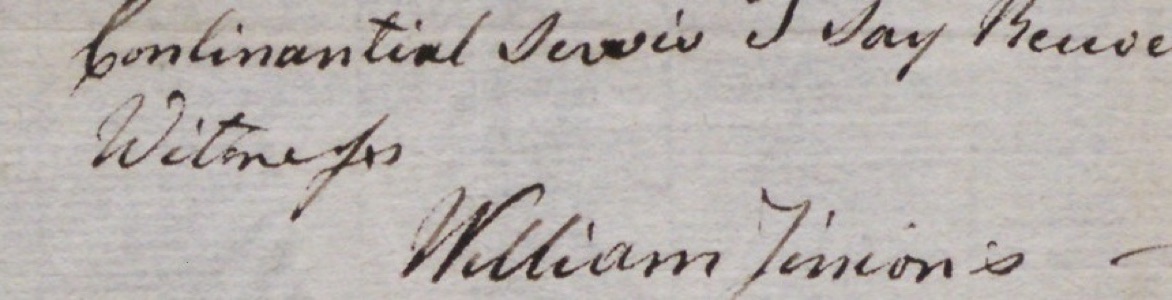
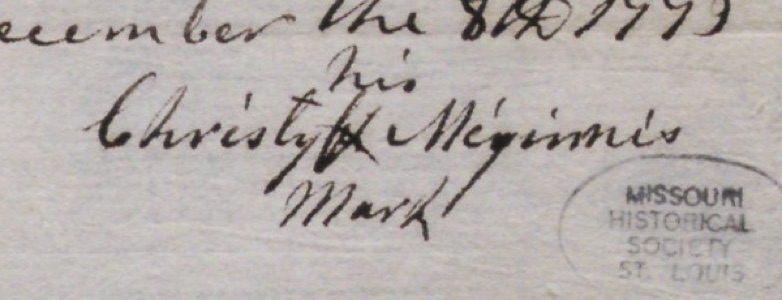
Witness William Jinions signature below a line of text
A witness signing in his own hand Witnesses who could write signed their own names. "Witness" is written Witneſs, with a long s followed by a short s. Look at the whole receipt: the W of William and the letters of the body text match, so Jinions probably wrote the entire paper, and the name of the man who made his mark, too.Christy McGinnis; Missouri Historical Society (Missouri History Museum), via DPLA, Public domain
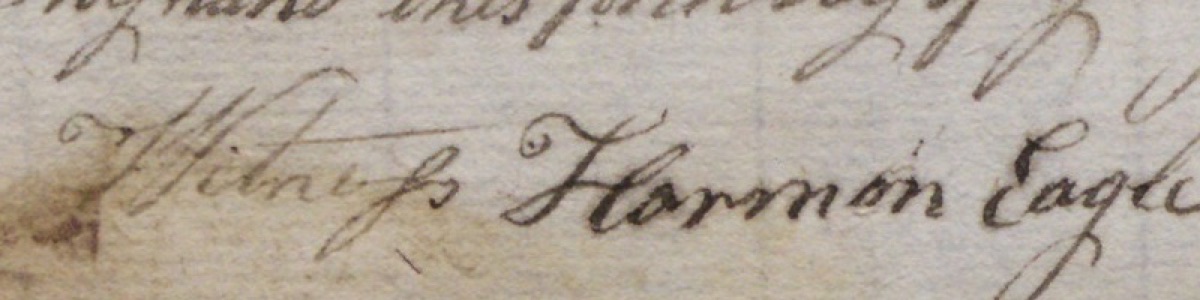
Witness line Harmon Eagle, written in the clerk's hand
A witness name the witness did not write "Witneſs Harmon Eagle" looks like a proud signature with a big looped H. But two months later Eagle enlisted himself, and on that paper (cataloged as Herman Eagle) he signed with his X mark. So this name was written for him, most likely by the clerk. A neat witness name does not prove the witness could write, and the same man appears as Harmon and Herman.John Crowley; Missouri Historical Society (Missouri History Museum), via DPLA, Public domain
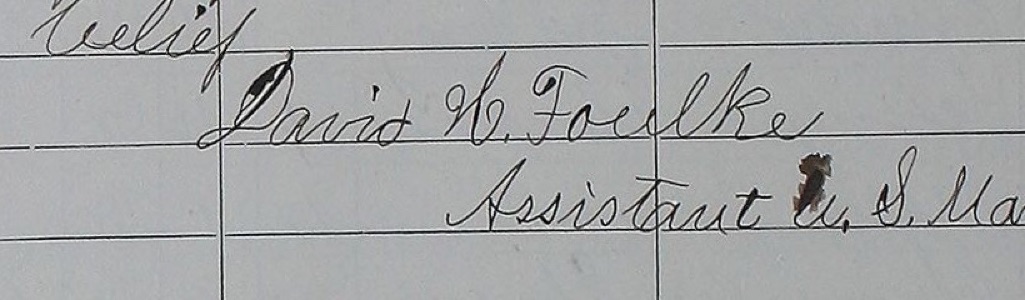
Signature David H. Foulke, Assistant U. S. Marshal, on a census form
An official's signature Census takers signed a certificate at the end of their returns. The middle initial here could be read as H or W: when a letter is unclear, find the same man's signature on other pages and compare.U.S. Census Bureau; Indiana State Library, via DPLA, Public domain

Now you read it

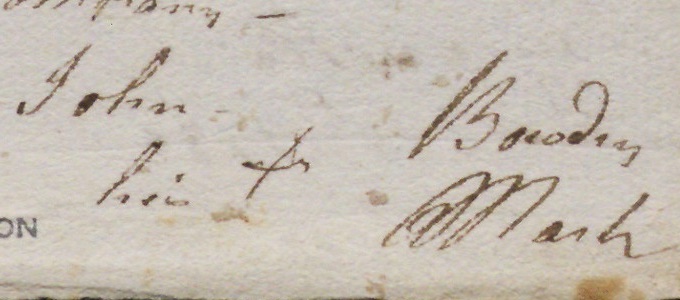
Signature John his X mark Russell
Which part of this signature did John Russell most likely write himself?
Tips
  • Read a mark as one phrase: first name, his (or her) mark, surname. Never index "his" or "mark" as part of the name.
  • A mark does not always mean a person could not read. It can mean illness, old age, poor eyesight, or simply custom.
  • In will books, deed books and other clerk copies, marks and signatures are the clerk's handwriting. Look for the loose original papers if you want your ancestor's own hand.
  • Witnesses who signed in their own hand are often neighbors and relatives. Note every witness name.
  • When a letter in a signature is unclear, compare the same person's signature on other documents.
  • Spelling of surnames in signatures written by clerks is the clerk's spelling. Search every variant.