 Daily Ancestor
How to read an 1880 census page, column by column
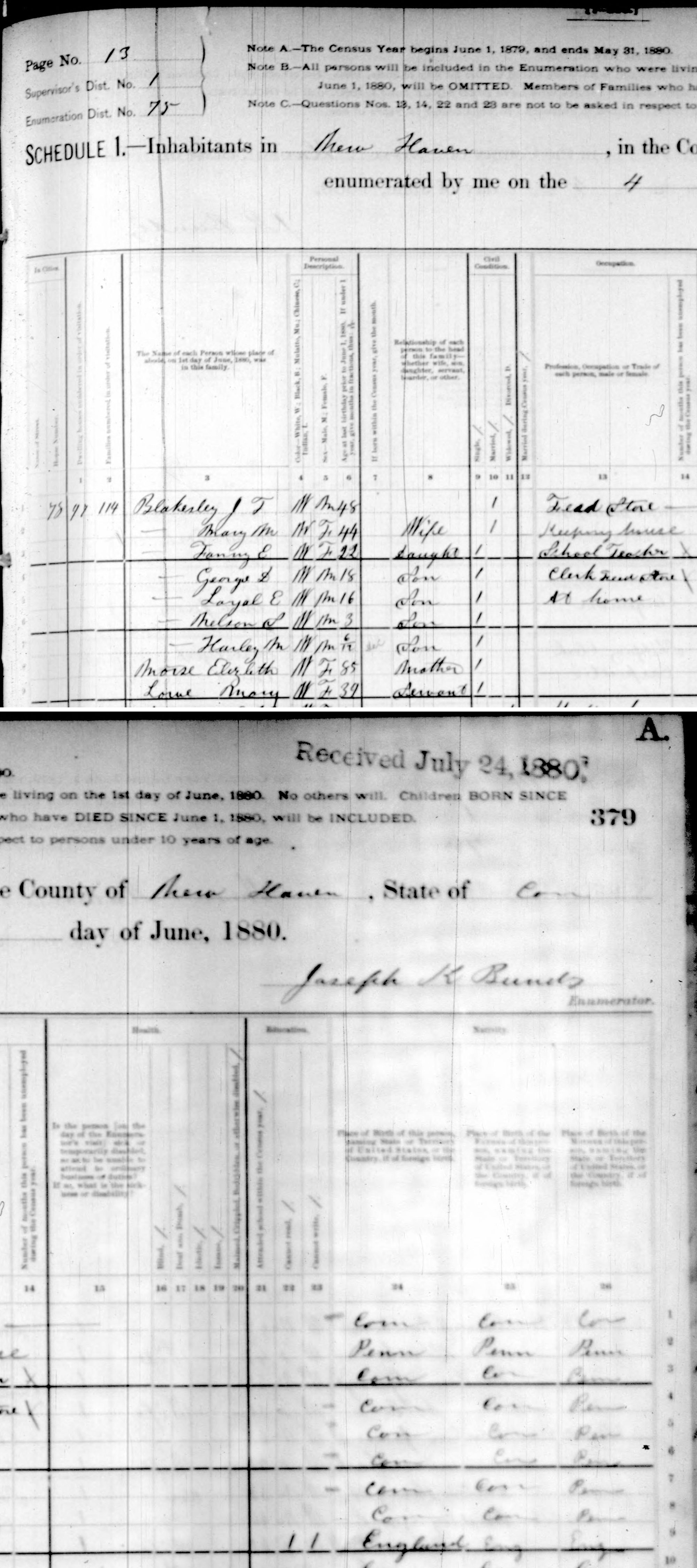
A real 1880 U.S. census page from New Haven, Connecticut, read across all 26 columns for one household: relationships, marital status and the birthplaces of each person's parents.
An 1880 census page is so wide that we show it in two halves: the left half on top, the right half below, with the same nine lines on both. This is page 13 of enumeration district 75 in New Haven, Connecticut, and we follow the Blakesley household on lines 1 to 9, from the house number to the mother's birthplace.
1880 is the first census that says how each person was related to the head of the household and where each person's father and mother were born. The Census Office's printed instructions to enumerators explain the rest of the marks.
Field by field
- 1 Page, supervisor's district and enumeration district
It reads Page No. 13; Supervisor's Dist. No. 1; Enumeration Dist. No. 75
These numbers are the address of the page. Enumerators numbered their pages in order and filled the four pages of each sheet, A to D, before starting the next, so page 13 is the first page of his fourth sheet, the A printed in the corner. Cite it as ED 75, page 13.
Enumeration district: Area assigned to one census taker (E.D.)
- 2 Notes printed across the top
It reads Note A. The Census Year begins June 1, 1879, and ends May 31, 1880. Note B. All persons will be included in the Enumeration who were livin[g on the 1st day of June, 1880. No others will. Children BORN SINCE, on the right half] June 1, 1880, will be OMITTED. Members of Families who h[ave DIED SINCE June 1, 1880, will be INCLUDED, on the right half]. Note C. Questions Nos. 13, 14, 22 and 23 are not to be asked in respect to [persons under 10 years of age, on the right half].
The rules every answer follows. Ages and facts are as of June 1, 1880, and questions about the census year cover June 1879 to May 1880. Note C explains why the youngest children have no occupation and no reading marks.
- 3 Place and date (left half)
It reads SCHEDULE 1. Inhabitants in New Haven, in the Co[unty, on the right half] enumerated by me on the 4 [day of June, 1880, on the right half]
The city this page covers. The instructions limited the count to June, and to the first two weeks of June in cities of 10,000 people or more, so a visit on June 4 is normal for a city.
- 4 County, state and enumerator (right half)
It reads in the County of New Haven, State of Con, [enumerated by me on the 4] day of June, 1880. Joseph K Bundy [probably; the surname is hard to read], Enumerator.
Con is Connecticut. The enumerator's signature on every page tells you who asked the questions; his spellings of names and places may differ from the family's own.
- 5 Stamps added later
It reads Received July 24, 1880. [stamped]; 379 [stamped]; A.
The received stamp and the number 379 were added after the enumerator finished, probably when the schedules were handled in the census office; they are not part of the family's answers. Note the stamped 379 in your citation too, beside the page number 13.
- 6 House number, dwelling and family numbers
It reads 75 or 78 [house number; the second digit is unclear]; 97; 114
In cities the first two columns ask for the street and house number, with the street name written lengthwise down the column. Then come the dwelling and family numbers in the order the enumerator visited: the 97th house and the 114th family on his route.
Dwelling number: House number in the order the census taker visited
- 7 Column 3: names
It reads Blakesley J T; [dash] Mary M; [dash] Fanny E; [dash] George L; [dash] Loyal E; [dash] Nelson S; [dash] Harley M; Morse Elizabeth; Lowe Mary
Surname first, then given names. The instructions said a dash stands in for the family name when it repeats, so every dashed line is a Blakesley. Elizabeth Morse and Mary Lowe have surnames of their own. The head is listed only by his initials, J. T.
- 8 Columns 4 to 6: color, sex and age
It reads W M 48; W F 44; W F 22; W M 18; W M 16; W M 3; W M 6/12; W F 85; W F 39
In 1880 color had to be written for everyone, so W means white here. Age is at the last birthday before June 1, 1880, and a baby under one was given in twelfths: Harley, 6/12, was six months old, born around the end of 1879.
- 9 Column 7: month of birth within the census year
It reads [a faint mark on Harley's line, possibly Dec]; [blank on the other lines]
Only for a baby born between June 1879 and May 1880, the month of birth. The faint mark beside Harley may be Dec, for December 1879, which fits his age of 6/12, but it is too pale to be sure.
- 10 Column 8: relationship to the head of the family
It reads [blank for the head]; Wife; Daught[er]; Son; Son; Son; Son; Mother; Servant
Each relationship is to the head, J. T., not to the person on the line above. Elizabeth Morse is called his mother although her surname is not Blakesley: she may have married again, or the word may be loose, so check it. Her birthplace, Connecticut, fits J. T.'s mother better than Mary's, whose parents were both born in Pennsylvania.
- 11 Columns 9 to 12: single, married, widowed, divorced, married in the year
It reads Married: J. T., Mary M.; Single: Fanny E., George L., Loyal E., Nelson S., Harley M., Elizabeth Morse, Mary Lowe; [nothing in Widowed, Divorced or Married during the census year]
J. T. and Mary are marked married and everyone else single. A single mark for an 85-year-old mother is odd, and the mark may have been run down the column by mistake, so do not use it to rule out a marriage. Nobody married between June 1879 and May 1880.
- 12 Column 13: occupation
It reads Feed Store; Keeping house; School Teacher; Clerk Feed Store; At home; [blank for the younger children]
The instructions say women keeping house for their own family were to be entered as keeping house, and At home was the usual entry for children. J. T. was in the feed store business and George clerked in a feed store, possibly his father's. The small x marks after Fanny's and George's occupations are not explained on the form; they may be later office marks, so do not read them as answers.
- 13 Columns 14 to 20: unemployment, sickness and disability
It reads [blank on all nine lines; only the dash after J. T.'s occupation on line 1 and the x marks after Fanny's and George's occupations reach into columns 14 and 15]
Months unemployed in the census year, any sickness on the day of the visit, and whether blind, deaf and dumb, idiotic, insane, or maimed, crippled or bedridden. All blank, so nothing was reported for this household.
- 14 Columns 21 to 23: school, cannot read, cannot write
It reads [blank except Mary Lowe's line]; Mary Lowe: / [cannot read]; / [cannot write]
Mary Lowe, the 39-year-old servant, was recorded as unable to read or write. On this form a yes in these columns is a slanted stroke, as the note at the foot of the full page explains. Nobody in the household is marked as having attended school in the census year, not even 16-year-old Loyal, who is at home.
Cannot read, cannot write: Census mark that a person could not read or write
- 15 Columns 24 to 26: birthplace of the person, the father and the mother
It reads J. T.: Con, Con, Con. Mary M.: Penn, Penn, Penn. Fanny, George, Loyal, Nelson, Harley: Con, Con, Penn. Elizabeth Morse: Con, Con, Penn. Mary Lowe: England, Eng, Eng. [a short dash before Con on lines 1 and 4 to 7]
Three birthplaces on every line, and the instructions asked for the exact country, such as England rather than Great Britain. The children's entries agree with their parents': father born in Connecticut, mother in Pennsylvania. Mary Lowe was born in England to English parents, a lead to passenger lists and naturalization records.
- Copy the enumeration district and page number first: ED 75, page 13 is how you cite and find this page again.
- Relationship is always to the head of the household, never to the line above.
- The three birthplace columns let you check who belongs to whom: a child's parents' birthplaces should match the parents' own.
- A mark in the wrong column happens. When one answer looks odd, like a single 85-year-old mother, check it in another record.
- Read every answer as of June 1, 1880, not the day the enumerator came.
The full guide to this kind of record
Which records exist for your ancestor? Make a research plan
How to cite this page
Daily Ancestor. "How to read an 1880 census page, column by column." How to read. https://dailyancestor.com/how-to-read/census-1880. Last checked 2026-10-28.