 Daily Ancestor
How to read a 1913 death certificate, field by field
A real 1913 Missouri death certificate, explained box by box: who gave each answer, how far to trust it, and where each clue sends you next.
This is the whole front of a real certificate: Louisa F. Ross, who died in Kirksville, Missouri, on January 29, 1913. The back of the form calls it the Revised United States Standard Certificate of Death, approved by the U.S. Census and the American Public Health Association, so certificates from many states in these years ask the same questions in nearly the same places.
The form has two halves written by two different people. The left side, the personal particulars, came from an informant, usually a relative. The right side, the medical certificate, came from the doctor. Knowing who wrote what tells you how much to trust each answer.
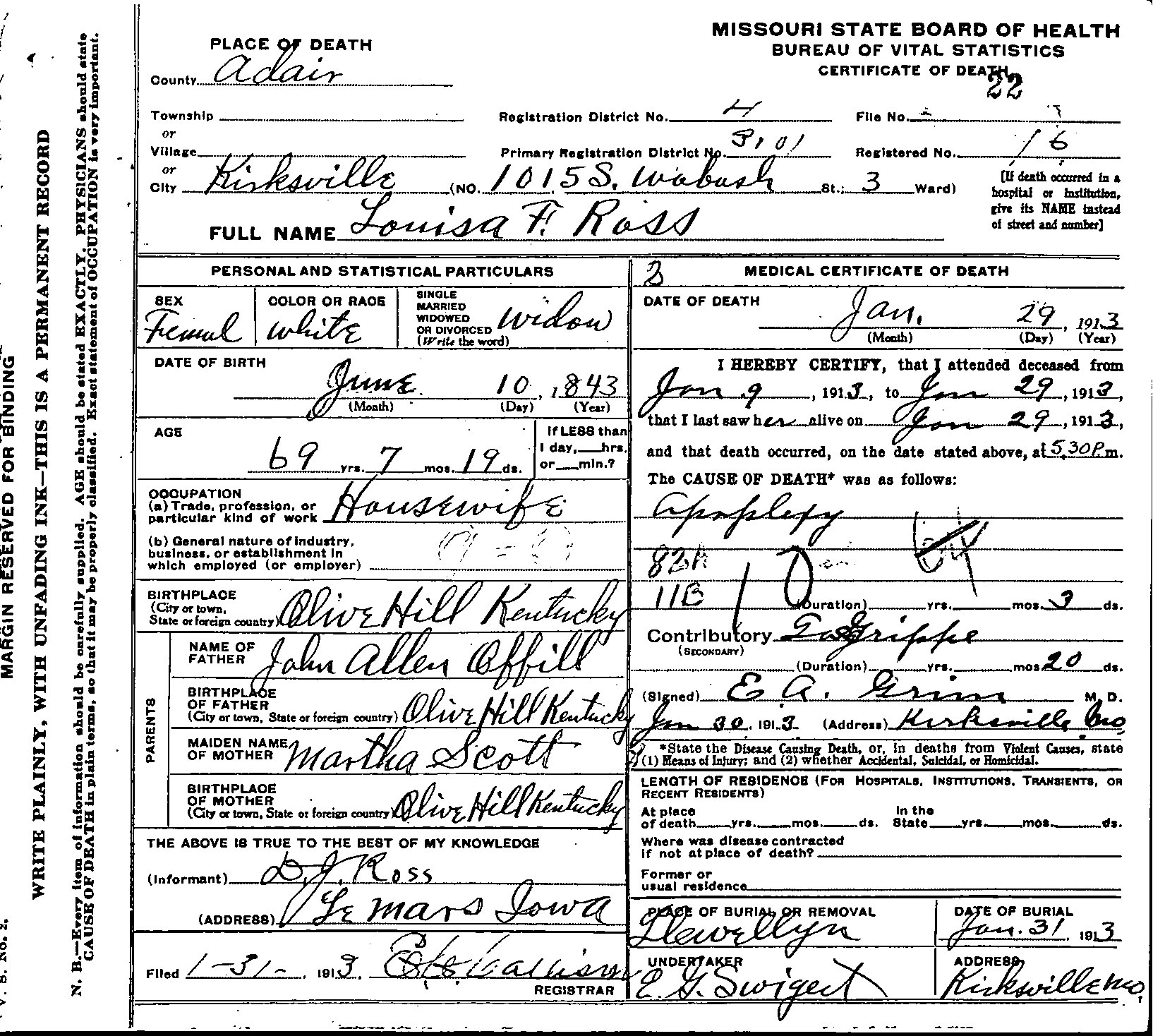
Field by field
- 1 Place of death
It reads County Adair; City Kirksville (No. 1015 S. Wabash St.; 3 Ward); Registration District No. 4; Primary Registration District No. 3101 (probably)
Where she died, down to the house number and ward. A street address lets you look for the family in a Kirksville city directory or on the 1910 census at the same address. The district numbers belong to the state's registration system and point to the local registrar who handled the certificate.
- 2 Full name
It reads Louisa F. Ross
Her name at death, so a married woman appears under her husband's surname. Her maiden name is not asked here, but you can work it out from her father's name further down.
- 3 Sex, color or race, single, married, widowed or divorced
It reads Femal; white; widow
Widow means her husband died before her. Search for his death before January 1913 and for their marriage record, which will give her maiden name a second time.
- 4 Date of birth and age
It reads June 10, 1843; 69 yrs. 7 mos. 19 ds.
The age was worked out from the birth date, and the two agree: June 10, 1843, to January 29, 1913, is 69 years, 7 months and 19 days. A birth date on a death certificate is only as good as the informant's memory, so check it against census ages and any gravestone.
- 5 Occupation
It reads Housewife
The back of this very form told doctors and clerks that women at home doing only their own housework could be entered as Housewife. It does not mean she never worked for pay earlier in life.
- 6 Birthplace
It reads Olive Hill Kentucky
A town name is a gift: it tells you where to look for her birth family before she came to Missouri. Treat it as a strong lead, not proof, because the informant was reporting something that happened nearly 70 years earlier.
- 7 Parents: names and birthplaces
It reads Name of father John Allen Offill; birthplace of father Olive Hill Kentucky; maiden name of mother Martha Scott; birthplace of mother Olive Hill Kentucky
This box is often the only place a record names the parents of someone born before vital records began. Her father's surname, Offill, is her maiden name. Search Kentucky records for John Allen Offill and Martha Scott, and expect other spellings of Offill.
- 8 Informant
It reads D. J. Ross; (Address) Le mars Iowa
The informant signed that the personal facts above were true to the best of their knowledge. D. J. Ross shares her surname and lived in Le Mars, Iowa, so D. J. was probably a son or other relative, but the certificate does not say. An informant who lived far away may have known less about her early life.
- 9 Filed and registrar
It reads Filed 1-31-1913; [registrar's signature, not clearly legible]
The date the local registrar received the certificate, two days after the death. Missouri began recording deaths statewide in 1910, so a death this early is often the first state record a family has.
- 10 Certificate, file and registered numbers
It reads 22; File No. [unclear]; Registered No. 16
The 22 is the number the state used for this certificate within the year. The Missouri State Archives search finds it by name, county and year, and these numbers help you cite it or ask for a copy.
- 11 Date of death
It reads Jan. 29, 1913
This part, the Medical Certificate, was filled in by the doctor, so the date and time of death are usually firsthand. Use the date to look for an obituary in the Kirksville paper in the days that followed.
- 12 Doctor's attendance
It reads I HEREBY CERTIFY, that I attended deceased from Jan 9, 1913, to Jan 29, 1913, that I last saw her alive on Jan 29, 1913, and that death occurred, on the date stated above, at 5.30 P.m.
The doctor saw her for three weeks before she died. That tells you the last illness was not sudden, which fits the contributory cause written below.
- 13 Cause of death
It reads Apoplexy; 82A; 11B; (Duration) 3 ds.
The back of the form asks for the disease causing death first, the primary cause. Apoplexy was the usual word for a stroke, and it lasted 3 days. The 82A, 11B and the large 10 look like codes added later in the office; they are not part of the doctor's statement.
- 14 Contributory (secondary)
It reads La Grippe; (Duration) 20 ds.
A condition that added to the death, here influenza for 20 days. The form's own example puts the disease causing death first and the secondary one after it, so read the labels, not which illness lasted longer.
- 15 Doctor's signature and address
It reads (Signed) E. A. Grim M.D.; Jan 30, 1913 (Address) Kirksville Mo
The doctor who certified the cause. His address is Kirksville, the same town where she died, so look for him in the same city directory as the family.
- 16 Place of burial, date of burial, undertaker
It reads Llewellyn; Jan. 31 1913; E. G. Swigert; Kirksville Mo
Where and when she was buried and who handled the funeral. Llewellyn is the burial place as written; search cemetery listings near Kirksville under that name. Search for the undertaker's business in Kirksville too; if its records survive, they are a second account of the same death.
- Split the certificate in two: personal facts came from the informant, the cause and time of death came from the doctor.
- The parents' names are often the best clue on the page, and the father's surname gives a married woman's maiden name.
- Check the informant's name and address: a relative far away may have guessed at dates and birthplaces.
- Follow the burial place and undertaker to a cemetery record and an obituary for the same week.
The full guide to this kind of record
Which records exist for your ancestor? Make a research plan
How to cite this page
Daily Ancestor. "How to read a 1913 death certificate, field by field." How to read. https://dailyancestor.com/how-to-read/death-certificate-1913. Last checked 2026-10-28.