 Daily Ancestor
How to read an 1857 will in a county will book, part by part
A real 1857 will copied into the Sacramento County Record of Wills: the testator, nine heirs, the executor, two witnesses, their sworn statements and the judge's order admitting it to probate.
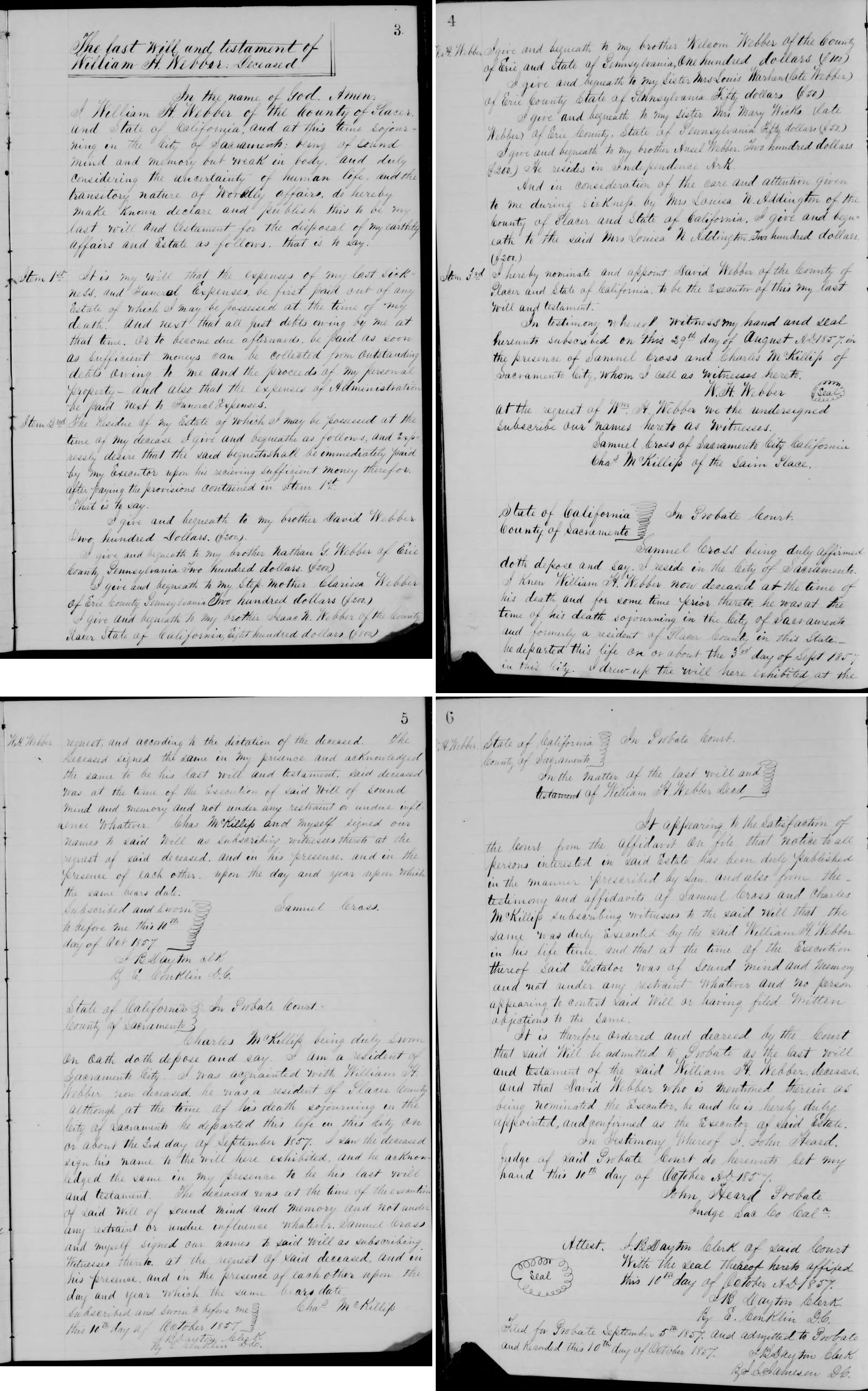
When a will was proved in court, a clerk copied it, word for word, into a bound record book, followed by the witnesses' sworn statements and the judge's order. These are pages 3 to 6 of Volume A of the Sacramento County Record of Wills, holding the will of William H. Webber, who died in Sacramento in September 1857. We show the four pages two by two, in reading order.
The will itself names his brothers, sisters and stepmother and where each lived, and the court papers that follow add his date of death and the dates the will was filed and approved. Read it from top to bottom, then check the names against the probate case file, which may hold more.
Field by field
- 1 Title: whose will
It reads The last Will and testament of William H. Webber: Deceased.
The clerk's heading for this copy. William H. Webber is the testator, the person who made the will. The same name is written in the margin of each following page so the entry can be found quickly.
- 2 Opening: who he was and where he lived
It reads In the name of God. Amen. I William H. Webber of the County of Placer, and State of California, and at this time sojourning in the City of Sacramento: being of sound mind and memory but weak in body, and duly considering the uncertainty of human life, and the transitory nature of Worldly affairs, do hereby make known declare and publish this to be my last will and testament for the disposal of my earthly affairs and Estate as follows. that is to say:
Skip past the religious opening to the facts. His home was Placer County, but he was staying in Sacramento, weak in body, when he made the will. Look for him in Placer County records too.
- 3 Item 1st: debts and funeral first
It reads Item 1st. It is my will that the expenses of my last sickness, and Funeral Expenses, be first paid out of any Estate of which I may be possessed at the time of my death. And next that all just debts owing by me at that time. Or to become due afterwards, be paid as soon as sufficient moneys can be collected from Outstanding debts owing to me and the proceeds of my personal property- And also that the expenses of Administration be paid next to Funeral Expenses.
Each part of the will starts with Item. Debts owed to him and his personal property were to pay his last illness, his funeral and his own debts before any gift was paid, so he may have been owed money by others, which is a lead to court and business records.
- 4 Item 2nd: the residue
It reads Item 2nd. The Residue of my Estate of which I may be possessed at the time of my decease I give and bequeathe as follows, and expressly desire that the said bequests shall be immediately paid by my Executor upon his recieving sufficient money therefor. after paying the provisions contained in Item 1st. That is to say.
The residue is what was left after Item 1st. Every gift that follows is a sum of money; the will does not mention land at all.
- 5 Gifts on page 3: brothers and stepmother
It reads I give and bequeath to my brother David Webber Two hundred Dollars. ($200). I give and bequeath to my brother Nathan G. Webber of Erie County, Pennsylvania Two hundred dollars. ($200) I give and bequeath to my Step-Mother Clarissa Webber of Erie County Pennsylvania Two hundred dollars ($200.) I give and bequeath to my brother Isaac N. Webber of the County Placer State of California, Eight hundred dollars ($800)
Three brothers and a stepmother, with where two of them lived. A stepmother means his father had married again, and his own mother is not named. Erie County, Pennsylvania, appears again and again: it is the place to look for the family before California.
- 6 Gifts on page 4: more brothers and two sisters
It reads I give and bequeath to my brother Welcom Webber Of the County of Erie and State of Pennsylvania, One hundred dollars ($100) I give and bequeath to my Sister Mrs Louis Warhen [surname probably Warhen, possibly Warren] (late Webber) of Erie County State of Pennsylvania Fifty dollars ($50) I give and bequeath to my sister Mrs Mary Wicks (late Webber) of Erie County, State of Pennsylvania Fifty dollars ($50.) I give and bequeath to my brother Ansel Webber. Two hundred dollars ($200.) He resides in Independence Ark.
Late Webber here most likely means formerly Webber: each sister was born a Webber and is named by her married surname, which is the name to search for her and her children. Brother Ansel had moved to Independence, Arkansas.
- 7 A gift for care in his sickness
It reads And in consideration of the care and attention given to me during sickness. by Mrs Louisa N. Addington of the County of Placer and State of California. I give and bequeath to the said Mrs Louisa N. Addington Two hundred dollars. ($200.)
Not every heir is family. The will says why she received a gift, so do not add her to the family tree without other proof. Together the gifts come to 2,000 dollars.
- 8 Item 3rd: the executor
It reads Item 3rd. I hereby nominate and appoint David Webber of the County of Placer and State of California. to be the Executor of this my last Will and testament.
The executor carries out the will. His brother David, who also lived in Placer County, was chosen. The court still had to confirm him, which happens on page 6.
- 9 Signature, date and seal
It reads In testimony whereof witness my hand and seal hereunto subscribed on this 29th day of August A.D. 1857. in the presence of Samuel Cross and Charles McKillip of Sacramento City, Whom I call as witnesses hereto. W.H. Webber (Seal)
The date he made the will, August 29, 1857. Remember this is a copy: the record book holds copies of the wills filed in the county, so the signature and the word Seal in a drawn loop were written by the clerk, not by Webber himself.
- 10 The witnesses
It reads at the request of Wm H. Webber we the undersigned Subscribe our names hereto as Witnesses. Samuel Cross of Sacramento City California Chas McKillip of the Saim Place.
Two witnesses watched him sign. After his death the court relied on them to prove the will was genuine, so their statements follow.
- 11 Samuel Cross's statement
It reads State of California County of Sacramento In Probate Court. Samuel Cross being duly affirmed doth depose and say. I reside in the City of Sacramento. I knew William H. Webber now deceased at the time of his death and for some time prior thereto. he was at the time of his death sojourning in the City of Sacramento and formerly a resident of Placer County in this State. he departed this life on or about the 3rd day of Sept 1857 in this City. I drew up the will here exhibited at the
Cross affirmed rather than swore, and he says he wrote the will himself. His statement gives the death, about September 3, 1857, in Sacramento: a date and place to take to newspapers and cemetery records.
- 12 Cross's statement continued, sworn before the clerk
It reads request, and according to the dictation of the deceased. The deceased signed the same in my presence and acknowledged the same to be his last will and testament. [...] Samuel Cross. Subscribed and sworn to before me this 10th day of Oct 1857. J B Dayton [first initial probably J] Clk By E. Conklin D.C.
The will was written as Webber dictated it, and he was of sound mind, according to the witness. D.C. is deputy clerk: the clerk's office took the statement on October 10, 1857.
- 13 Charles McKillip's statement
It reads State of California County of Sacramento In Probate Court. Charles McKillip being duly Sworn On Oath doth depose and say. I am a resident of Sacramento City. I was acquainted with William H. Webber now deceased. he was a resident of Placer County although at the time of his death sojourning in the City of Sacramento he departed this life in this City On or about the 3rd [probably; the figure is not perfectly clear] day of September 1857. [...] Chas McKillip. Subscribed and Sworn to before me this 10th day of October 1857. J B Dayton Clerk By E. Conklin D.C.
The second witness tells the same story and gives the same date of death, on or about September 3, 1857. Both say on or about, so record the death as about September 3, 1857, and look for a burial or newspaper notice to confirm it.
- 14 The judge's order
It reads State of California County of Sacramento In Probate Court. In the matter of the last will and testament of William H. Webber Decd. It appearing to the Satisfaction of the Court from the affidavit On file that notice to all persons interested in said Estate has been duly published [...] and no person appearing to contest said Will [...] It is therefore Ordered and decreed by the Court that said Will be admitted to Probate as the last will and testament of the said William H. Webber, deceased. and that David Webber who is mentioned therein as being nominated the Executor, he and he is hereby duly appointed, and confirmed as the Executor of said Estate. In Testimony Whereof I John Heard, Judge of said Probate Court do hereunto set my hand this 10th day of October A.D. 1857. John Heard Probate Judge Sac Co Cal.
Admitted to probate means the court accepted the will as genuine. Notice had been published, so look for it in Sacramento newspapers of September and October 1857, and nobody objected. David was confirmed as executor.
- 15 Filed and recorded
It reads Attest. J B Dayton Clerk of said Court With the seal thereof hereto affixed this 10th day of October A.D. 1857. J B Dayton Clerk By E. Conklin D.C. [court seal drawn] Filed for Probate September 5th 1857. and admitted to Probate and Recorded this 10th day of October 1857. J B Dayton Clerk By J. L. Jamesen [probably] D.C.
Two key dates: the will was handed in to the court on September 5, 1857, about two days after his death, and recorded in this book on October 10. The Center for Sacramento History holds probate case files, registers of estates and indexes for the same court, where the inventory and accounts of this estate may survive.
- A will book is a clerk's copy: the signatures and seals in it were written by the clerk.
- Read every name with its place: here Erie County, Pennsylvania, points to where the family came from.
- A woman named as late Webber was most likely born a Webber; search for her under her married name.
- The witnesses' statements and the court's order often give the date of death and the filing date, which the will itself cannot.
- The bound book is only part of the story: ask for the probate case file, which may hold the inventory and accounts.
The full guide to this kind of record
Which records exist for your ancestor? Make a research plan
How to cite this page
Daily Ancestor. "How to read an 1857 will in a county will book, part by part." How to read. https://dailyancestor.com/how-to-read/will-1857. Last checked 2026-10-28.