 Daily Ancestor
How to read a 1917 WWI draft card, field by field
A real June 5, 1917 draft registration card, front and back, explained question by question: what each answer tells you and what to search next.
About 24 million men filled in a draft registration card in 1917 and 1918, so if your grandfather or great-grandfather was born between about 1872 and 1900, there is a good chance he has one. This is a card from the first registration day, June 5, 1917, for Alvin C. York of Pall Mall, Fentress County, Tennessee. The front is on top and the back is below.
The card asked 12 questions, and the registrar filled in the back. Many men never served, and the card says nothing about service in this war, but it gives a birth date, a birthplace, an employer and a description in one place.
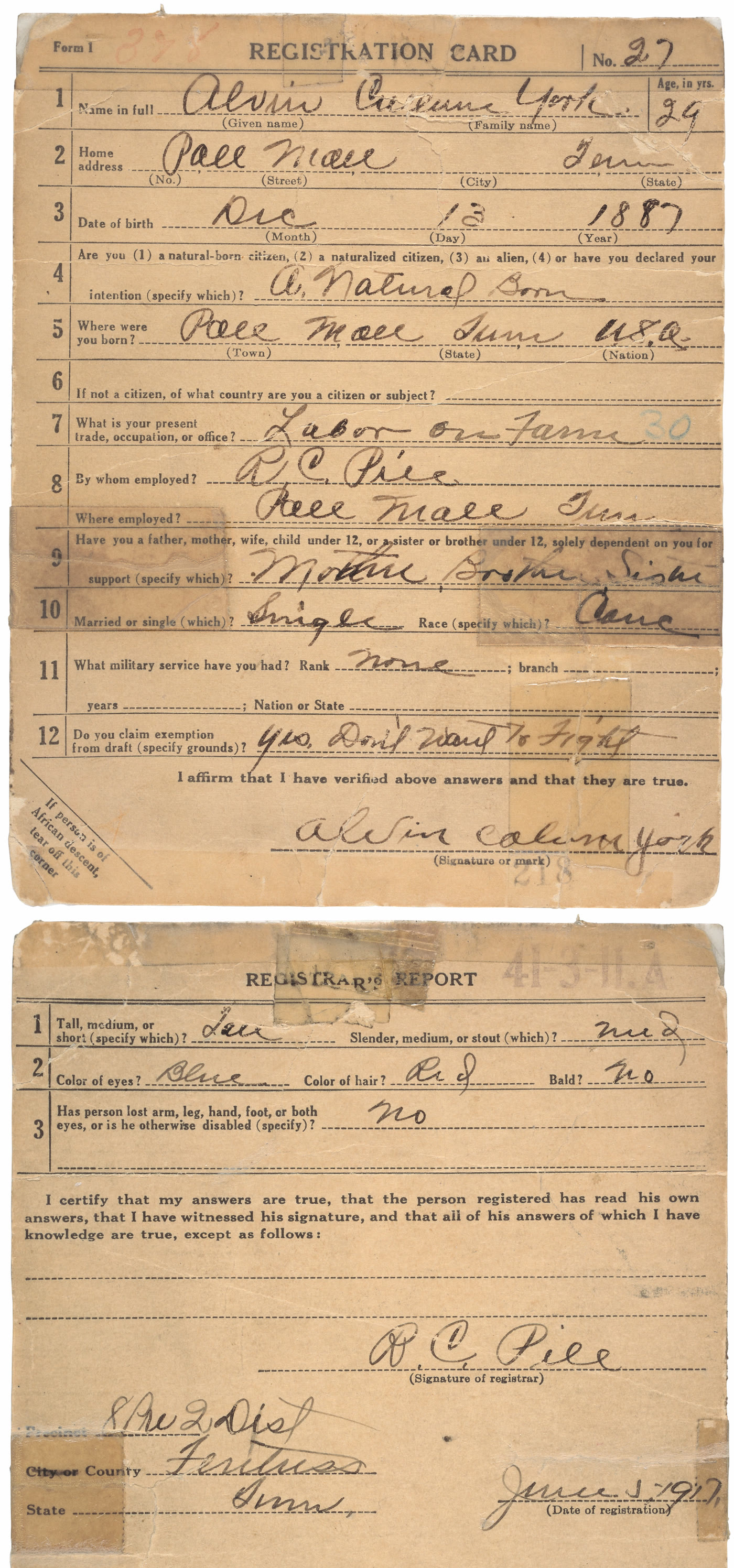
Field by field
- 1 1. Name in full and age
It reads Alvin Cullum York [middle name probably Cullum; the letters are hard to read]; Age, in yrs. 29
The name as the registrar wrote it, which may not match how the family spelled it. Age 29 fits the first registration, which the National Archives says was for men aged 21 to 31.
Draft registration card: Card filled in when registering for a 20th-century draft
- 2 2. Home address
It reads Pall Mall Tenn
Here only the community and the state, with no street. Cards are filed by state, then county or local board, then surname, so the county matters more than the street when you search.
- 3 3. Date of birth
It reads Dec 13 1887
A full birth date in the man's own words, useful when no birth certificate exists. Check it against the 1900 census, which asked for the month and year of birth.
- 4 4. Citizenship
It reads A Natural Born
Natural born means born a citizen. For an immigrant this line says naturalized, alien or declared intention, which tells you whether to look for naturalization papers and roughly when.
- 5 5. Where born
It reads Pall Mall Tenn U.S.A.
Town, state and nation. NARA's description of this card notes that he registered in Fentress County, where he was born, so here the home and the birthplace are the same place.
- 6 7. Present trade, occupation, or office
It reads Labor on Farm; [a blue 30, probably added later in another hand]
What he did for a living in June 1917. The blue number at the end is in a different color and was probably added later by someone else; it is not part of his answer.
- 7 8. By whom employed, where employed
It reads R. C. Pile; Pall Mall Tenn
His employer's name. Notice that the registrar who signed the back of this card was also R. C. Pile, so in a small community the man who wrote down the answers could be the registrant's own employer.
- 8 9. Dependents
It reads Mother Brother Sister
Who relied on him for support. This line names family members without their names, so take it to the census: in 1910 look for a household in Pall Mall with his mother and younger siblings.
- 9 10. Married or single, race
It reads Single; Race (specify which)? Cauc
Single, and the race written as Cauc, short for Caucasian. Race on these cards decided which corner was torn off, see the corner below.
- 10 11. Military service
It reads Rank None
Earlier service, if any. None here. Remember that the National Archives says these cards are not military service records: they end when a man reports to the training camp and say nothing about his service in the war.
- 11 12. Exemption claimed
It reads Yes. Don't Want To Fight
A National Archives handout on these cards uses this very answer as its example of an exemption claim. A claim was decided later by the local board, or for some kinds of claims by the district board, so look in the local board's classification lists or docket books for what happened next.
Local board: Draft board that registered and classified local men
- 12 Signature of registrant
It reads Alvin Cullum York [middle name probably Cullum; the letters are unclear] (Signature or mark)
His own signature, or a mark if he could not write. Compare it with signatures on later papers to be sure you have the right man.
- 13 Torn corner
It reads If person is of African descent, tear off this corner
The printed corner is still there, which matches Cauc in question 10. The printed instruction says to tear it off for a man of African descent, so on other cards a missing corner is itself information.
- 14 Registrar's report: description
It reads Tall, medium, or short? Tall; Slender, medium, or stout? Med; Color of eyes? Blue; Color of hair? Red; Bald? No; Has person lost arm, leg, hand, foot, or both eyes, or is he otherwise disabled? No
The back of the card is the registrar's description of the man: tall, medium build, blue eyes, red hair. For many men it is the only written description of what they looked like.
- 15 Signature of registrar
It reads R. C. Pile (Signature of registrar)
The registrar certified that the man had read his own answers and that he witnessed the signature. The same name appears as his employer on the front.
- 16 Precinct, county, state and date of registration
It reads 8 Pre 2 Dist [probably; the precinct entry is hard to read]; City or County Fentress; State Tenn.; June 5 1917 (Date of registration)
June 5, 1917, the first of the three registration days. Fentress County, Tennessee, is where to look for his local board's other records.
- Find the card by state, then county or local board, then surname: that is how the cards are arranged.
- Use the birth date and birthplace as leads, then confirm them in census and church records.
- A draft card is not proof of service. NARA's description calls York a sergeant; that fact comes from other records, not from this card.
- Read the back too: the registrar's description and the date and place of registration are there.
The full guide to this kind of record
Which records exist for your ancestor? Make a research plan
- World War I Draft Registration Cards (National Archives)
- World War I Selective Service System Draft Registration Cards, 1917 to 1918, reference report (National Archives)
- Measuring America: The Decennial Censuses From 1790 to 2000, 1900 instructions to enumerators (U.S. Census Bureau)
- The Genealogical Significance of World War I Draft Registration Cards, Zina Rhone, National Archives at Atlanta (2014 Genealogy Fair handout)
How to cite this page
Daily Ancestor. "How to read a 1917 WWI draft card, field by field." How to read. https://dailyancestor.com/how-to-read/wwi-draft-card-1917. Last checked 2026-10-28.