All lessons
Handwriting · 1780‑1880

Reading clerk's hands in deeds and wills

Most deeds and wills you will find were not written by your ancestor. A lawyer, a neighbor who wrote well, or the county clerk wrote the original, and the clerk then copied it, word for word, into a big deed book or will book. Clerks wrote fast and all day, so their hands are rushed, full of abbreviations and sometimes careless with spelling.

The good news: legal papers repeat the same formulas again and again. Once you know the opening words, the land description and the closing clauses, you can skim past them and spend your effort on the few words that matter: the names, the place, the date, the money and the land. This lesson shows the stock phrases in real deeds and wills from 1793 to 1820.


Letter by letter

The words Daniel Hall Esquire in an 18th century hand
Names with Esquire Deeds name every neighbor whose land touches the tract, often with a title after the name. Esquire, here spelled out with a looped capital E and a q that dips below the line, marked a gentleman or a justice of the peace. Do not read it as part of the surname.Register of Mesne Conveyance, Charleston County, South Carolina (Deed Book L6, p. 67), Public domain
Opening words of an 1812 will
Will opening: In the Name of God Wills of this period almost always open with In the Name of God Amen. The I here is a small hooked stroke, and the G of God looks a little like a 9. The date and the testator's name come right after it.Solomon Johnson; State Archives of North Carolina, Public domain
The words Will and Testament from an 1812 will
Will and Testament The capital T looks like a J or an F, and the s in the middle is shaped like an r, so Testament can look like Tertament. When a word looks almost right, read it out loud.Solomon Johnson; State Archives of North Carolina, Public domain
Printed word Township followed by handwritten fifty four north
Land description: township and range Older deeds in the East describe land by compass calls and distances (metes and bounds). In public land states the land is named by a federal survey instead: section, township and range. Here the printed word Township is followed by the clerk's fifty four north. The f of fifty is tall and looped, and north begins with an n that looks like a u.Missouri Historical Society, via Digital Public Library of America, Public domain
The words Recorded and Examined in a clerk's hand
The clerk's recording note When a deed was copied into the deed book, the clerk added a line such as Recorded and Examined, with the date and his name. That date is when it was recorded, which can be months or years after the sale. The capital R and E are drawn with big loops.Register of Mesne Conveyance, Charleston County, South Carolina (Deed Book L6, p. 67), Public domain
Printed word the followed by handwritten southeast quarter
Printed forms with handwritten blanks By the 1800s many deeds were printed forms. The printed word the is in type, and the clerk filled in southeast quarter by hand. Read the printed words first: they tell you what the handwritten part has to be.Missouri Historical Society, via Digital Public Library of America, Public domain
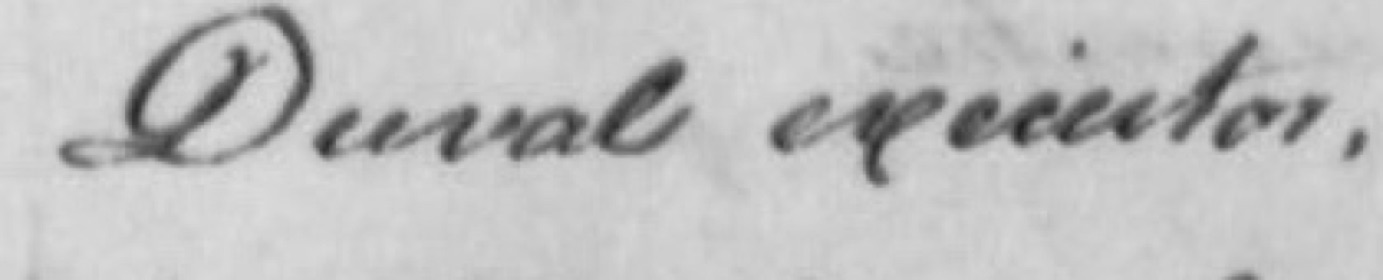
The words Duval executor from a will of 1803
Executor Wythe wrote his own will in a careful round hand. The x in executor is made of two curves that do not quite cross, so it can look like a q or a c. The D of Duval, the executor's surname, has a loop at the bottom.George Wythe; Library of Congress, Thomas Jefferson Papers, Public domain

Now you read it

Words from a bequest in an 1812 will
What did Solomon Johnson leave his wife here?
Tips
  • Learn the formulas (Know all men, In the Name of God Amen, his heirs and assigns forever) and skim them.
  • Find the names, the county, the date, the money and the land first. Those are the facts you need.
  • Most deed and will books are clerk's copies. A signature or X mark there is the clerk's copy, not your ancestor's own hand.
  • The recording date can be long after the date of the deed itself. Note both.
  • Read odd spellings out loud: Maire is mare, Heffer is heifer.
  • On printed forms, the printed words tell you what each handwritten blank means.
Next lesson