All lessons
Handwriting · 1700‑1830

The long s (ſ) and how to spot it

Until about 1800, and in some hands until the 1820s (longer still in a double s, see the next lesson), English writers used two shapes for the small letter s. The round s we still use went at the end of a word. Everywhere else, at the start or in the middle, they often wrote a tall "long s" (ſ) that reaches up like an l and often dips below the line like a p.

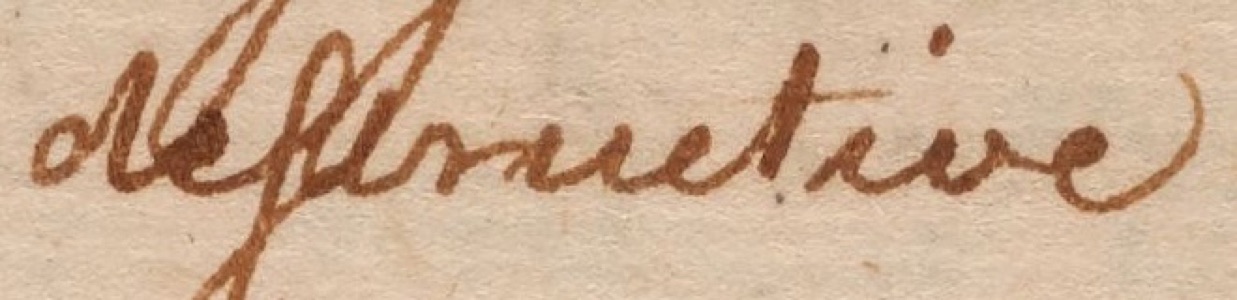
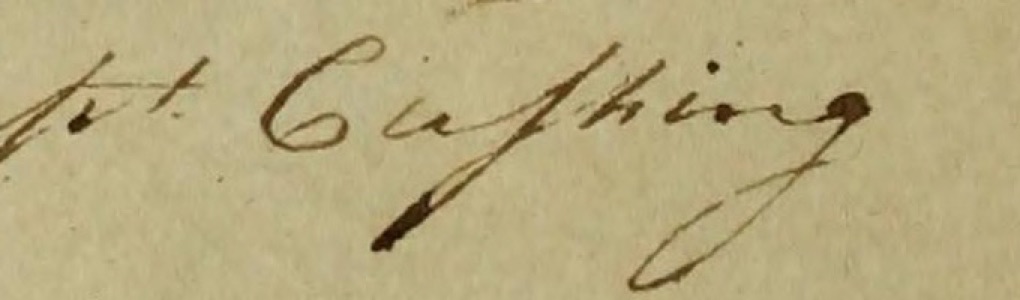
To modern eyes the long s looks like an f. That is how "Cushing" becomes "Cufhing" in an index and "Massachusetts" becomes "Maffachufetts". The good news: once you know the shape, it is easy. Read the word out loud with an s and it almost always makes sense.

Letter by letter

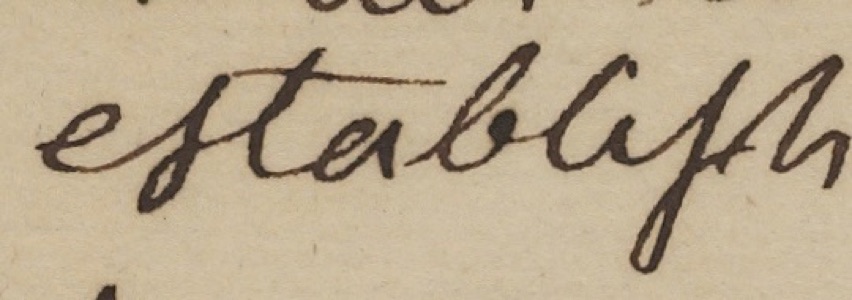
Handwritten word establish written with two long s that look like f
ſ in the middle of a word Two long s in one word: after the e and after the i. Both rise tall and drop below the line. Read with s and you get "establish".U.S. Senate; National Archives and Records Administration, Public domain
Handwritten words house of Represen with long s in house and in Represen
ſ before e "houſe of Repreſen..." (the line breaks in the middle of Representatives). The long s in "house" has a long tail below the line, and so does the one in "Represen". Neither has a crossbar.U.S. Senate; National Archives and Records Administration, Public domain
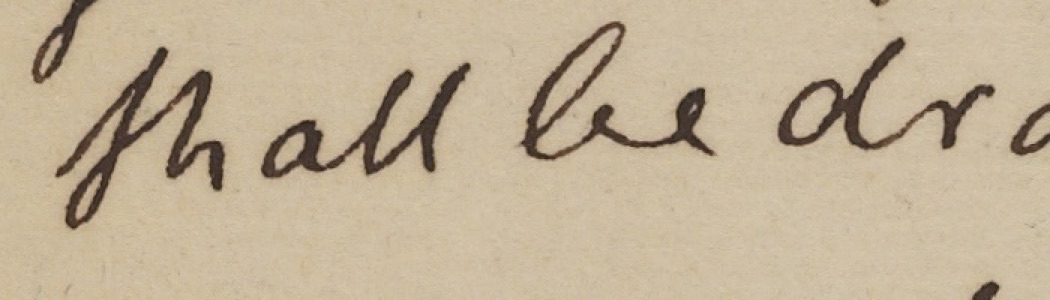
Handwritten words shall be dra, the s of shall is a tall long s
ſ at the start of a word This writer also uses the long s at the very start of a word: "ſhall be dra[wn]". A word that seems to begin with fh is almost always sh.U.S. Senate; National Archives and Records Administration, Public domain
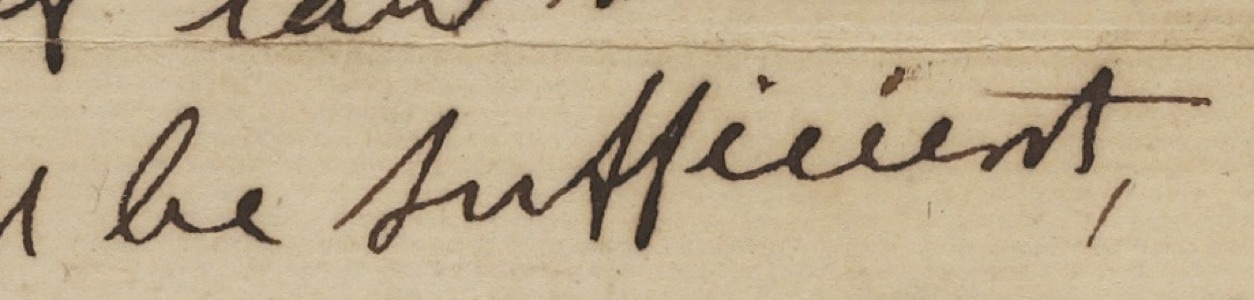
Handwritten words be sufficient, starting with a long s followed by double f
ſ next to f "be ſufficient": the first letter of "sufficient" is a long s, then come two real f's. In this hand they look almost alike, so the word itself is your best guide.U.S. Senate; National Archives and Records Administration, Public domain
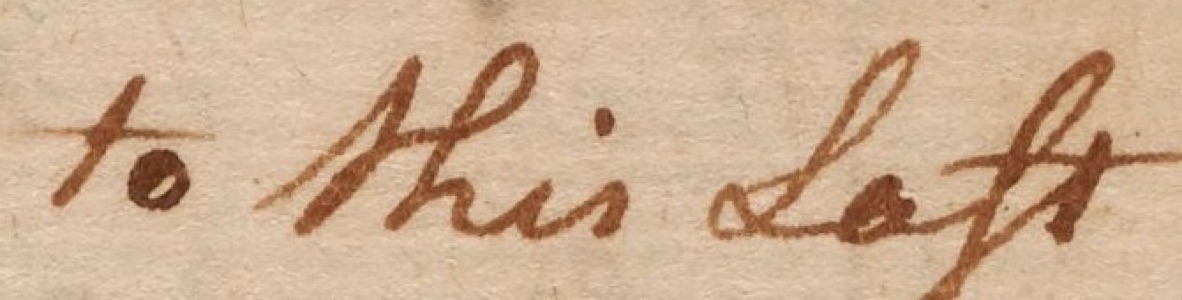
Handwritten words to this last, with a round s ending this and a long s inside last
round s at the end, ſ inside "to this laſt": look at "this". It ends with a small round s. "Last" has its s in the middle, so the writer used the long form. That rule (round at the end, long elsewhere) holds in most hands of the time.Thomas Newell (diarist), Public domain
Handwritten words ielson furnish the, with long s in both Danielson and furnish
ſ in names and verbs "[Dan]ielſon furniſh the": the long s shows up in the surname Danielson and in "furnish". In a list of soldiers, a name like "Danielfon" is really Danielson.Nathan Morse, writer of the orderly book of Capt. Luke Drury's company; Boston Public Library, Public domain

Now you read it

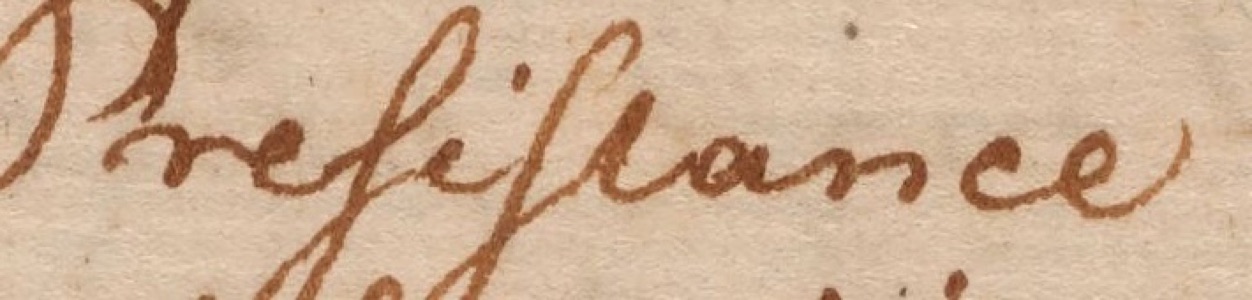
Handwritten word resistance with two long s
What word is this? (Boston, 1773)
Tips
  • Try s first: if a word with an "f" makes no sense, read that letter as s.
  • The long s is never at the end of a word. If a tall letter ends the word, it is probably a real f or a flourish.
  • A real f usually has a crossbar or a loop through the middle; a long s has none or only a small nub on the left.
  • Search indexes under both spellings: Cushing and Cufhing, Massey and Maffey, Hosea and Hofea.
  • The single long s faded out of print around 1800 and out of most handwriting by the 1820s. The double-s form (ſs) lasted much longer, into the 1840s and later, so only a single long s helps you date an undated paper.
Next lesson