 Daily Ancestor
How to read an 1850 census page, column by column
A real 1850 U.S. census page from Henry County, Indiana, read across all 13 columns for one family: what each column asked, and what each answer tells you.
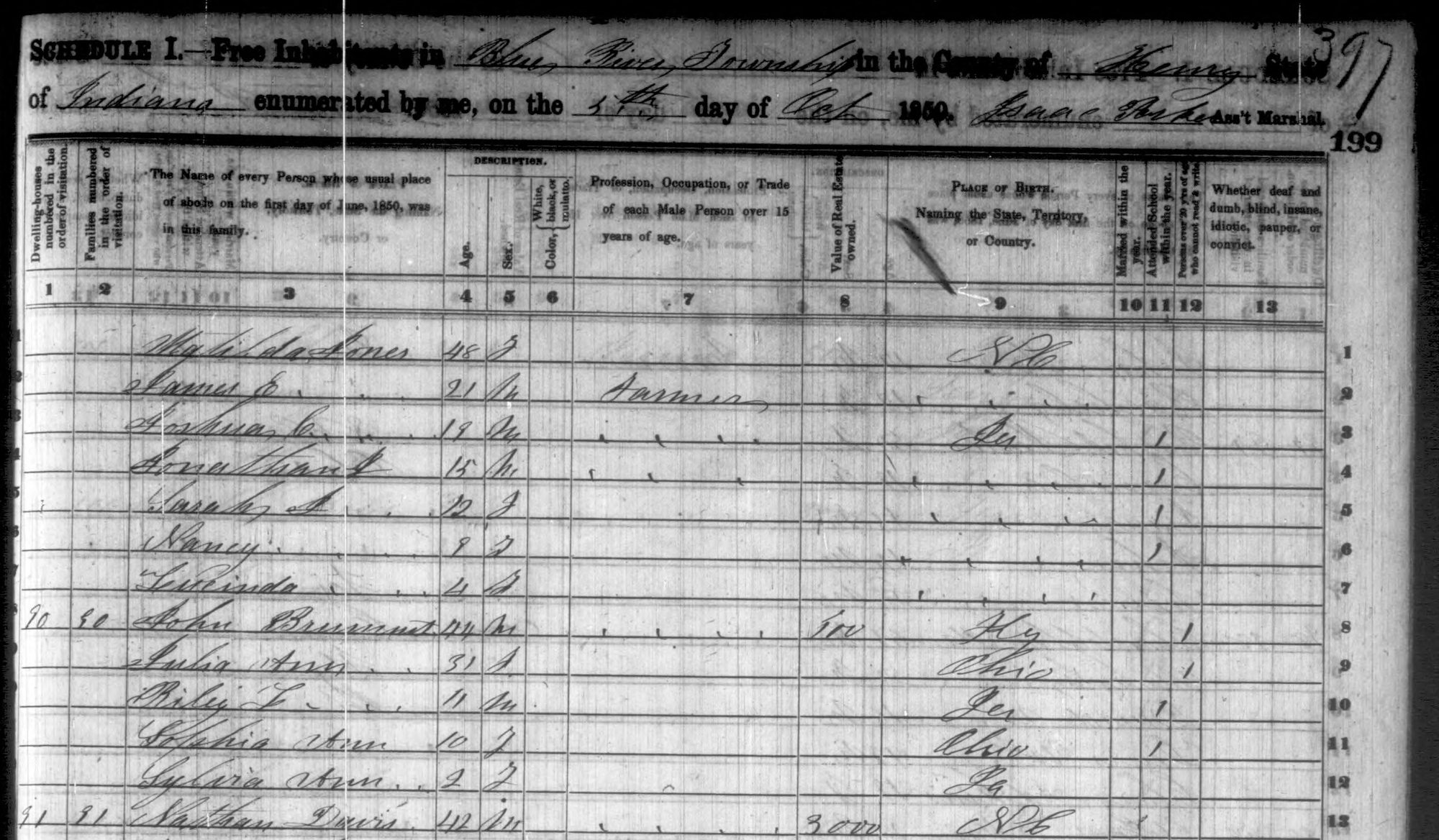
The 1850 census is the first to write down every free person in a household by name. This is the top of page 199 (handwritten 397) for Blue River Township, Henry County, Indiana, and we follow one family, John Brummet's on lines 8 to 12, through all 13 columns.
The Census Board printed detailed instructions for the assistant marshals who carried these sheets from house to house, and they explain almost every mark on the page. One thing they did not ask for is how people were related, so read this page for what it says, not for what it seems to say.
Field by field
- 1 Township, county, state, date and assistant marshal
It reads SCHEDULE I. Free Inhabitants in Blue River Township in the County of Henry State of Indiana enumerated by me, on the 5th [probably; the figure is faint] day of Oct 1850. Isaac Parker [probably; the end of the surname runs into the printed words] Ass't Marshal.
The place, from township up to state, and the day this page was written. The Census Board told assistants to put the place and the date in this heading on every page and to sign it. Their instructions also asked them to finish before October 1, so this October date was late.
Assistant marshal: Census taker of 1790 to 1870, under the U.S. marshal
- 2 Page numbers
It reads 397 [handwritten]; 199 [printed or stamped]
This page carries two numbers. Write both down with the township and county when you cite it, so you or anyone else can find the same image again.
- 3 The census day, in the name column heading
It reads The Name of every Person whose usual place of abode on the first day of June, 1850, was in this family.
Every answer on the page describes the family as of June 1, 1850, even though the assistant came in October. The instructions say a person who died after June 1 was still to be listed, a baby born after June 1 was to be left off, and family members away on a journey were to be counted at home.
- 4 Columns 1 and 2: dwelling and family numbers
It reads 90; 90 [the second figure written loosely, probably 90]
The 90th house and the 90th family this assistant marshal visited in his district, counting from 1. The numbers follow his route, so the Davis family on line 13 (91, 91) was the next house he reached. Lines 1 to 7 continue a family that began on the page before.
Dwelling number: House number in the order the census taker visited
- 5 Column 3: names
It reads John Brummet [probably; the middle letters of the surname are hard to read]; Julia Ann; Riley T [probably; the initial could also be J]; Sophia Ann; Sylvia Ann
The surname is written once, on the first line. The instructions said to start with the father and mother, then the children from oldest to youngest, then anyone else. So Julia Ann is probably John's wife and the three younger people probably their children, but 1850 has no relationship column: the page never says so.
- 6 Columns 4 and 5: age and sex
It reads 44 M; 31 F; 11 M; 10 F; 2 F
Age at the last birthday before June 1, 1850, so John was born about 1805 or 1806 and Sylvia about 1847 or 1848. If the exact age was not known, the assistant was told to write the nearest guess, so treat every age as a clue, not a fact. M is male and F is female.
- 7 Column 6: color
It reads [blank on all five lines]
Blank does not mean the question was skipped. The instructions said to leave the space blank for a white person and to write B or M otherwise, so these five were recorded as white.
- 8 Column 7: occupation
It reads Farmer [line 2]; [dots on lines 3, 4 and 8, under Farmer]
Only males over 15 were asked their occupation. John's line has no word, only dots under the Farmer written on line 2, which most likely are ditto marks meaning farmer too. Women's work was not asked, so the blank on Julia Ann's line says nothing about what she did.
- 9 Column 8: value of real estate
It reads 500 [first figure probably 5]
The value in dollars of the real estate John owned, wherever it lay, with no deduction for any debt on it. An owner means deeds and tax lists to look for in the county records.
- 10 Column 9: place of birth
It reads Ky; Ohio; Ia; Ohio; Ia
The state or country of birth, and the instructions allowed state names to be shortened. Ky is Kentucky. Ia on an Indiana page most likely means Indiana here, though the same letters can mean Iowa elsewhere. If the entries are right, the children were born in Indiana, then Ohio, then Indiana again, so look for the family in Ohio records around 1840.
- 11 Column 10: married within the year
It reads [blank]
A mark here would mean a marriage between June 1, 1849 and June 1, 1850. Nobody in this family has one.
- 12 Column 11: attended school within the year
It reads [blank]; [blank]; 1; 1; [blank]
Riley and Sophia had been at school during the past year. The assistant was told to mark everyone who had attended any school, and not to count Sunday school.
- 13 Column 12: over 20 and cannot read and write
It reads 1; 1; [blank]; [blank]; [blank]
John and Julia Ann were recorded as adults who could not read and write. So do not expect their own signatures on deeds or letters; look for a mark instead. A person who could read and write any language was to be counted as able.
- 14 Column 13: deaf and dumb, blind, insane, idiotic, pauper or convict
It reads [blank]
Nothing written for this family. These were the census words of 1850 for disabilities and for people supported by the public or convicted of a crime within the year.
- Copy the township, county, state and both page numbers first: that is how you cite and find the page again.
- Read every answer as of June 1, 1850, not the day the assistant marshal came.
- 1850 names everyone but never says how they were related: the order of names is a strong hint, not proof.
- Small dots under an entry usually repeat it, so read the line above before you write down a blank.
- Birthplaces of the children, oldest to youngest, often trace a family's moves from state to state.
The full guide to this kind of record
Which records exist for your ancestor? Make a research plan
How to cite this page
Daily Ancestor. "How to read an 1850 census page, column by column." How to read. https://dailyancestor.com/how-to-read/census-1850. Last checked 2026-10-28.