 Daily Ancestor
The 1850 U.S. Census
The 1850 census, dated June 1, 1850, is the first to list every free person in a household by name, with age, sex, and place of birth.
The seventh census began on Saturday, June 1, 1850. A new Census Board designed six printed schedules, and assistants now wrote one line for each free person instead of tally marks under the head of household.
This is where most family trees first come alive: the names of wives and children, ages in years, occupations, and the state or country of birth. Relationships, though, are still not written down.
The questions, column by column
| Dwelling and family numbers | Numbered in the order visited, so neighbors on the page were usually neighbors on the road. |
|---|---|
| Name of every person whose usual place of abode on June 1, 1850, was in this family | Every free person, including those away on a trip. |
| Age, sex, color | Age at last birthday before June 1; babies in twelfths of a year. Color was left blank for white, B for black, M for mulatto. |
| Occupation of each male over 15 | Only men's occupations were asked. |
| Value of real estate owned | A lead to deeds and tax records. |
| Place of birth | State, territory, or country. |
| Married within the year, attended school, over 20 and cannot read and write | Marks only. |
| Deaf and dumb, blind, insane, idiotic, pauper, or convict | Wording of the time, recorded as stated. |
New this census
- Names of all free persons.
- Ages, birthplaces, occupations, and real estate values.
- Separate schedules for enslaved people, deaths, farms, industry, and social statistics.
Watch out for
- No relationship column. Names were to begin with the father and mother and run from the oldest child to the youngest, then others, but a woman listed second could be a second wife or a sister.
- Ages are as of June 1, 1850, even when the visit came later. People who died after June 1 were still listed.
- Married within the year means between June 1, 1849, and May 31, 1850, a reason to look for a marriage record.
- No schedules exist for Contra Costa, San Francisco, or Santa Clara counties, California, or for civil districts 10 and 12 to 17 of Bedford County, Tennessee. Utah's count was taken in 1851.
Other schedules
- Slave schedule: lists slaveholders by name. Enslaved people appear by number with age, sex, and color, not by name, along with counts of those who escaped or were freed during the year.
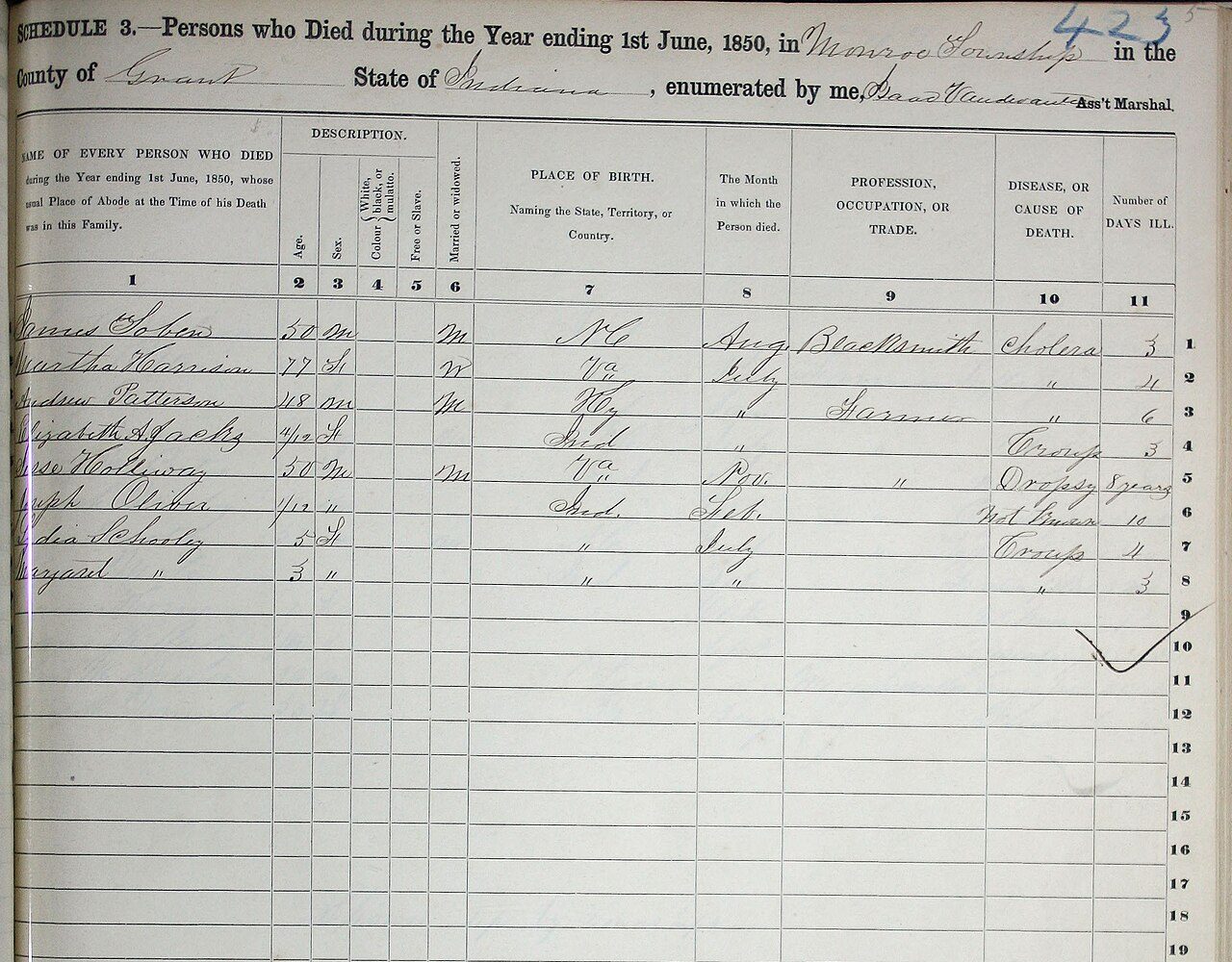
- Mortality schedule: people who died in the year ending June 1, 1850, with age, sex, birthplace, month and cause of death, and occupation. For some it is the only death record.
- Agriculture, products of industry, and social statistics schedules describe farms, businesses, and communities.
Where to see it
- Population schedules are microfilm M432 (1,009 rolls). FamilySearch (free with an account) and Ancestry (free on computers at National Archives facilities) both index it and show the images. The other schedules are filmed by state; see the National Archives nonpopulation page.