 Daily Ancestor
How to read a 1910 census page, column by column
A real 1910 U.S. census page from Pennsylvania, read across all 32 columns for one family: what each column asked, and what each answer tells you.
A 1910 census sheet is so wide that we show it in two halves: the left half on top, the right half below, with the same line numbers on both. This is sheet 2B of Canton Borough, Bradford County, Pennsylvania, and we follow one family, the Carnegies on lines 63 to 67, from the first column to the last.
Every column answers a question the enumerator was told to ask, and the Census Bureau's instructions explain what each mark means. Reading them the way the enumerator meant them is the difference between a clue and a mistake.
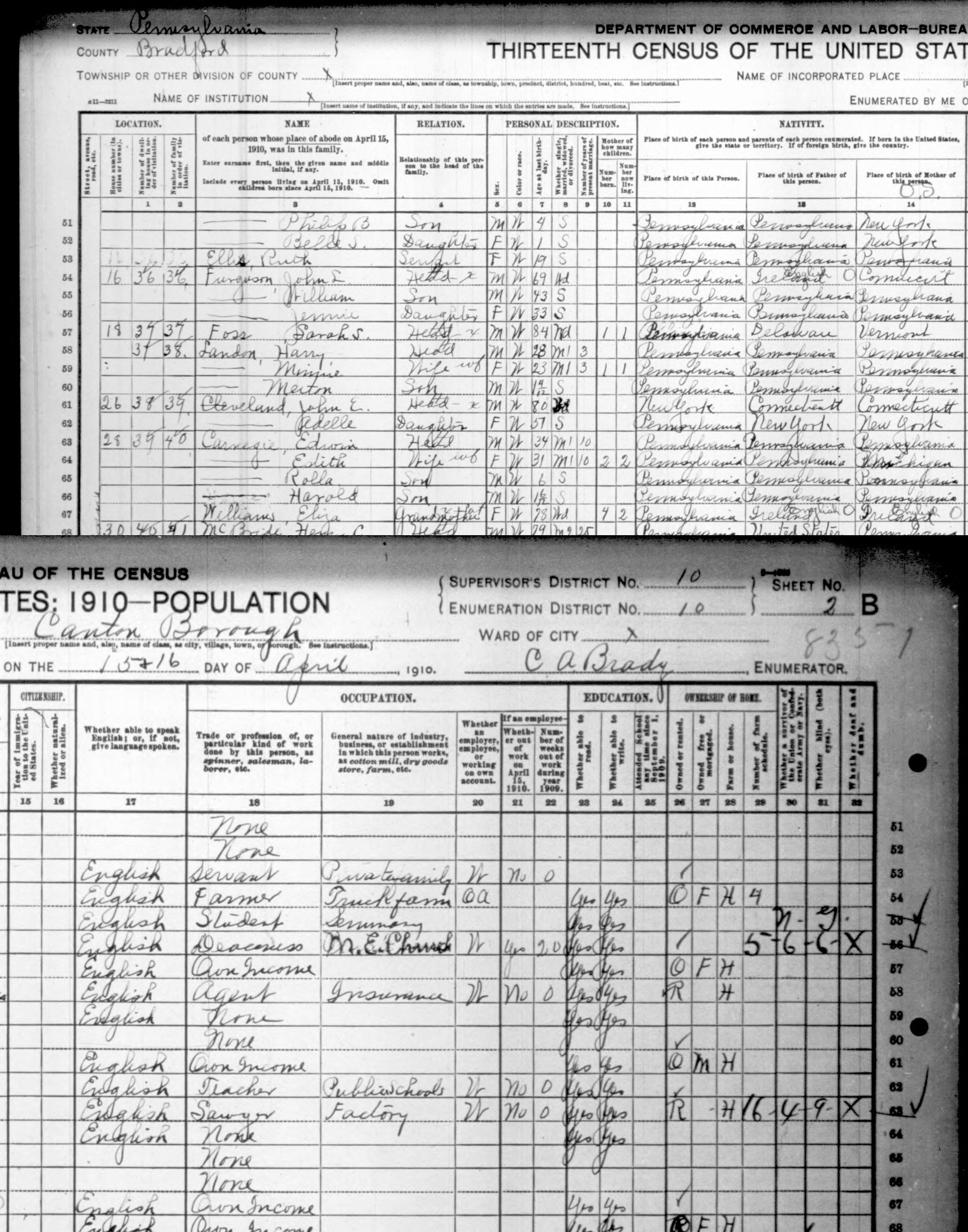
Field by field
- 1 State, county and township
It reads STATE Pennsylvania; COUNTY Bradford; TOWNSHIP OR OTHER DIVISION OF COUNTY x; NAME OF INSTITUTION x
The place, from the largest unit down. The x marks mean the line did not apply: this sheet covers a borough, not a township, and no institution.
- 2 Supervisor's district, enumeration district and sheet
It reads SUPERVISOR'S DISTRICT NO. 10; ENUMERATION DISTRICT NO. 10; SHEET NO. 2 B
These three numbers are the address of this page. Write them in your citation as ED 10, sheet 2B, Bradford County, so you or anyone else can find the same image again in seconds.
Enumeration district: Area assigned to one census taker (E.D.)
- 3 Place, date and enumerator
It reads [NAME OF INCORPORATED PLACE, printed on the top half] Canton Borough; WARD OF CITY x; [ENUMERATED BY ME, top half] ON THE 15 & 16 DAY OF April, 1910. C A Brady, ENUMERATOR.
The census taker visited on April 15 and 16. Every answer was supposed to describe the family as of the official census day, April 15, 1910, even if he came later.
- 4 Location: house, dwelling and family numbers
It reads 28; 39; 40 (line 63)
House number 28, the 39th dwelling and the 40th family the enumerator visited, written on the first line of the family. The numbers follow his route, so read the families above and below too: they lived nearby.
Dwelling number: House number in the order the census taker visited
- 5 Name
It reads Carnegie, Edwin; [line] Edith; [line] Rolla; [line] Harold; Williams, Eliza
Surname first, then given name. The instructions said to draw a line instead of repeating a surname, so the lines mean Carnegie. Eliza has her own surname, Williams, a clue to which side of the family she came from.
- 6 Relationship to head of family
It reads Head; Wife [small mark, wb or similar, added after it]; Son; Son; Grandmother [small marks added above in another hand]
Each person is described in relation to the head, Edwin. So Eliza was recorded as his grandmother; the census does not say on which side, and an enumerator could get this wrong, so look for her in Edwin's and Edith's families in earlier censuses.
- 7 Personal description: sex, race, age, marital status, years married
It reads M W 34 M1 10; F W 31 M1 10; M W 6 S; M W 1 6/12 S; F W 78 Wd
M1 means a first marriage and the 10 is years of the present marriage, so Edwin and Edith married about 1899 or 1900: look for the marriage record. Ages are at last birthday on April 15. A child under 2 was given in twelfths, so Harold was 1 year and 6 months. Wd means widowed.
- 8 Mother of how many children: born and living
It reads Edith: 2; 2. Eliza: 4; 2
Asked only of married, widowed or divorced women, and only about children each woman had herself. Edith had 2 and both were living, likely Rolla and Harold. Eliza had 4 children, 2 still living in 1910: two children you may not yet know about.
- 9 Place of birth: person, father, mother
It reads Edwin: Pennsylvania, Pennsylvania, Pennsylvania. Edith: Pennsylvania, Pennsylvania, [first letters written over, probably Michigan]. Rolla and Harold: Pennsylvania, Pennsylvania, Pennsylvania. Eliza: Pennsylvania, Ireland [English written above, then O], Ireland [English written above, then O]
For people born in the United States only the state was asked. For a parent born abroad the instructions also asked for the mother tongue, written after the country; that question was added after the forms were printed, so it has no column of its own. Here English is squeezed in above Ireland in lighter ink, possibly added later. So Eliza was recorded as the daughter of Irish-born, English-speaking parents.
- 10 Citizenship: year of immigration, naturalized or alien
It reads [blank for all five]
These columns were for people born abroad. Blank is the right answer for a family born in Pennsylvania, and it tells you not to look for naturalization papers for them.
- 11 Whether able to speak English
It reads English; English; [blank]; [blank]; English
Asked of everyone 10 years old and over, so the two boys are left blank.
- 12 Occupation and employment
It reads Sawyer; Factory; W; No; 0. Then None; None; None; Own Income
Edwin was a sawyer in a factory. W means he worked for wages, the next No means he was not out of work on April 15, and 0 means no weeks out of work in 1909. Own Income for Eliza means she lived on her own means. A factory in Canton Borough is worth a look in local histories.
- 13 Education: read, write, attended school
It reads Yes Yes; Yes Yes; Yes Yes (line 67)
Whether each person could read and write. Those two questions were left blank for children under 10, so only Edwin, Edith and Eliza have answers. Column 25, school since September 1, 1909, was supposed to get a Yes or No for everyone 5 to 21, but it is blank for Rolla, who was 6.
- 14 Ownership of home
It reads R; [a short dash]; H
R means the home was rented, so do not expect a deed for this house. The middle column, free or mortgaged, applied only to owned homes, and H means a house rather than a farm. Neighbors on this page who owned (O) may appear in county deed books.
Home owned or rented: O or R: whether the family owned its home
- 15 Marks across the last columns
It reads 16-4-9-X
Not his answers. Column 29 was only for farm homes, column 30 was asked only of men over 50, and columns 31 and 32 only for the blind and the deaf and dumb, none of which fits a 34-year-old renting a house. Similar groups of numbers appear on other lines of this sheet that list an occupation, such as the deaconess on line 56 and the fireman on line 91, so they were probably added later in the census office; do not copy them as facts.
- Copy the state, county, enumeration district and sheet number first: that is how you cite and find the page again.
- Read every answer as of the census day, April 15, 1910, not the day the enumerator came.
- Years married and children born and living are the 1910 census's best gifts: they point to a marriage record and to children who had died before 1910.
- Follow a line all the way across the sheet, and read the neighbors' lines too.
The full guide to this kind of record
Which records exist for your ancestor? Make a research plan
How to cite this page
Daily Ancestor. "How to read a 1910 census page, column by column." How to read. https://dailyancestor.com/how-to-read/census-1910. Last checked 2026-10-28.