 Daily Ancestor
How to read a 1913 declaration of intention, field by field
A real 1913 declaration of intention from Sacramento, explained line by line: what each answer tells you about the immigrant and which record to search next.
A declaration of intention, often called first papers, was the first step toward citizenship. The National Archives explains that a declaration could be filed at any time and that the whole process generally took at least five years; a declaration not followed by a petition within seven years became invalid. This is a real declaration on the federal form used after 1906: George Falkos, a fisherman born in Greece, who declared in the Superior Court of Sacramento County, California, on March 28, 1913.
The form asks the same questions in the same order for everyone, so the habits you learn here work on your own family's papers. Read each answer as what the immigrant told the clerk, sworn but from memory.
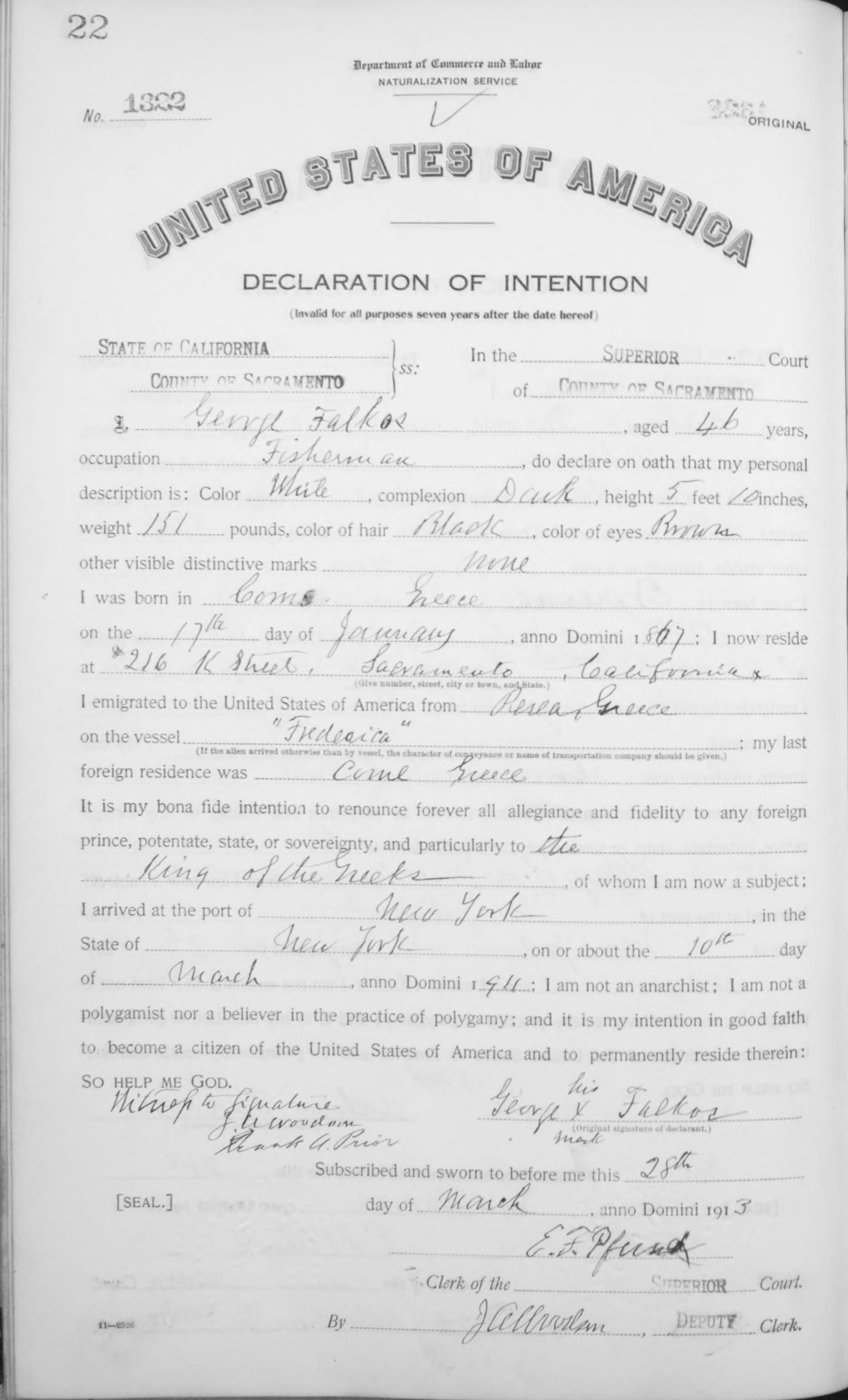
Field by field
- 1 Declaration number
It reads No. 1322
The court's number for this declaration. The book it is bound in holds numbers 1301 to 1600, and the 22 printed at the top left is the page, so note the number, the volume and the court whenever you cite it or ask for a copy.
Declaration of intention: Sworn first step: intent to become a citizen
- 2 Original
It reads [a blurred stamped number] ORIGINAL
ORIGINAL marks the copy that stayed with the court, bound here into the county's Record of Declaration of Intention. If the family kept papers, look for a matching copy at home too.
- 3 Seven-year limit
It reads (Invalid for all purposes seven years after the date hereof)
A declaration was the first step, not citizenship, and the form itself says it expired after seven years. If a petition comes more than seven years after this date, March 1920 or later, look for a second, newer declaration.
First papers: Everyday name for the declaration of intention
- 4 Court
It reads STATE OF CALIFORNIA, COUNTY OF SACRAMENTO ss: In the SUPERIOR Court of COUNTY OF SACRAMENTO
A county court, not a federal one, using the federal form. The National Archives says state and local courts went on naturalizing after 1906 and that their records are often at state archives or historical societies; this book is at the Center for Sacramento History.
- 5 Name, age and occupation
It reads I George Falkos, aged 46 years, occupation Fisherman
The name as the clerk wrote it, since Falkos signed with a mark (see below). Expect other spellings in other records. The age fits the birth date further down: born January 1867, he was 46 in March 1913.
- 6 Personal description
It reads Color White, complexion Dark, height 5 feet 10 inches, weight 151 pounds, color of hair Black, color of eyes Brown; other visible distinctive marks none
A word portrait you rarely get anywhere else. Compare it with any description on his passenger list to be sure you have the same man. Born in 1867, he was too old for every World War I draft registration, so do not expect a draft card.
- 7 Birthplace and birth date
It reads I was born in Com[last letter written over] Greece on the 17th day of January, anno Domini 1867
The town as well as the country, written as the clerk heard it. Here the last letter is written over, so try more than one spelling when you look for the village on a map of Greece.
- 8 Present residence
It reads I now reside at *216 K Street, Sacramento, California x
His street address in 1913. Look for him at this address in Sacramento city directories and in the 1920 census.
- 9 Emigrated from and vessel
It reads I emigrated to the United States of America from [illegible, possibly Perea], Greece on the vessel "[illegible, possibly Fredrica]"
The port he left from and the ship's name. With the arrival date below, these are what you need to find his passenger list, which USCIS calls the official arrival record for anyone who came before July 1, 1924.
- 10 Last foreign residence
It reads my last foreign residence was Come Greece [the same place name as the birthplace, written again]
Where he lived just before he left. Here it repeats his birthplace, so he was still living in his home village when he emigrated, which makes that village the place to search for his family.
- 11 Allegiance
It reads particularly to the King of the Greeks, of whom I am now a subject
The ruler he was a subject of and was giving up. It names a country, not a town, so use the birthplace line for where he came from.
Oath of allegiance: Sworn loyalty pledge that completed naturalization
- 12 Arrival
It reads I arrived at the port of New York, in the State of New York, on or about the 10th day of March, anno Domini 1911
His own memory of when and where he landed. He came after June 29, 1906, so he could not naturalize until the government found his arrival record and sent a Certificate of Arrival to the court. He declared about two years after landing, which the law allowed: a declaration could be filed at any time after arrival.
Certificate of arrival: Federal proof of lawful entry for naturalizing
- 13 Signature of declarant, with his mark
It reads George his X mark Falkos (Original signature of declarant.)
He made an X and the clerk wrote his name around it with the words his and mark. That usually means he could not write his name in 1913, so do not expect his own signature on other papers.
Declarant: Alien who had filed first papers, not yet a citizen
- 14 Witnesses to the mark
It reads Witness to Signature J. A. Woodson [reading uncertain]; Frank A. Prior
Because he signed with a mark, two people signed as witnesses that he made it. The first, J. A. Woodson, also signed below as deputy clerk, so he worked for the court. Look up the second, Frank A. Prior, in the city directory: a witness who was not a court employee may have been a friend, neighbor or employer.
- 15 Sworn before the clerk
It reads Subscribed and sworn to before me this 28th day of March, anno Domini 1913; E. F. Pfund [reading uncertain], Clerk of the SUPERIOR Court. By J. A. Woodson (probably), DEPUTY Clerk.
The date of the declaration, March 28, 1913. If he went on to petition, look first in the same court. For naturalizations from September 27, 1906, to March 31, 1956, USCIS also keeps duplicate copies in Certificate Files (C-Files), which you can request through its Genealogy Program.
- Copy the court, the volume, the number and the date of the declaration: they lead you to the petition that may have followed.
- The birthplace line usually names a town, which is what you need to cross the ocean in your research.
- The ship, port and arrival date take you straight to the passenger list.
- A mark instead of a signature tells you something about the person, and a declaration alone did not make anyone a citizen.
The full guide to this kind of record
Which records exist for your ancestor? Make a research plan
- Naturalization Records (National Archives)
- Researching Individuals (U.S. Citizenship and Immigration Services)
- History of the Declaration of Intention (1795 to 1952) (National Archives)
- A Guide to Interpreting Passenger List Annotations: In the Occupation Column (Marian L. Smith, former INS historian, JewishGen)
How to cite this page
Daily Ancestor. "How to read a 1913 declaration of intention, field by field." How to read. https://dailyancestor.com/how-to-read/declaration-of-intention-1913. Last checked 2026-10-28.