 Daily Ancestor
How to read an 1894 homestead final proof, question by question
A real 1894 homestead proof from the Kingfisher land office, Oklahoma Territory: the settler's sworn answers on age, birthplace, family, house and crops, and the numbers that find the file.
To earn free land under the Homestead Act, a settler had to come back to the land office after five years and prove that he had lived on and farmed the claim. This is the heart of that proof for Casper Burford of Kingfisher, Oklahoma Territory: the printed Testimony of Claimant with his answers, and below it the receiver's certificate and the folded cover from the next page.
Burford signed with his mark, so the answers were written down for him, probably by a land office clerk. They are sworn statements, so they are good evidence, but they are still one man's account. Read each answer, then check it against the rest of the case file.
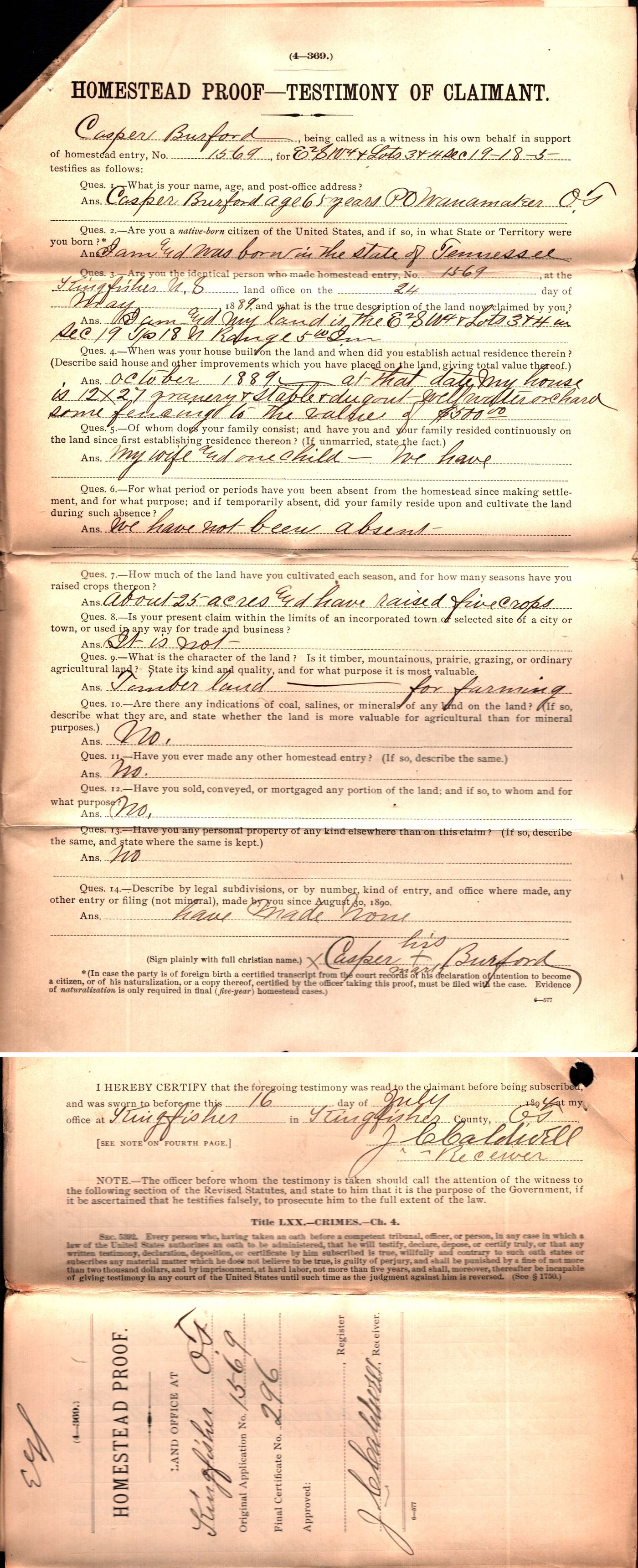
Field by field
- 1 Form name
It reads (4-369.) HOMESTEAD PROOF [dash] TESTIMONY OF CLAIMANT.
The claimant's own sworn statement at final proof. The Homestead Act said a settler could get his patent only after five years, by proving with two credible witnesses that he had lived on or farmed the land. The park's scans of the same file include the testimony of two witnesses, Scott Fox and John Stevenson.
- 2 Claimant, entry number and land
It reads Casper Burford, being called as a witness in his own behalf in support of homestead entry, No. 1569, for E2 SW4 + Lots 3+4 Sec 19-18-5 testifies as follows:
Entry No. 1569 is the number of his original application. The land is written in shorthand: the east half of the southwest quarter plus lots 3 and 4, in section 19, township 18, range 5. That legal description is the key to finding the same land in tract books and on the patent.
- 3 Question 1: name, age and post office
It reads Ques. 1. What is your name, age, and post-office address? Ans. Casper Burford age 65 years PO Wanamaker O.T.
Sixty-five in July 1894 puts his birth about 1828 or 1829. O.T. is Oklahoma Territory, as the Kingfisher office signed itself. The post office tells you which town's records and newspapers to search.
- 4 Question 2: citizenship and birthplace
It reads Ques. 2. Are you a native-born citizen of the United States, and if so, in what State or Territory were you born? * Ans. I am & was born in the state of Tennessee
Only citizens or people who had declared their intention to become citizens could homestead. Burford was born in Tennessee about 1828, but the 1830 and 1840 censuses named only the head of each household, so he will not be named in them as a child; start with later records. The footnote marked * says a man of foreign birth had to file a copy of his declaration of intention or of his naturalization with the case.
- 5 Question 3: the original entry
It reads Ques. 3. Are you the identical person who made homestead entry, No. 1569, at the Kingfisher U.S. land office on the 24 day of May, 1889, and what is the true description of the land now claimed by you? Ans. I am & my land is the E2 SW4 + Lots 3+4 in Sec 19 Tp 18 N Range 5 W I m [the last letters probably name the meridian]
He first filed on May 24, 1889, and made this proof on July 16, 1894, a little over five years later, as the law required. Elsewhere in the same file his name is spelled Bufford and there is an affidavit to correct his name, so search both spellings.
- 6 Question 4: house and improvements
It reads Ques. 4. When was your house built on the land and when did you establish actual residence therein? (Describe said house and other improvements which you have placed on the land, giving total value thereof.) Ans. October 1889 _ at that date my house is 12x27 granary + stable + dugout well water orchard some fencing to the value of $500.00
The best picture you will get of the farm: a house twelve by twenty-seven feet, a granary, a stable, a dugout, a well, an orchard and some fencing, all worth 500 dollars. These descriptions of houses, wells and fences are what the National Park Service calls the exceptional detail of homestead files.
- 7 Question 5: family
It reads Ques. 5. Of whom does your family consist; and have you and your family resided continuously on the land since first establishing residence thereon? (If unmarried, state the fact.) Ans. My wife & one child [dash] we have
A wife and one child lived with him, but neither is named. A census or a county record from Kingfisher County may give their names.
- 8 Question 6: absences
It reads Ques. 6. For what period or periods have you been absent from the homestead since making settlement, and for what purpose; and if temporarily absent, did your family reside upon and cultivate the land during such absence? Ans. We have not been absent
The law required him to live on the land, so any absence had to be explained. He says the family never left.
- 9 Question 7: crops
It reads Ques. 7. How much of the land have you cultivated each season, and for how many seasons have you raised crops thereon? Ans. About 25 acres & have raised five crops
Five crops on about 25 acres, probably one each season from 1890 to 1894. Farming the land was the other half of what he had to prove.
- 10 Questions 8 and 9: town and kind of land
It reads Ques. 8. Is your present claim within the limits of an incorporated town or selected site of a city or town, or used in any way for trade and business? Ans. It is not [dash] Ques. 9. What is the character of the land? Is it timber, mountainous, prairie, grazing, or ordinary agricultural land? State its kind and quality, and for what purpose it is most valuable. Ans. Timber land [dash] for farming
The law required an entry to be made for actual settlement and cultivation, so the office asked whether the land was really a farm and not a town lot or a business. He called it timber land, most valuable for farming.
- 11 Questions 10 to 14: minerals, other entries, sales
It reads Ques. 10. [...] Ans. No. Ques. 11. Have you ever made any other homestead entry? [...] Ans. No. Ques. 12. Have you sold, conveyed, or mortgaged any portion of the land [...] Ans. No, Ques. 13. Have you any personal property of any kind elsewhere than on this claim? [...] Ans. No Ques. 14. Describe [...] any other entry or filing (not mineral), made by you since August 30, 1890. Ans. have made none
No minerals, no earlier homestead, no sale or mortgage, no other land. Each no matters: an earlier entry or a mortgage would have sent you to other land records.
- 12 Signature by mark
It reads (Sign plainly with full christian name.) x Casper his + mark Burford
Burford signed with a cross, and the official wrote his name around it and the words his mark. That usually means he could not write his name, so do not expect his own signature on other papers. The answers above are probably in the official's handwriting too.
- 13 The receiver's certificate
It reads I HEREBY CERTIFY that the foregoing testimony was read to the claimant before being subscribed, and was sworn to before me this 16 day of July, 1894, at my office at Kingfisher in Kingfisher County, O.T. [SEE NOTE ON FOURTH PAGE.] J. C. Caldwell Receiver.
The testimony was read aloud to Burford before he made his mark, and sworn on July 16, 1894, before J. C. Caldwell, the land office receiver. This is the date of the final proof.
- 14 The cover: land office and final certificate number
It reads (4-369.) HOMESTEAD PROOF. LAND OFFICE AT Kingfisher O.T. Original Application No. 1569 Final Certificate No. 296 Approved: [blank], Register; J. C. Caldwell, Receiver. [a pencil mark at the left, unclear]
The most important numbers in the file. The National Archives explains that before July 1908 land entry case files were kept by state, land office, type of entry and final certificate number, so ask for Oklahoma, Kingfisher, homestead, final certificate 296.
Final certificate: Land office proof that a claim was complete
- Write down the land office, the type of entry and the final certificate number: before 1908 those four facts find the case file.
- The legal description, here E2 SW4 and lots 3 and 4 of section 19, township 18, range 5, ties the file to tract books, patents and later deeds.
- The settler's own answers give age, birthplace, family size and a picture of the farm, but not the names of his wife and child.
- Names were spelled more than one way even within one file, so search every spelling.
The full guide to this kind of record
Which records exist for your ancestor? Make a research plan
How to cite this page
Daily Ancestor. "How to read an 1894 homestead final proof, question by question." How to read. https://dailyancestor.com/how-to-read/homestead-1894. Last checked 2026-10-28.