 Daily Ancestor
How to read a 1911 passenger manifest, field by field
A real 1911 New York passenger manifest, followed across all 29 columns for one young immigrant: what each answer tells you and where it leads.
This 1911 passenger list is a form two pages wide, and each passenger's answers run across both pages. This is list 3 of the S.S. Cleveland, which sailed from Hamburg on June 16, 1911, and arrived at New York on June 27. We follow line 1, Moische Arias, an 18-year-old shoemaker, from column 1 to column 29.
Each sheet is very wide, so we show it in four strips: the left page in two halves, then the right page in two halves, all showing the same first three lines. Many of the questions were added by law over the years, which is why later lists tell you so much more than earlier ones.
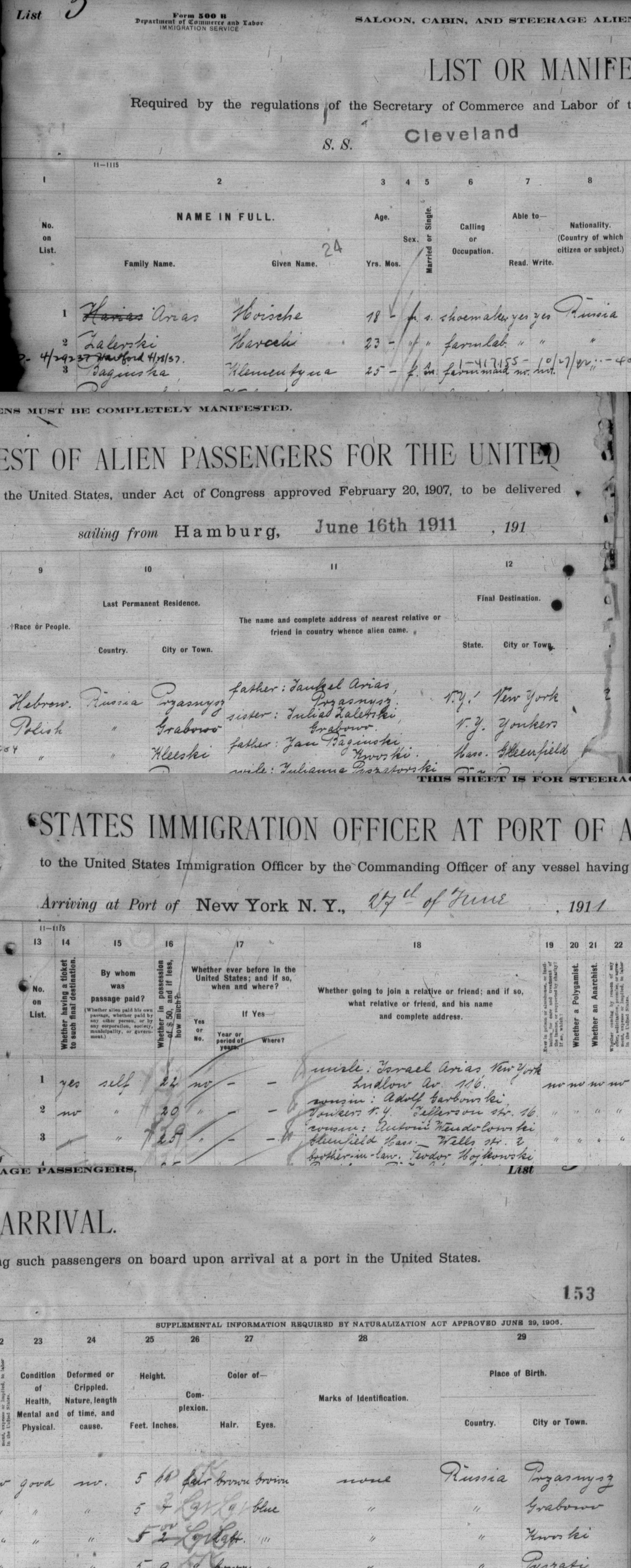
Field by field
- 1 Ship
It reads S. S. Cleveland
The ship's name, with the sailing port and date printed beside it on the next strip: sailing from Hamburg, June 16th 1911. Ship, port and date are what you need to find a passenger list in the arrival indexes.
- 2 Name in full (column 2), line 1
It reads [a crossed-out first spelling, probably Marias] Arias; Moische
Family name, then given name. A clerk struck the first spelling and wrote Arias beside it, so when you search an index, try both spellings and others that sound alike.
- 3 Age, sex, married or single (columns 3 to 5)
It reads 18; -; m.; s.
Moische was 18 years old (no months given), male and single. Treat the age as approximate and check it against later records.
- 4 Calling, read, write, nationality (columns 6 to 8)
It reads shoemaker; yes; yes; Russia
His trade and whether he could read and write. Nationality means the country he was a citizen or subject of, which in 1911 was Russia, not necessarily the language he spoke.
- 5 Later annotations, lines 2 and 3
It reads Left margin, between lines 2 and 3: [illegible]- 4/29237 Hartford 4/18/37 [a stroke runs through "37 Har"]; line 3, occupation column: 1-417155 - 10/27/4[last digit unclear] - 40[cut off at the edge of this strip; the full page reads 404]
Not part of the 1911 voyage. From 1926, when an immigrant who arrived after June 29, 1906 applied to naturalize, a clerk checked his arrival record and wrote a note on it: a district number, an application number and the date of the check. These lists were microfilmed in 1942 and 1943, so notes like these were written between 1926 and about 1943 and point to a naturalization that passenger started then.
Certificate of arrival: Federal proof of lawful entry for naturalizing
- 6 Race or people (column 9)
It reads Hebrew.
The footnote at the bottom of this sheet, below the lines shown here, says race or people was set by the stock the immigrant came from and the language he spoke. Hebrew here is how the officials classed a Jewish immigrant, a hint to look for Jewish community records for his town.
- 7 Last permanent residence (column 10)
It reads Russia; Przasnysz
The town he left, the most important clue on the page for going back further. Look it up on a map of the time, since town names and borders have changed.
- 8 Nearest relative in the country he came from (column 11)
It reads father: Jankel Arias, Przasnysz.
Added by the 1907 law named at the top of this form. It names his father and confirms the home town, a second generation in one line.
- 9 Final destination (column 12)
It reads N.Y.; New York
Where he said he was going to live. Look for him there in the 1920 census and in New York city directories.
Final destination: U.S. state and town the arrival was bound for
- 10 Port and date of arrival
It reads Arriving at Port of New York N.Y., 27th of June, 1911
The right-hand sheet carries the arrival date, 11 days after sailing. USCIS calls a passenger list like this the official arrival record for anyone who came before July 1, 1924, and a later application for a Certificate of Arrival had to be checked against it.
- 11 Ticket, passage paid by, money (columns 14 to 16)
It reads yes; self; 22
He had a ticket to his final destination, paid his own passage, and carried 22 dollars. The question asked whether he had 50 dollars and, if less, how much.
By whom was passage paid: Who paid the immigrant's ship fare
- 12 Ever before in the United States (column 17)
It reads no; -; -
This was his first trip. A yes here would give a year and a place for an earlier arrival to look for.
- 13 Going to join a relative or friend (column 18)
It reads uncle: Israel Arias New York Ludlow Av. 116.
Often the best clue on the whole manifest: a named relative with an address in America. Search for Israel Arias at that address in the 1910 census and in New York city directories.
Going to join: Relative or friend in America the arrival was headed to
- 14 Health and condition (columns 23 and 24)
It reads good; no.
Condition of health good, and not deformed or crippled. Just before these, columns 19 to 22 ask about prison, almshouse or asylum, polygamy, anarchism and promised work, all answered no no no no.
- 15 Height, complexion, hair, eyes, marks (columns 25 to 28)
It reads 5; 11 [a pencil figure is written over the inches]; fair [dk added above in pencil]; brown; brown; none
A description of the man, under a heading on this form that says it was required by the Naturalization Act of June 29, 1906. The pencil marks show someone changed or added to the entry after it was first written.
- 16 Place of birth (column 29)
It reads Russia; Przasnysz
Country and town of birth, here the same town as his last residence. When the two differ, the birthplace is where to look for his birth record.
- Read one line across both pages: the left page tells you who the passenger was, the right page who he was joining and what he looked like.
- The last residence, the nearest relative and the place of birth are your way back to the old country.
- The relative he was joining, with an address, is your fastest way to find him in America.
- Numbers and dates added later in the margins can point to a naturalization, so note them before you move on.
The full guide to this kind of record
Which records exist for your ancestor? Make a research plan
- The Creation and Destruction of Ellis Island Immigration Manifests, Part 1 (Prologue, National Archives, 1996)
- Passenger Manifest Annotations (National Archives)
- Researching Individuals (U.S. Citizenship and Immigration Services)
- A Guide to Interpreting Passenger List Annotations: In the Occupation Column (Marian L. Smith, former INS historian, JewishGen)
How to cite this page
Daily Ancestor. "How to read a 1911 passenger manifest, field by field." How to read. https://dailyancestor.com/how-to-read/passenger-manifest-1911. Last checked 2026-10-28.