 Daily Ancestor
The Boy Chosen in the Christian Church
In 1891 a charity printed two letters in its annual report: one to a governor, one from him. Together they read like a case file of an orphan train rider.
Most orphan train riders left no paper trail of their own. Andrew H. Burke left several, and one of the best is hiding in a place few family historians think to look: the printed annual report of the charity that sent him west. The Thirty-Ninth Annual Report of the Children's Aid Society of New York, dated November 1891, gives three pages to a section called "Incidents in the Emigration Work," with the subtitle "Correspondence with the Governor of North Dakota." The report is long out of copyright and free to read on the Internet Archive, scanned from a copy at Columbia University.
The section opens with a short note from the Society's assistant treasurer. He writes that Andrew H. Burke, "now Governor of North Dakota," was one of "our boys," and that "nearly all of the children sent out in that particular company, August 2d, 1859," had done well. Then he lists a few of the same party, and here is the first lesson of the record: he gives only initials. "T. B. is now cashier of the Citizens Bank of Indiana." "D. H. married a cousin of his employer, and is now a successful Methodist minister." Even when it was boasting, the Society kept its children's names out of print.
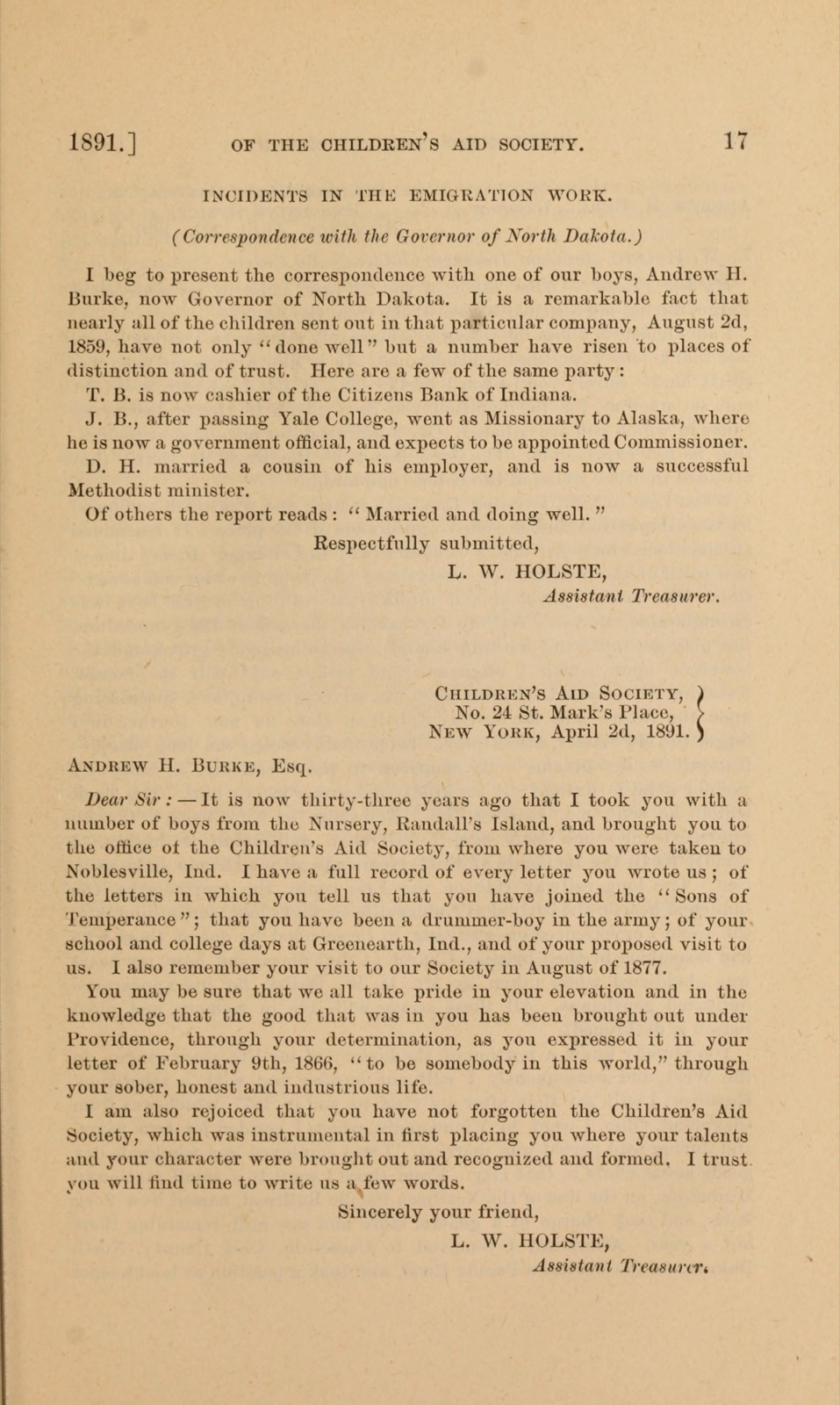
One set of initials can be matched with some confidence. "J. B., after passing Yale College, went as Missionary to Alaska, where he is now a government official, and expects to be appointed Commissioner." That fits John Green Brady, who rode an orphan train to Indiana in August 1859, graduated from Yale in 1874, went to Alaska as a missionary and was later appointed governor of Alaska, serving from 1897 to 1906. He died at Sitka on December 17, 1918. The report itself never says his name; the match comes from putting its details next to his published biography, so it is an identification, not a fact printed on the page.
Next comes the Society's letter to Burke, dated April 2, 1891, from No. 24 St. Mark's Place. The writer says he took Burke "with a number of boys from the Nursery, Randall's Island," brought him to the Society's office, and from there he was "taken to Noblesville, Ind." Then a sentence that should make any descendant sit up: "I have a full record of every letter you wrote us." The Society kept files on its children and filed their letters. The writer lists what Burke had told them over the years: that he had joined the Sons of Temperance, that he had been "a drummer-boy in the army," that he went to school and college at a place printed as "Greenearth, Ind.," and that he visited the Society in August 1877. He also quotes a letter Burke wrote on February 9, 1866, in which the boy said he meant "to be somebody in this world."
That town name is worth a second look. There is no Greenearth in Indiana. Burke's biography from the State Historical Society of North Dakota says he studied for two years at Asbury College, and Indiana Asbury, renamed DePauw in 1884, is in Greencastle. "Greenearth" is very probably a misreading of Greencastle, made when someone copied a handwritten letter into type. Printed reports were set from handwriting, so their place names can be wrong in ways a clerk's original would not be.
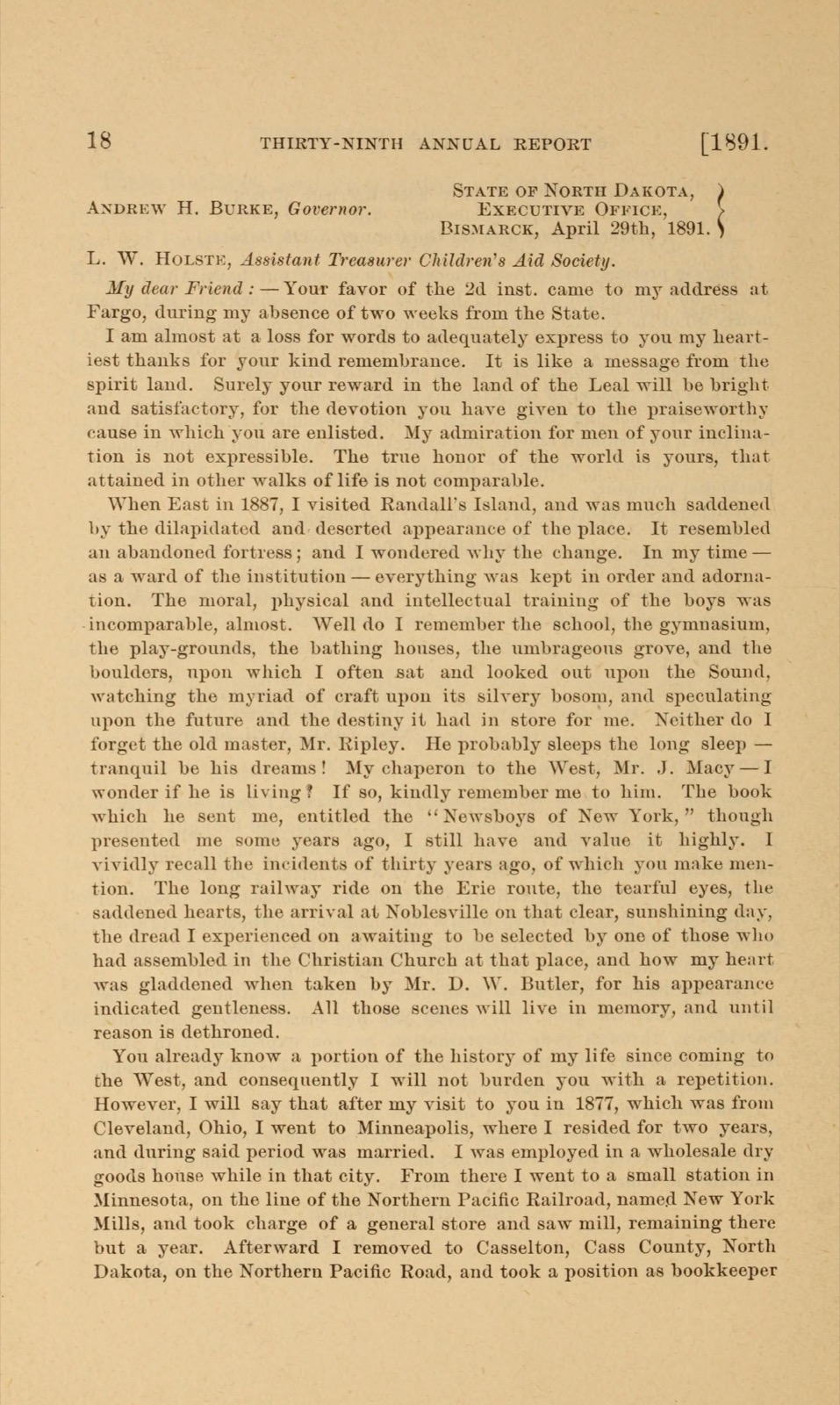
Watch the dates, too. The writer says it is "now thirty-three years ago" that he took Burke from Randall's Island, which would point to 1858, yet the note on the same page dates the company to August 2, 1859. Burke's reply speaks of "the incidents of thirty years ago." Some modern accounts give 1858 for his placement. Round numbers in a letter are memory, not a register. The specific date, August 2, 1859, is the one to test against other records.
Burke answered from the Executive Office in Bismarck on April 29, 1891. His letter is the part of the record no clerk could have written. He remembers Randall's Island, the school, the gymnasium, "the boulders, upon which I often sat and looked out upon the Sound." He names the agent who took the company west and asks whether he is still living. Then he describes the journey in his own words: "The long railway ride on the Erie route, the tearful eyes, the saddened hearts, the arrival at Noblesville on that clear, sunshining day, the dread I experienced on awaiting to be selected by one of those who had assembled in the Christian Church at that place." He was taken, he writes, by a man whose "appearance indicated gentleness." The letter gives that man's name, which a researcher can carry into Indiana records.
The rest of the reply reads like a résumé, and every line is a lead. After visiting the Society in 1877, coming from Cleveland, he lived two years in Minneapolis, married during those two years, and worked for a wholesale dry goods house. He ran a general store and saw mill at New York Mills, Minnesota, for about a year. Then he moved to Casselton, Cass County, North Dakota, where he kept books in a general store, became cashier of the First National Bank after six months, and served six years as county treasurer. He was elected governor in November 1890 and "inaugurated January 7th last." He sums it up himself: "So the little boy whom you took from the Nursery thirty-three years ago to send to a home in the West is now a full-fledged Governor of a sovereign State of this Union."
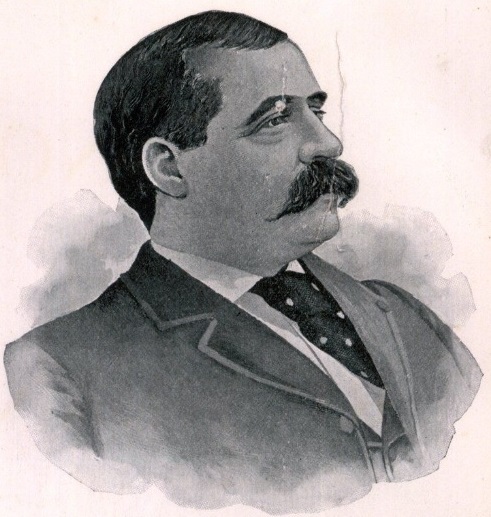
The State Historical Society of North Dakota fills in what the letters leave out. It gives his birth as May 15, 1850, in New York, says he was orphaned at four and became a ward of the Children's Aid Society, enlisted as a drummer boy with an Indiana regiment, and arrived in Casselton in 1880 with $65. He served as governor from 1891 to 1893 and died at Roswell, New Mexico, on November 17, 1918. If the 1850 birth date is right, he was nine when the company left New York in August 1859, a figure you get by subtraction, not one any of these records states.
The Children's Aid Society's own archives, the kind of files that letter describes, are held today at the New-York Historical Society, which publishes an online finding aid. But even without them, one printed annual report gave us the date his company left, the town where he was chosen, the building where the children waited, his school, his war service and his whole route west, mostly in his own words.
- Look for your orphan train rider in the charity's own printed annual reports. They often printed letters from placed children and their new families, sometimes with initials instead of names.
- A report that uses initials still gives you dates, towns and details you can match against other records. Treat any name you attach to the initials as your identification, and say so.
- Printed reports were typeset from handwriting. A place name that does not exist, like "Greenearth," is usually a misreading; look for a real place that looks similar in script.
- "Thirty years ago" in a letter is memory. Give more weight to an exact date, like a company leaving on August 2, 1859, and test it against other records.
- The Children's Aid Society's case files are at the New-York Historical Society. Start with its online finding aid before you plan a visit or a request.
- Thirty-Ninth Annual Report of the Children's Aid Society, November 1891, pages 17 to 19: Incidents in the Emigration Work (Internet Archive)
- Andrew H. Burke, North Dakota Governors Online Exhibit (State Historical Society of North Dakota)
- Andrew H. Burke, Wikipedia
- John Green Brady, Wikipedia (the August 2, 1859 train to Noblesville; Yale 1874; governor of Alaska 1897 to 1906; died December 17, 1918)
- DePauw University, Wikipedia (founded as Indiana Asbury in Greencastle, renamed 1884)
- Orphan Trains: A Brief History and Research How-to (New York Genealogical and Biographical Society): Children's Aid Society records at the New-York Historical Society
How to cite this page
Daily Ancestor. "The Boy Chosen in the Christian Church." Stories from the Records. https://dailyancestor.com/stories/orphan-train-andrew-burke. Last checked 2026-10-28.