 Daily Ancestor
The Grandchildren's Share
An Ohio farmer's estate papers from 1848 to 1852 hide a small family story: three grandchildren, a guardian, and six receipts that add up.
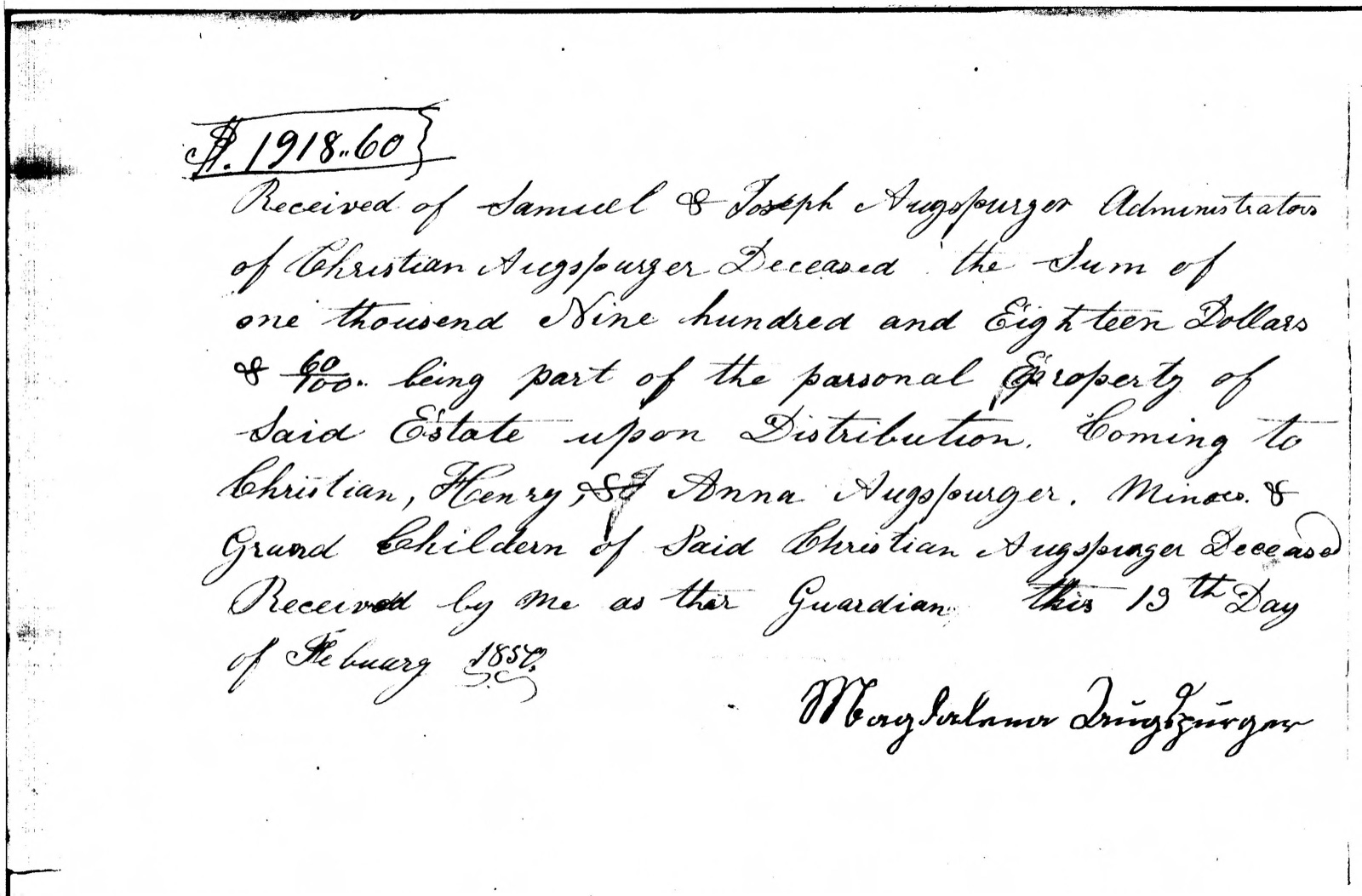
On the 13th of February, 1850, somebody in Butler County, Ohio, wrote out a receipt in a careful English hand. It says the writer had received from the two administrators "of Christian Augspurger Deceased the Sum of one thousend Nine hundred and Eighteen Dollars & 60/100," money "being part of the parsonal Property of Said Estate upon Distribution." The money was coming to three children, "Minors & Grand Childern" of the dead man, and it was "Received by me as ther Guardian." Under that line is a signature in a different hand, written in the old German style of handwriting. The spellings in these quotations are the clerk's own.
That small slip is one of dozens of papers from one estate, kept by the MidPointe Library System in Ohio and now free to view on Wikimedia Commons. Read together, they show how a large farm family split an inheritance, and how children who could not sign for themselves still got their share.
Christian Augspurger was the pioneer of the Amish settlement in Butler County. According to W. H. Grubb's History of the Mennonites of Butler County, Ohio (1916), he had managed a farm near Strasbourg, tried America once, went back to France, and in 1819 returned for good with a group of families. He bought a farm in Milford Township, later a 250-acre farm in Madison Township, and moved there in 1830. Grubb says he at one time owned 1,975 acres in Butler County.
The county history of 1882 adds that he had twelve children, six sons and six daughters, and that "In 1848 Christian Augspurger's wife died, and in 1848 he also died." His land and "a large personal estate" were, it says, "all divided equally among his children."
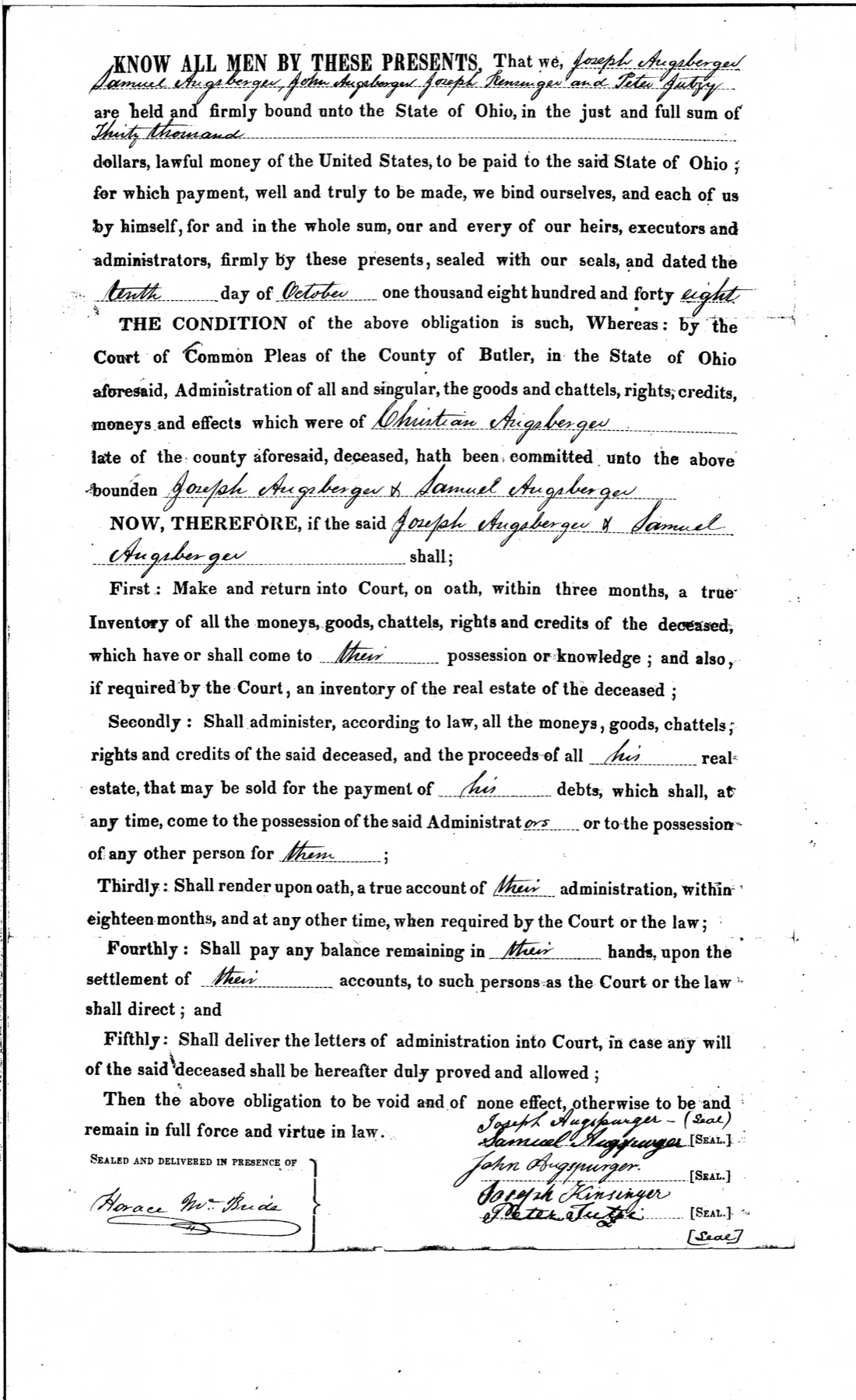
The paperwork began on October 10, 1848. A printed bond from the Court of Common Pleas of Butler County shows two men of the family, both named among his sons in the county history, taking on the administration of his "goods and chattels, rights, credits, moneys and effects," with three more men joining them, all bound to the State of Ohio "in the just and full sum of Thirty thousand" dollars. The clerk who filled in the blanks spelled the family name "Augsberger." The three Augspurgers signed it "Augspurger." Expect that kind of difference in your own family's papers.
One of those sons was Joseph. Grubb gives a Joseph Augspurger, son of Christian and Catherine, born in France on March 17, 1806, later a minister, who died on January 29, 1864, and was buried in a family cemetery near Woodsdale. Grubb also says Christian the pioneer and his wife rest in a small cemetery on an Augspurger farm near Woodsdale, which appears to be the same one. The records suggest that this Joseph is the administrator, though the estate papers do not give his age.
Now to the grandchildren. On August 20, 1849, the adult heirs signed one joint receipt for $17,603.50 from the administrators, money "equally divided" among them. Fifteen names stand at the bottom, some in English letters, some in German script. The children's guardian is not among them.
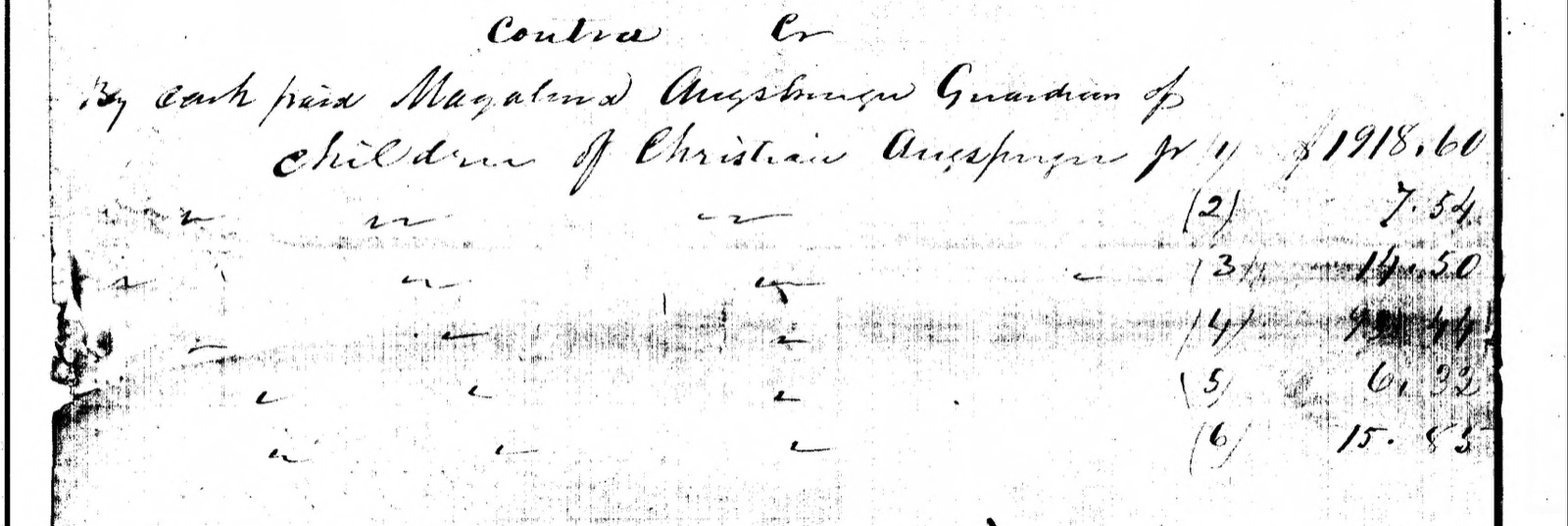
Their money came separately. The administrators' account with the heirs, dated March 30, 1852, in the library's catalog, opens its list of payments with a line to the "Guardian of children of" a son who carried his father's first name, written with "Jr." after it. That payment, numbered (1), is $1,918.60, the same figure as the February 1850 receipt. Five smaller payments to the guardian follow, numbered (2) to (6).
By the catalog's titles, the collection holds six receipts from the guardian, dated from February 1850 to February 1852. Six receipts and six numbered payments: the records suggest each receipt is the voucher for one line in the account. This is the way an administrator proved to the court that he had paid what he said he paid.
Why did these three need a guardian at all? Their father's share went to them, and the papers call them minors. A minor could not give the administrators a valid receipt. A guardian, appointed by a court and usually bonded, could sign for them and had to answer for the money. None of the papers I read says when or how the son marked "Jr." died. That his children, not he, took the share suggests that he had died before the estate was divided.
There is one more lesson in how the shares were figured. A partition sheet from about 1849 lists the land by heir, with acres and a price per acre. Joseph, for example, took 253 acres at $53 an acre, $13,409. The land comes to 1,645 and a quarter acres; below it, three more names are listed with cash instead of land, and the page's grand total is $90,162.08. The guardian's children do not appear on this sheet at all. When an estate is "divided equally," equal can mean land for some, money for others, and, for a branch whose parent is gone, payments to a guardian.
The receipts give the three children's first names and their guardian's name. What became of them is a search for another day, in the guardianship records of the court and in later censuses and church records. The estate papers have already done their part: they show that a branch of the family existed, that a parent in it had probably died, and that someone took on the legal duty of protecting those children's money.
- A guardian's receipt inside a grandparent's estate packet is a clue that one of the dead person's children had probably died before the estate was divided, leaving minor children who took that parent's share.
- Match receipts to the administrator's account. Numbered payments and matching dollar amounts show which slip of paper belongs to which line.
- A joint receipt signed by the adult heirs lists most of the family in one place; a branch missing from it may turn up as a guardian's payment instead.
- Expect the surname to change from hand to hand: Augspurger, Augsberger and Augsburger all appear in this one estate.
- Look at signatures, not just the text. A receipt written by a clerk but signed in German script tells you something about the person who signed.
- Receipt from the guardian to the Estate of Christian Augspurger, 1850 February 13 (MidPointe Library System, on Wikimedia Commons); five later guardian receipts in the same collection checked by title
- Account with Heirs, Full and Final Settlement of the Estate of Christian Augspurger, 1852 March 30, page 2
- Appointment of Administrators for the Estate of Christian Augspurger, 1848 October 10, page 1 (administrators' bond)
- Receipt from the heirs to the Estate of Christian Augspurger, 1849 August 20
- Account with Heirs, Partition of Real Estate for the Estate of Christian Augspurger, circa 1849, page 1
- W. H. Grubb, History of the Mennonites of Butler County, Ohio (1916), pages 11 to 12 (Christian Augspurger), 29 to 30 (Rev. Joseph Augspurger, 2nd) and 33 (family cemetery near Woodsdale)
- A History and Biographical Cyclopaedia of Butler County, Ohio (Cincinnati: Western Biographical Publishing, 1882), Madison Township, page 601
How to cite this page
Daily Ancestor. "The Grandchildren's Share." Stories from the Records. https://dailyancestor.com/stories/the-grandchildrens-share. Last checked 2026-10-01.