 Daily Ancestor
The Widow Who Burned the Discharge
In 1838 a Massachusetts widow told a judge she had burned her husband's Revolutionary War discharge a month earlier. Here is how she proved his service anyway.
In the summer of 1838 an old woman in Belchertown, Massachusetts, did something that many of us have done with a box of family papers: she decided an old document was of no use and got rid of it. A few weeks later she needed it. We know this because she said so, under oath, and a court officer wrote it down. The page is still in her pension file at the National Archives, and anyone can read it today.
Her name was Amy Chapman, though the file spells it more than one way. The outer envelope of the file says "Ama or Amy," an inner jacket says "Amy," the court papers say "Ama" (though the register's certificate at the end looks more like "Anna"), and the pastor's copy of her marriage record reads "Amey" (that last reading could also be "Amy"). She was the widow of William Chapman, who served in the Revolutionary War and died, according to the file, on the third day of April 1807. The file is numbered W. 18884. The W tells you it is a widow's file.
Why did a widow apply 31 years after her husband died? Because Congress had only just made it possible. The act of July 7, 1838, which her declaration calls "An act granting half pay and pensions to certain widows," offered five years of pension to widows of Revolutionary soldiers who had married after the soldier's service but before January 1, 1794. Amy applied within five weeks of the act passing.
On August 10, 1838, her declaration was taken before the county's judge of probate. She was 79 years old. A note signed by the judge at the bottom of it says that she "cannot from bodily infirmity attend the court," so the papers were probably taken where she lived, though the file does not say where. In her declaration she listed what she remembered of William's war: he enlisted for three years "when the first three years men were raised," was in the retreat from Ticonderoga, was present when the British army surrendered at Saratoga, and was at the Battle of Monmouth. A line squeezed in between the others adds, as far as it can be read, that he was one of the guard taking the prisoners to Boston.
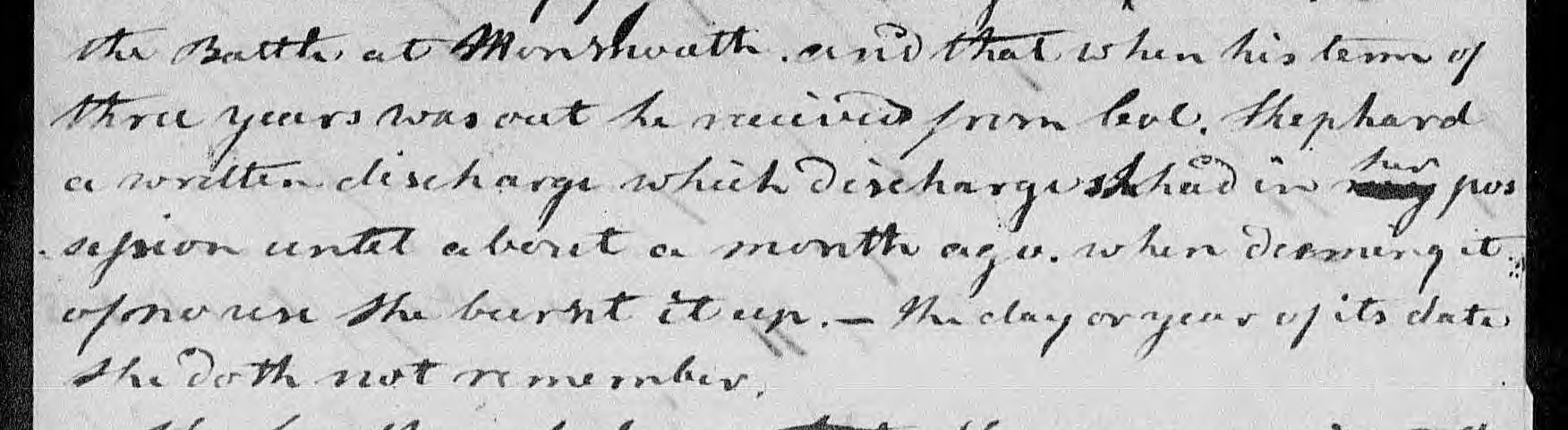
Then comes the sentence that makes this file unforgettable. When his three years were up, William received a written discharge from his colonel, "which discharge she had in her possession until about a month ago." Then: "when deeming it of no use she burnt it up." Whoever wrote the page first wrote "my" and then struck it out and wrote "her" above it. After a dash the page adds: "the day or year of its date she doth not remember."
So the one paper that would have proved William's service in his own colonel's hand was gone, burned, by her own account, about a month before August 10, 1838, which puts it at about the time Congress passed the law that would have made it worth money. The file does not say whether anyone else saw the discharge before it was burned. What it does show is how the claim was rebuilt without it.
First, a witness. A 73-year-old man of Belchertown swore the same day that he had been "well acquainted" with William, "having always lived in the same neighborhood." He remembered William enlisting for three years in 1777 and not coming home, to his knowledge, until his time was out. He said he enlisted himself in 1781 in the same regiment, the Fourth Massachusetts, and that William and Amy were married while he was away in the service. He added that she had lived in that area ever since her husband died and had never married again. A justice of the peace certified that his testimony "is entitled to full credit."
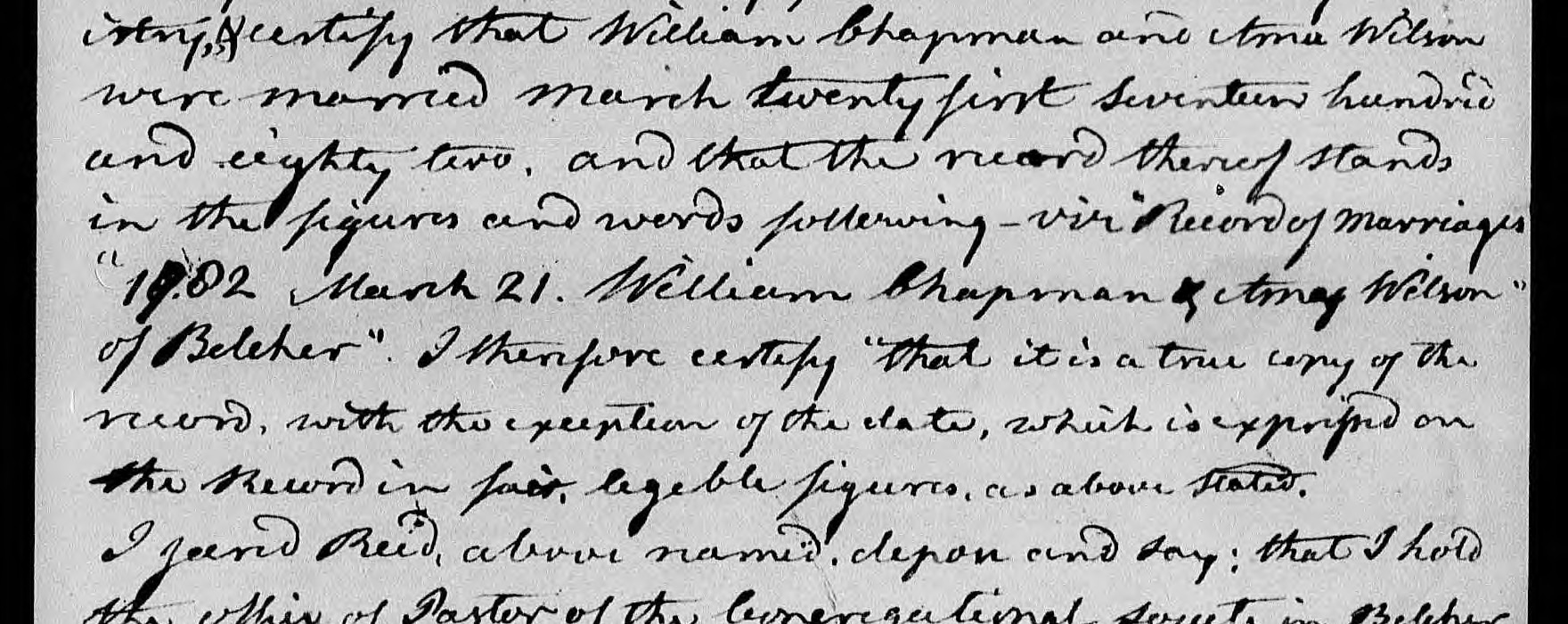
Second, the church book. A widow under this act had to prove when she married, and Amy said the minister of Belchertown, "the Rev. Justus Forward," had married them on March 21, 1782. Forward had died in 1814, but his records had not. The pastor serving the Congregational society in 1838 swore that he had the church records "in the hand writing of said Forward" and copied the entry for the government: "1782 March 21. William Chapman & Amey Wilson of Belcher". He was careful about one detail. His certificate spells the date out in words and then explains that it is a true copy "with the exception of the date, which is expressed on the Record in fair legible figures."
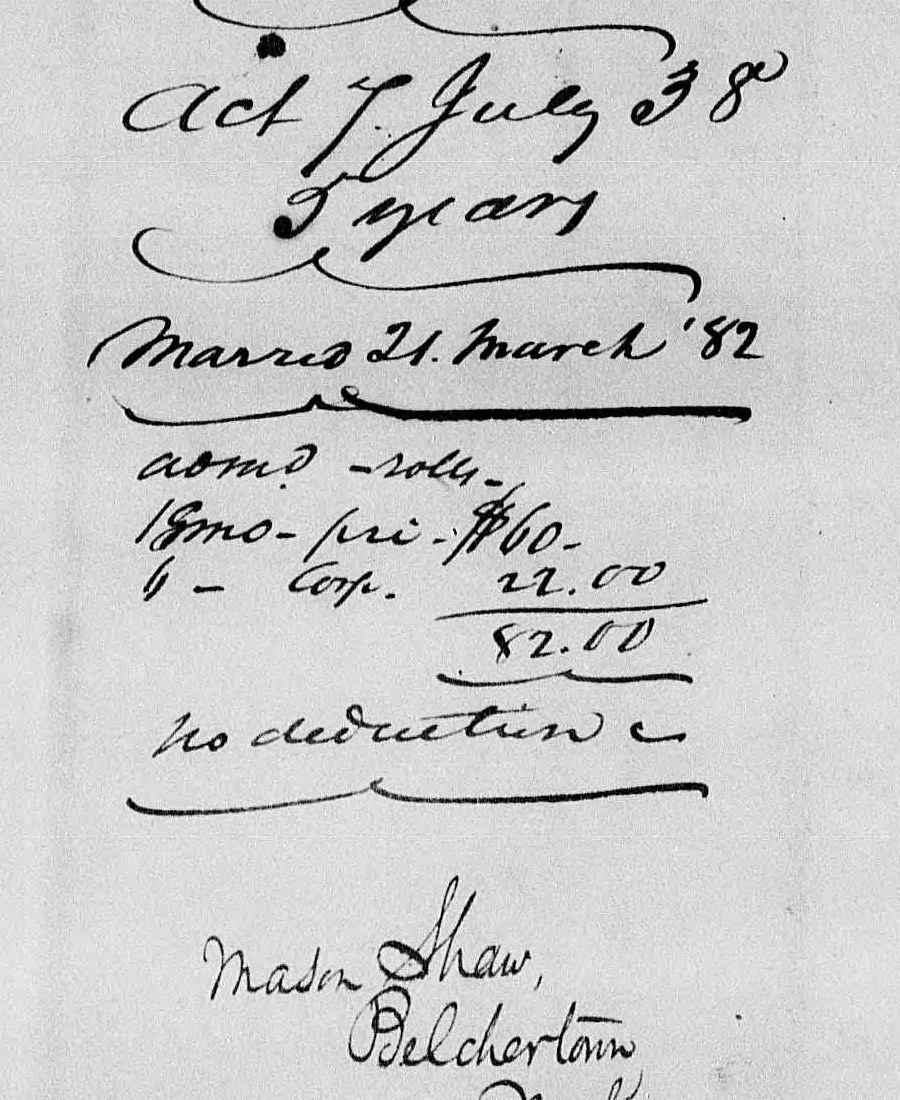
Third, the government's own records. In Washington, the clerks did not rely on Amy's memory of William's rank. She had called him a private and sergeant. A docket slip in the file says the claim was "admd" (admitted) by the "rolls," and the arithmetic below it counts 18 months as a private at $60 and 6 months as a corporal at $22, for a total of $82 a year, with "no deduction." The jacket of the file, written later, also calls him "Corp." The file suggests the office went by its own muster rolls, not by the family's memory of his rank.
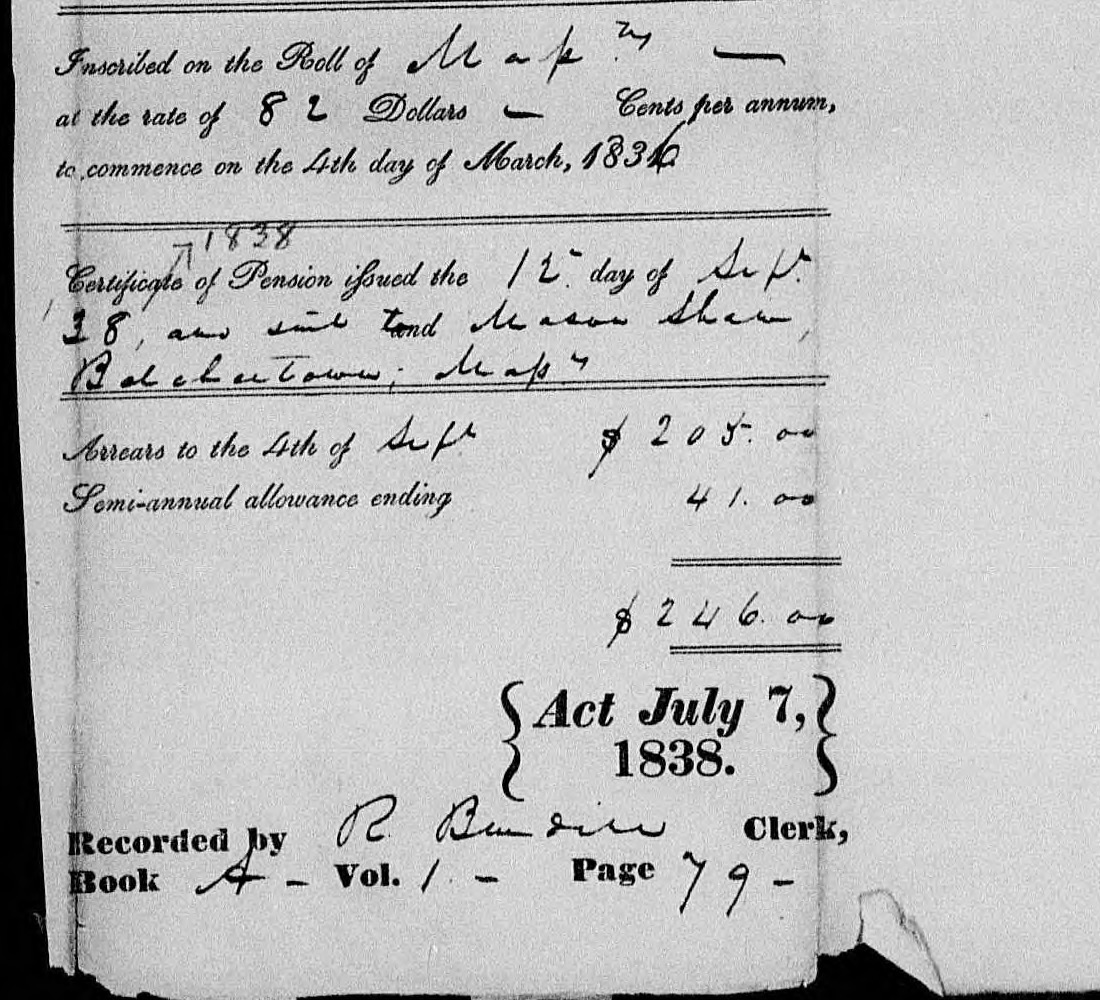
The certificate was issued on September 12, 1838, and sent to the same justice of the peace in Belchertown. It put Amy on the Massachusetts roll at $82 a year, starting from March 4, 1836. That start date is why the first payment was large: $205 in arrears up to September 4, 1838, plus $41 for the next half year, $246 in all.
What happened to Amy after that? The pension file does not say. All nine of its pages date from 1838; there is no later letter, no note of her death and no claim from her heirs. The next places to look are the ones the file itself points to: the Belchertown church records and the town's old burying grounds, where a gravestone could give her death and her age. A Wilson family history published in 1988 covers her family, but we could not read its entry in full, so we do not repeat its dates here.
A burned discharge, a neighbor's memory, a pastor's careful copy and a clerk's sum: in nine pages, this small file shows how a widow proved a marriage made 56 years earlier and her husband's service in a war that had ended 55 years before. It also leaves a gentle warning for anyone holding a box of old papers. The one that looks useless may be the one somebody needs.
- Read the widow's declaration word by word. Small asides, like a burned discharge or a struck-out word, tell you how the claim was built and what evidence is missing.
- Check which pension act a file was made under. The act of July 7, 1838, explains why a widow applied 31 years after her husband died and why she had to prove a marriage before 1794.
- When a family remembers one rank and the pension office allows another, look for the clerk's notes. A line like "admd rolls" means the government used its own muster rolls, not the family's memory.
- A pension file can point you to other originals: here, the Belchertown church records kept by the Rev. Justus Forward. Go to those records, not only to the copy.
- Compare the file with published genealogies, but read the entry itself before you rely on it. A date seen only in a search snippet is a lead to check, not a fact.
- Revolutionary War Pension and Bounty Land Warrant Application File W. 18884, William Chapman, Mass. (NARA NAID 54196628), pages 1 to 9 read; page 5 and 6: Ama Chapman's declaration, August 10, 1838
- Same file, page 7: deposition of a Belchertown witness, aged 73, August 10, 1838
- Same file, page 9: pastor's certified copy of the 1782 marriage record from the Belchertown church records
- Same file, pages 2 to 4: pension certificate summary (Sept. 12, 1838), file jacket, and docket slip
- Historical Sketch of the Congregational Church in Belchertown, Mass. (1852), page 79: list of pastors, "Justus Forward, settled 1756, died 1814, aged 84"
- Ken Stevens, Descendants of Jacob Wilson of Braintree, Massachusetts (1988), Internet Archive lending copy (borrow only; listed as a lead, entry not read in full)
How to cite this page
Daily Ancestor. "The Widow Who Burned the Discharge." Stories from the Records. https://dailyancestor.com/stories/the-widow-who-burned-the-discharge. Last checked 2026-10-01.