 Daily Ancestor
The Two Decembers of Lemuel Pickens
An Indiana farmer's line on the 1880 mortality schedule, the family he left behind, and a county history that seems to put his death a year too late.
In June 1880, census takers across the United States asked a question most people forget the census ever asked: did anyone in this household die during the past year? The answers went onto a separate form, Schedule 5, the mortality schedule. On one page from Paoli Township in Orange County, Indiana, line 12 belongs to a farmer named Lemuel Pickens. His entry takes up one row. Put next to two other records, it turns into a small puzzle about a date.
The printed heading of the form reads "Persons who Died during the Year ending May 31, 1880." A note at the top makes the window exact: "The Census Year begins June 1, 1879, and ends May 31, 1880." Every person on the page was supposed to have died within those twelve months. Their names were gathered during the June 1880 count, alongside the regular count of the living.
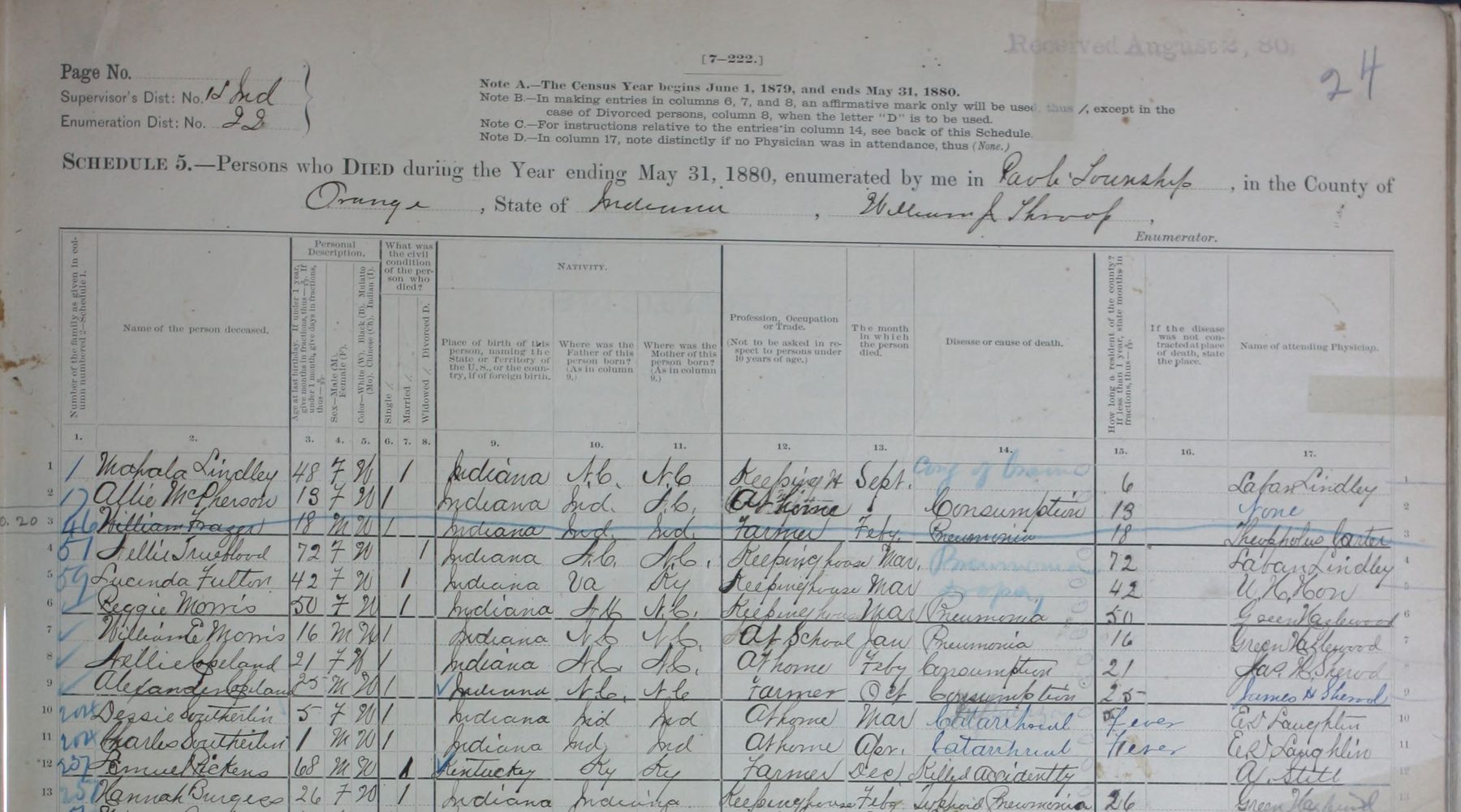
Reading across line 12 is like reading a short sentence. Column 3, age at last birthday: 68. Column 4, sex: M. Column 5, color: W. Columns 6 to 8 record whether the person was single, married or widowed, and his mark sits in column 7: married. Column 9 gives his birthplace, Kentucky, and columns 10 and 11 say his father and mother were born there too ("Ky"). Column 12, occupation: "Farmer." Column 13, the month of death: "Dec". Column 14, the cause, in the enumerator's own spelling: "Killed accidently." The last column names the attending physician. In column 1, before his name, someone added a number in blue pencil. That column is headed "Number of the family as given in column numbered 2" of Schedule 1: it links each death to a household on the population count. His number looks like 237, though the middle digit could also be read as a 5. We will follow it in a moment.
At the bottom of the page is a box headed "Remarks." The printed instructions on the back of the sheet reserve this space for unusual diseases and, for an explanation in case of "any unusual number of deaths by violence or accident". This enumerator used it for single cases too. The first remark is about him: "No 12 Lemuel Pickens was accidently Killed;". After a crossed-out word the note continues that he "was hauling lumber his team run away" and threw him off, that "the wagon run across his breast and crushed him badly," and that "he died in a few hours." The spelling here is the original. The word for throwing him off is hard to read; it looks like "thro".
So the mortality schedule tells us that Lemuel Pickens died in a December that fell inside the census year. Since the year ran from June 1879 to May 1880, that December can only be December 1879.
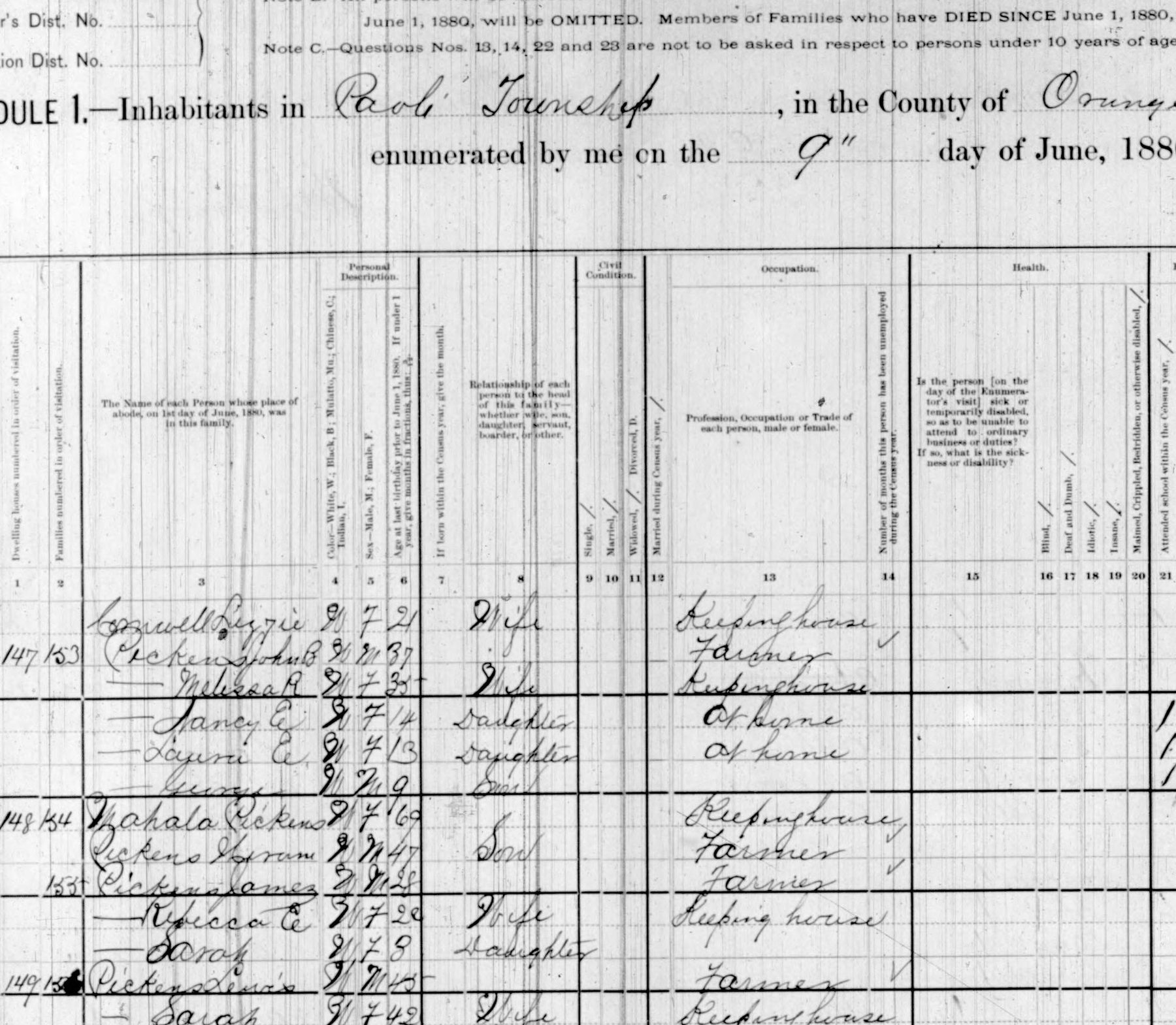
The same enumerator also filled in Schedule 1, the population schedule, and Paoli Township's pages survive on National Archives microfilm, Reel 302 of the 1880 Indiana census, now free on Internet Archive. Two households there matter. The first is the one the blue number points to. On page 24, family 237 is headed by a Pickens farmer of 43, born in Indiana to parents born in Kentucky, living with his wife and two sons. The second is on page 16, dated June 9, 1880: dwelling 148, family 154. Its head is a woman of 69, keeping house, born in Kentucky to parents born in Kentucky, and below her is her son, 47, a farmer, born in Indiana, whose father's birthplace column says "Ky." Her first name is the one the 1884 county history, which we will come to, gives Lemuel's wife. That is a strong match, though a shared name alone is not proof. Neither household has a man of 68.
That absence matters, because the population form carries its own rule printed at the top: "Members of Families who have DIED SINCE June 1, 1880, will be INCLUDED." If Lemuel had still been alive on June 1, 1880, he should have been listed with his family, whichever household that was, even if he died later. He is in neither, and he is on the mortality schedule. The two forms, filled in by the same man in the same month, agree with each other. Why the death was tied to family 237 and not to the household of the woman who shares his wife's name, the pages do not say. A family number is a lead to follow, not proof of where someone lived.
The June 9 page also shows the family's neighborhood. In the same dwelling, 148, a second family (155) is headed by a Pickens farmer of 28 with his wife and a daughter. Next door, dwelling 147, is a Pickens farmer of 37 with his wife and three children, and in dwelling 149 a Pickens farmer of 45 heads a large household. The two younger men are both recorded with parents born in Kentucky. The census does not say how these households were related to Lemuel; the relationship column only links people inside one family. The records suggest a cluster of kin living side by side, but proving who was whose son would need other records, such as deeds, wills or marriage records.
The third record came four years later. In 1884, Goodspeed Bros. of Chicago published a History of Lawrence, Orange, and Washington Counties, Indiana. Its list of Orange County commissioners on page 438 includes Lemuel Pickens in 1858 and again in 1861. On page 664, a biographical sketch of one of his sons, a merchant at Millersburg born in Paoli Township in 1850, calls him "one of the thirteen children" of Lemuel and his wife. It says the parents came from Shelby County, Kentucky, which fits the Kentucky birthplace on the mortality schedule. The sketch also describes the accident: "his death was occasioned by his team running and killing him almost instantly, December 2, 1880."
Here the records part ways on two details. The first is the year. A death in December 1880 could not appear on a mortality schedule that closed on May 31, 1880, and it would not keep him off a population schedule taken that June. Two records made in 1880 point to December 1879; one written in 1884 says 1880. The records suggest the history's year is wrong. If its day is right, the date was probably December 2, 1879, but that combination is a conclusion, not something any one record states.
The second detail is how fast he died. The enumerator's note says "in a few hours"; the history says "almost instantly." The note was written in 1880, within months of the accident, during the census itself. The sketch was printed four years later. We cannot tell who supplied the wording for either one, so the safest course is to keep both versions and note where each came from.
None of this makes the county history worthless. It supplies what the census never asks: the Shelby County origin, the thirteen children, his name twice in the list of county commissioners. The census, in turn, supplies what the history gets wrong: a firm window for the death and a snapshot of the family's households six months later. Together, three short pieces of paper give us a Kentucky-born farmer who served his county, Pickens households side by side in 1880, and one winter day hauling lumber that ended his life.
- Check the census year before you write down a death year. The 1880 mortality schedule covers June 1, 1879, to May 31, 1880, so a death marked "Dec" should belong to December 1879.
- On the 1880 mortality schedule, column 1 gives the family number from the population schedule. Look that family up: it may lead you to a different household than the one you expected. Neighbors with the same surname are clues too, but not proof: the relationship column only connects people inside one family.
- Always read the Remarks box at the bottom of a mortality schedule page. It was meant for unusual diseases and accidents, and some enumerators used it to explain single deaths, which may be the only description of what happened.
- Use the population schedule taken the same month as a cross-check. Who heads the household now, and who is missing, can confirm the mortality entry.
- County histories are valuable for origins, offices and children, but their dates were often written years later. When a history disagrees with a record made at the time, record both and say which one you trust and why.
- U.S. Census Mortality Schedule for Indiana, 1880, Counties O-S, page 30: Schedule 5, Paoli Township, Orange County, Enumeration District 22, line 12 and Remarks (Indiana State Library via DPLA and Wikimedia Commons)
- Same volume, page 31: back of the sheet, printed Instructions to enumerators (remarks on deaths by violence or accident)
- 10th census, 1880, Indiana [microform], Reel 302: Schedule 1, Paoli Township, Orange County, Enumeration District 22, enumerated June 9, 1880, dwellings 147 to 149 (image n662)
- 10th census, 1880, Indiana [microform], Reel 302: Schedule 1, Paoli Township, Orange County, page 24, dwelling 229, family 237 (image n670)
- History of Lawrence, Orange, and Washington Counties, Indiana (Chicago: Goodspeed Bros. & Co., 1884), page 664: biographical sketch of a son of Lemuel Pickens
- Same book, page 438: list of Orange County commissioners (Lemuel Pickens, 1858 and 1861)
How to cite this page
Daily Ancestor. "The Two Decembers of Lemuel Pickens." Stories from the Records. https://dailyancestor.com/stories/the-two-decembers-of-lemuel-pickens. Last checked 2026-10-01.