 Daily Ancestor
Paid in Cotton, Corn and Wheat
A one-page Freedmen's Bureau labor contract from Tennessee, 1866: no dollars, two crosses, three stamps, and a docket that dropped a woman's name.
It is one sheet of lined paper, folded twice, with three small orange stamps stuck to the bottom. At the top is a single paragraph in brown ink. At the foot are three names, and two of them have a cross beside them instead of a signature. On the back, a Freedmen's Bureau clerk wrote a number and a date. That is the whole record: a labor contract from Hardeman County, Tennessee, approved on January 19, 1866, and now kept in the National Archives in Washington.
Contracts like this one are among the most common papers the Freedmen's Bureau left behind. Congress created the Bureau of Refugees, Freedmen, and Abandoned Lands by an act approved March 3, 1865. In his report that December, the Bureau's commissioner wrote that its assistant commissioner for Kentucky and Tennessee had found work for freedpeople "mainly by associating the planters and freedmen with his sub-agents in commissions organized for the purpose of settling local disputes, making labor contracts," and keeping such cases out of the military courts. A written contract, approved by a Bureau officer, was meant to show what both sides had promised.
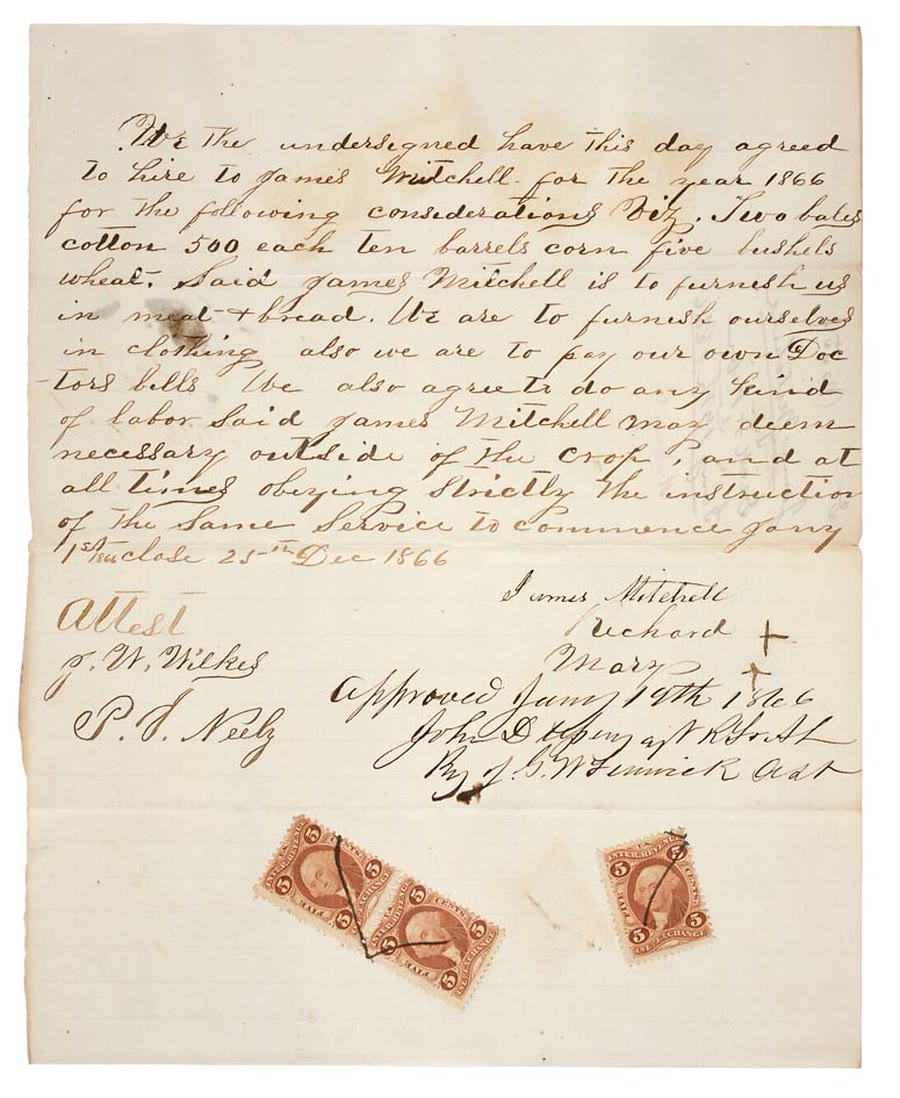
A short note before we read it. This story names only people whose deaths we can document from a source we opened, and we could not do that for anyone on this paper. So the employer, the two workers, the witnesses and the officers stay unnamed here, and where a name falls inside a quotation we replace it with a description in square brackets. Their names are on the scan and in the archive's catalog title, linked below, for anyone who wants to look further.
The contract is written in the voice of the workers. It opens: "We the undersigned have this day agreed to hire to [the employer] for the year 1866 for the following considerations Viz." Here "to hire to" someone means to hire yourself out to him: the people signing are the ones being hired. Notice the word "considerations." In a contract the consideration is what each side gives in return, and "Viz." is the old abbreviation for "namely." What follows is the pay.
There are no dollars in it. The pay is "Two bales cotton 500 each ten barrels corn five bushels wheat." The paper does not say 500 of what; pounds per bale is the likely reading, but that word is not written. It also reads as one payment to the signers together, not a wage for each. Then the daily bargain: the employer "is to furnish us in meat & bread." The workers, in turn, "are to furnish ourselves in clothing also we are to pay our own Doctors bills." Meat and bread came from the employer; clothing and the doctor were the workers' own cost.
The next lines are the ones a careful reader slows down for. The workers "also agree to do any kind of labor" the employer "may deem necessary outside of the crop," and to work "at all times obeying strictly the instruction of the same." The last word of that line runs into the edge of the page, so it could also be read as "instructions." The term is spelled out at the end: "Service to commence Jany 1st and close 25th Dec 1866." The year of work ended on Christmas Day.
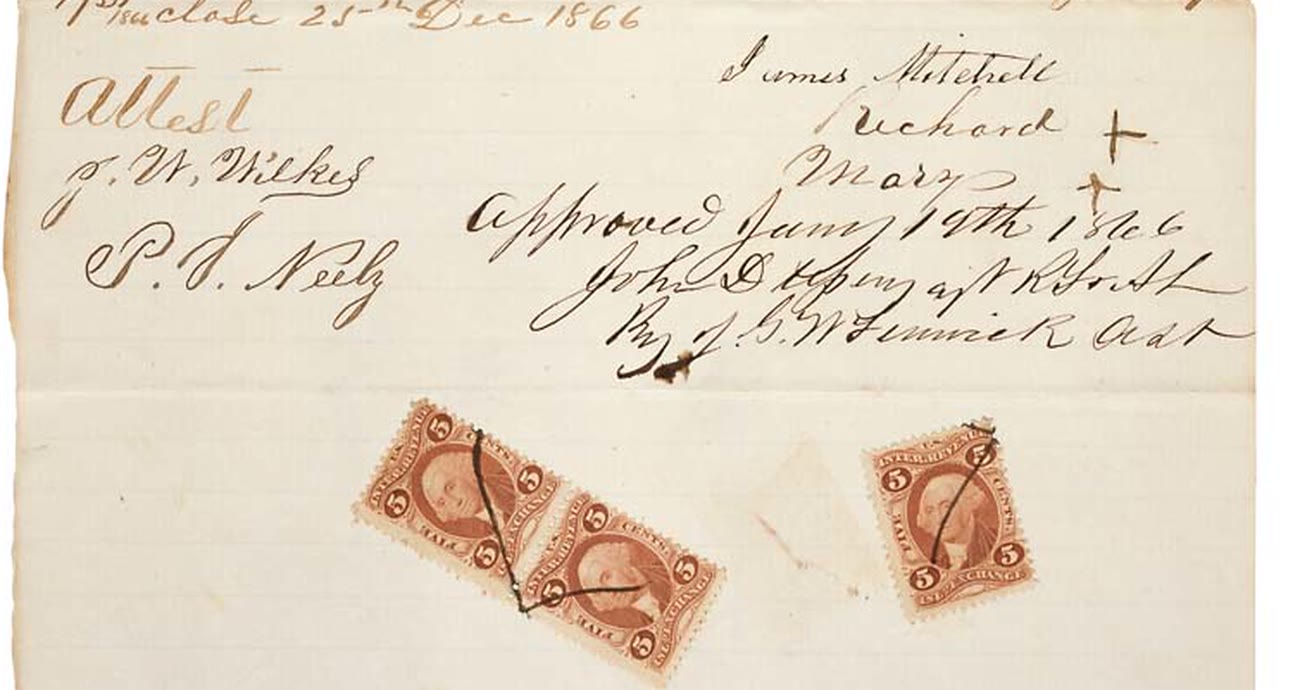
Below the paragraph the employer wrote his name. Under it are two first names, a man's and a woman's, each followed by a cross. A cross beside a written name usually means the person made a mark and someone else wrote the name around it. To the left, under the word "Attest," two witnesses signed. Then comes the Bureau's part: "Approved Jany 19th 1866," followed by an officer's name and title and a second line that begins "By" and ends "Adjt," for adjutant. Both names and the title are hard to read on this small scan, and we will not guess at them.
The three stamps tell their own small story. Each is a five-cent United States internal revenue stamp with a portrait of George Washington and the word "Exchange" along one edge, and they are cancelled with pen strokes so they could not be used again: one V-shaped stroke crosses the joined pair on the left, and the third has its own. Under the internal revenue law of June 30, 1864, an "Agreement or contract" owed a stamp duty of five cents "for every sheet or piece of paper," and five cents more for each additional agreement written on the same sheet. The paper does not say why it carries three stamps. One possibility is that each signer's agreement was taxed separately, but that is a guess, not something the record states.
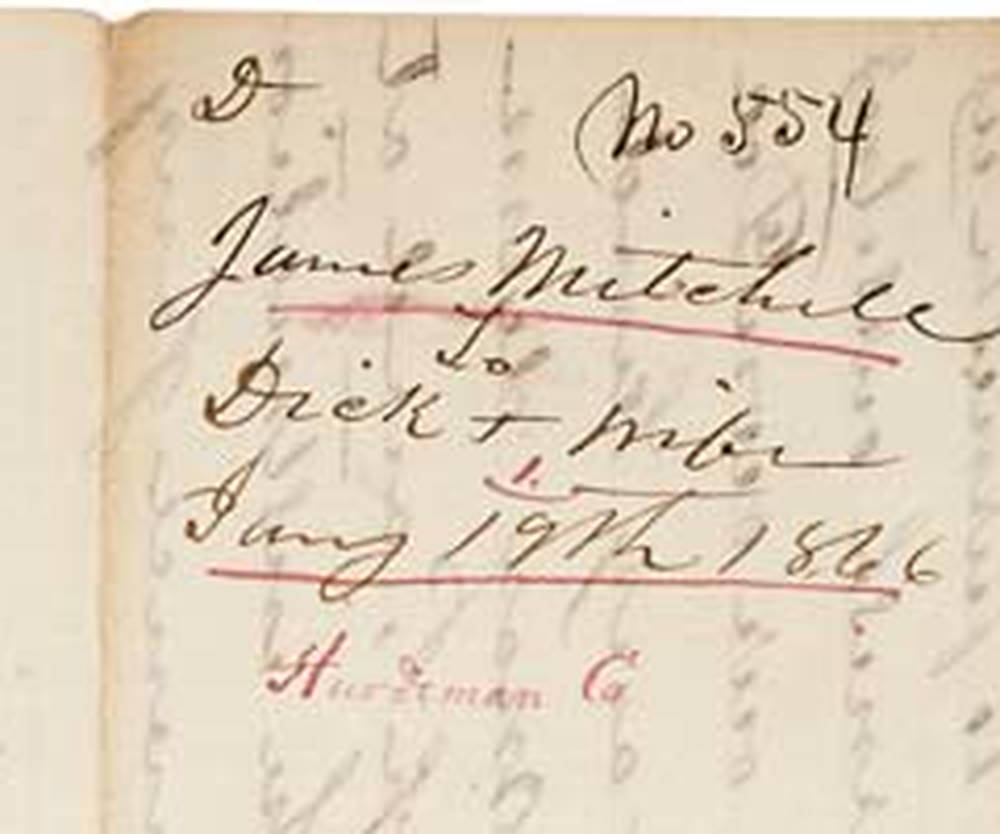
Now turn the sheet over. On the back is a docket, the short label a clerk wrote so a folded paper could be filed and found again. In black ink it reads "No 554," then the employer's name, the word "to," the workers, and "Jany 19th 1866," with "Hardeman Co" added in red. Here the clerk did something worth noticing. On the front the man is listed under his full first name. On the docket he gets a familiar short form of it, and the woman gets no name at all: she is simply "wife."
That matters for anyone searching today, because catalogs are often built from dockets. The National Archives catalog title for this paper follows the back, not the front: the short form and "Wife," exactly as the clerk filed it. The catalog places it among the records of the Bureau's assistant commissioner for Tennessee, the series filmed as microfilm publication M999. If your family was in the South in 1866, search under nicknames as well as full names, and under phrases like "and wife." A woman may be on the front of a contract and missing from every index built from the back.
In 1866 Clinton B. Fisk, who signed his dedication "Assistant Commissioner in the Freedmen's Bureau" at Nashville on March 1, 1866, published a little book of lectures for freedpeople. In the one on contracts he wrote: "It is better to have all important bargains written down and signed by the parties, and that binds them; and if there should be any dispute about what was agreed to, the paper can be produced and read, and that settles the whole matter." This paper does exactly that much. It tells us what was promised for 1866. It does not tell us whether the cotton, the corn and the wheat were ever delivered, or where the two people with the crosses went after Christmas. For that, the next stop would be the same Bureau's local office records for Hardeman County.
- Read a contract for its pay and its costs: who furnished food, clothing and the doctor tells you as much about daily life as the wage does.
- A cross beside a written name usually means a mark, so the name was probably spelled by someone else. Try other spellings and nicknames.
- Turn the paper over. Dockets on the back are how clerks filed papers, and catalog titles are often copied from them, sometimes with shortened names or a woman listed only as "wife."
- Revenue stamps on papers from 1862 to the early 1870s are a clue to the date and type of document; the stamp law lists what each kind of paper owed.
- A contract records a promise, not what happened. Look for the same names in the Bureau's local office records, such as complaint registers and letters, to learn how the year turned out.
- Labor contract, Hardeman County, Tennessee, January 19, 1866. National Archives catalog, NAID 595062 (Records of the Bureau of Refugees, Freedmen, and Abandoned Lands, Record Group 105, series "Contracts"; microfilm publication M999)
- Same contract, page 1 (front) on Wikimedia Commons
- Same contract, page 2 (back, with docket) on Wikimedia Commons
- Freedmen's Bureau: Message from the President transmitting the report of the Commissioner, December 19, 1865 (39th Congress, 1st Session, House Ex. Doc. No. 11), p. 31, section "Kentucky and Tennessee"
- Clinton B. Fisk (1828 to 1890), Plain Counsels for Freedmen (Boston: American Tract Society, 1866), dedication dated Nashville, March 1, 1866, and Lecture XI, Contracts, pp. 47 to 50 (quotation pp. 48 to 49)
- The New Internal Revenue Law, approved June 30, 1864, Schedule B, Stamp Duties, p. 87 ("Agreement or contract")
How to cite this page
Daily Ancestor. "Paid in Cotton, Corn and Wheat." Stories from the Records. https://dailyancestor.com/stories/paid-in-cotton-corn-and-wheat. Last checked 2026-10-01.