 Daily Ancestor
Taller and Lighter at Twenty-Nine
A sailor named Obed Dana Doolittle seems to appear twice in a New Haven customs ledger, seven years apart, and the two descriptions do not agree.
In a bound ledger kept at the customs house in New Haven, Connecticut, a young man named Obed Dana Doolittle appears twice, as far as we can tell. The first time he is 22 years old, 5 feet 5¾ inches tall, with a "dark" complexion. The second time he is 29, about 5 feet 8¼ inches tall, and his complexion is marked the same as the man above him: "light." Same name, same birthplace, same ledger. So did he grow two and a half inches and change color in seven years? Of course not. But the two lines are a good lesson in what these old descriptions were for, and how much weight they can carry.
The ledger is a register of seamen's protection certificates. It began with a law. On May 28, 1796, Congress passed "An Act for the relief and protection of American Seamen." In those years foreign warships, above all British ones, were taking sailors off American ships and forcing them to serve, a practice called impressment, and an American sailor needed a way to prove he was a citizen. The act told the collector of customs in every district to "keep a book or books" and, when a seaman produced proof of his citizenship, to enter his name and give him a certificate. The printed form in the act left room for his age and height, followed by an instruction in brackets: "[describing the said seaman as particularly as may be]". The sailor paid twenty-five cents.
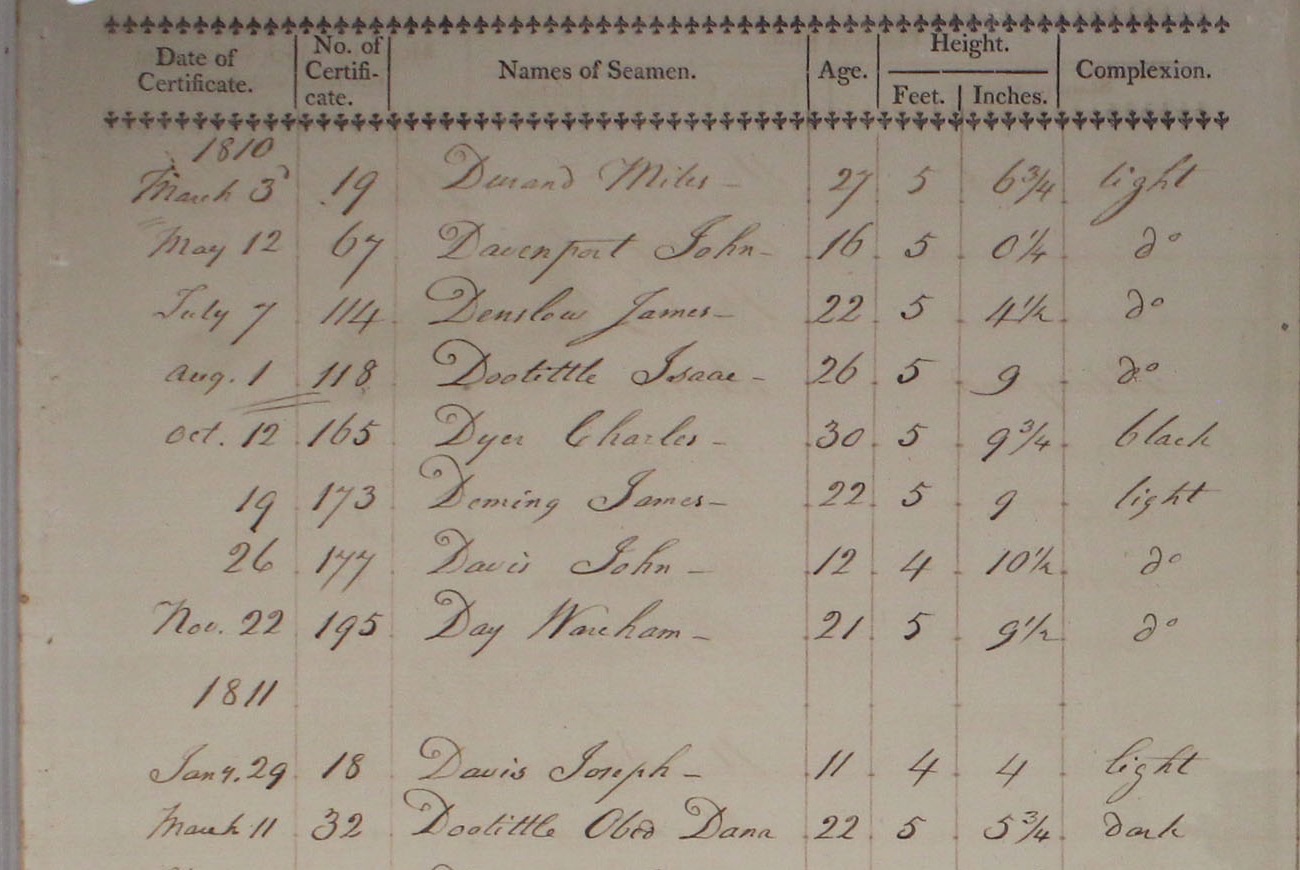
That bracket is the key to every column in the New Haven book. A certificate was only a piece of paper, and paper can change hands. The description was there so that an officer reading it could look at the man in front of him and judge whether the paper belonged to him. Age, height and complexion were simply the quickest things to write down. They were tools for recognizing a face, not a careful record of who a person was.
The New Haven register now sits in the National Archives at Boston, and its pages have been photographed and shared on Wikimedia Commons. The columns are printed across two facing pages: date of certificate, number, name, age, height in feet and inches, complexion, then birthplace by state and town, and finally "Means by which Citizenship has been acquired." Names are grouped by first letter, so the D pages gather Davises, Deans and Demings from many years in one place.
On the D page that covers 1810 to 1812, under March 11, 1811, certificate number 32 went to "Doolittle Obed Dana," age 22, height 5 feet 5¾ inches, complexion "dark," born in Connecticut, in Cheshire. His citizenship came by "Nativity in US," written once at the top of the column and repeated below with ditto marks. Look at the other words in that column on the same page: "light," "dark," and, for two men, "black." On later pages a clerk also wrote "yellow," "sallow" and "ruddy." The column mixed what we would now call skin tone with what we would now call race, written quickly at a counter, and the register shows that men described as "black," born in Connecticut and in other states, also held certificates as citizens by birth.
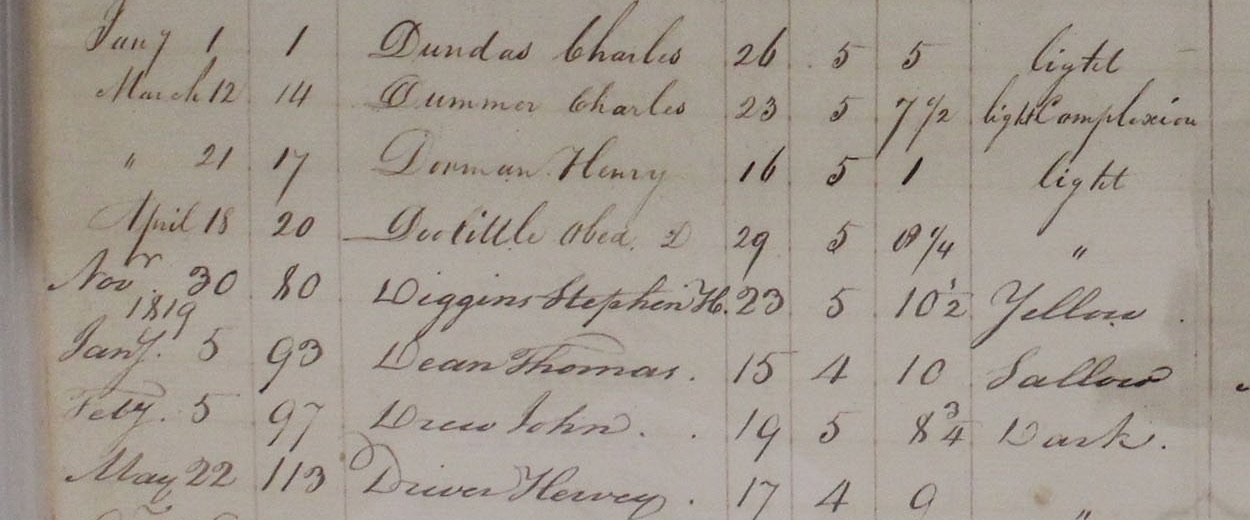
Near the bottom of that same page there is a small surprise. Under the years "1813. 1814" the clerk wrote a single word in the name column: "None." No D names were entered in those two years. The war with Britain that began in 1812 was under way, and that is probably part of the reason, though the ledger itself does not say why.
Turn to the next D page. Under April 18, 1818, certificate number 20 went to a man whose surname is written so loosely that it could be read "Doolittle" or something close to it, followed by "Obed. D". He was 29 and born in Cheshire. His height is 5 feet and an inch figure that looks like 8¼, though the 8 may have been written over another number. In the complexion column there is only a ditto mark, under the word "light" in the line above. The handwriting on this part of the page looks different from the 1811 entry, so a different clerk may have written it.
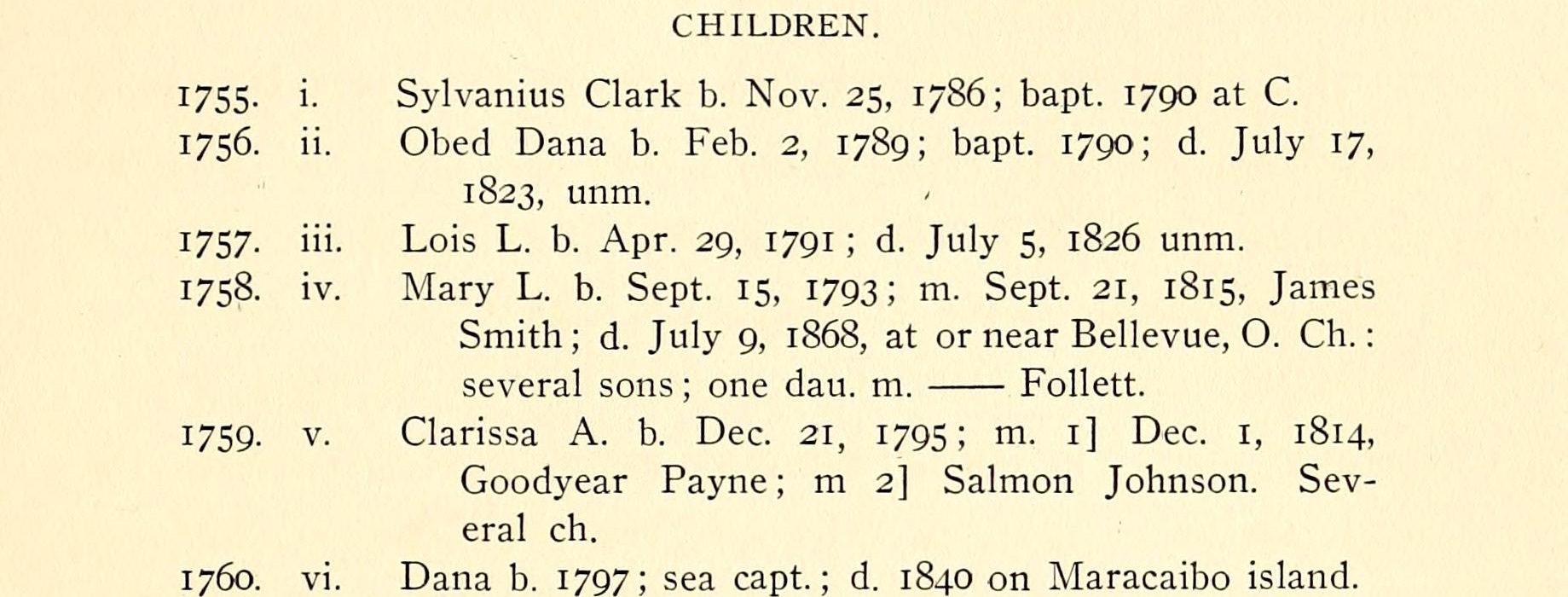
Are these two lines the same man? The register cannot say, but a family history can help. The Doolittle Family in America, a genealogy published in parts from 1901 to 1908 and now free on the Internet Archive, has an entry for Obed Doolittle Jr., born in 1764 in Wolcott, Connecticut, who enlisted from Cheshire in the Revolution and later lived three and a half miles west of "C.", the book's short form for Cheshire. Second among his children is "Obed Dana b. Feb. 2, 1789; bapt. 1790; d. July 17, 1823, unm." A man born in February 1789 would be 22 in March 1811 and 29 in April 1818, exactly the ages in the ledger. The name is unusual and the birthplace fits. This is an inference, not proof, but it is a strong one.
The same book lists a younger brother: "Dana b. 1797; sea capt.; d. 1840 on Maracaibo island." The book does not say that Obed Dana went to sea; the customs ledger is the record that does. If the identification is right, the two sources together suggest a family from the hills near Cheshire with at least two sons who made a living on the water.
The genealogy tells us one more thing. The father died at the home of his son Jesse in Waterbury on October 7, and the book prints the year as "1753 a. 89." That cannot be right for a man born in 1764. His age at death points to 1853, and 1753 happens to be the number of an entry two pages earlier in the book. Printed books make mistakes too. The book says he was buried near the old home at Woodtick, in Wolcott, with his wife and three unmarried children, one of them named Obed. That Obed is almost certainly Obed Dana, the only Obed among the children, who died unmarried in 1823 at the age of 34; the book does not say where he died. Whether he is also our sailor rests on the match of name, birthplace and ages above.
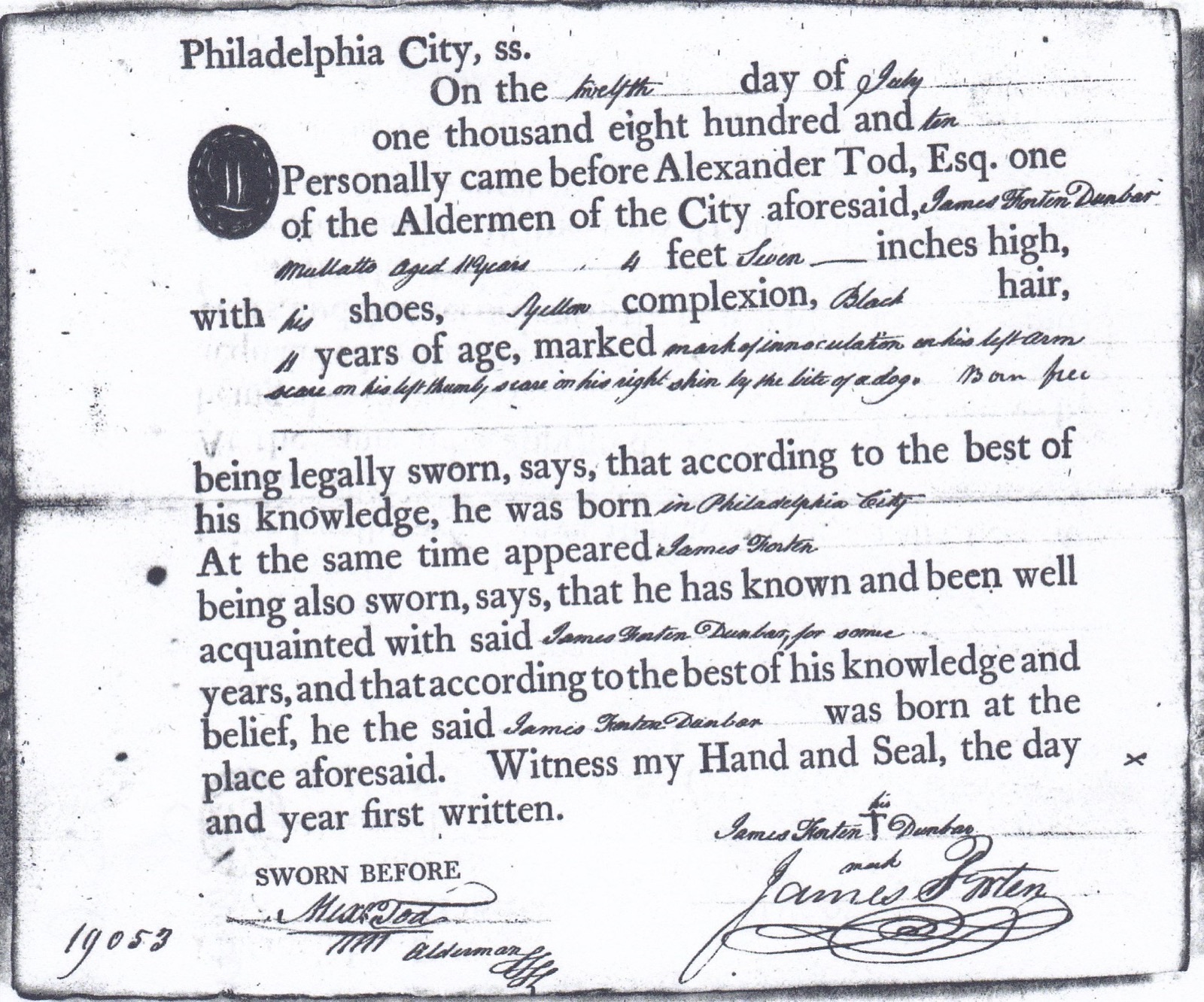
So what about the extra two and a half inches and the change from dark to light? The records cannot settle it, but they offer clues. A sworn proof of citizenship from Philadelphia, made in 1810, asks how many inches high a seaman stood "with his shoes," so at least some descriptions were taken with shoes on. The New Haven ledger does not say how its clerks measured. Complexion was one person's quick judgment, and a sailor's face could look quite different after months at sea than after a winter ashore. If these are the same man, two clerks, seven years apart, simply saw him a little differently. That is normal for these records, and it is why one description should never be read as a measurement.
If you find an ancestor in a protection register or a crew list, treat the age as a clue to the birth year, the birthplace as a lead to follow, and the height and complexion as a sketch. Then look for him a second time. Obed Dana Doolittle's two entries, side by side, tell us more than either one does alone.
- A protection certificate or register entry describes a man so that someone could recognize him, not to record who he was. Read height and complexion as a quick sketch, not a measurement.
- Look for the same sailor a second time. Registers are often grouped by first letter, so later entries for the same man can be on the next page.
- Use the age to estimate a birth year, then test it against a family history or church record. When the birth date fits both entries exactly, you have a strong (but still inferred) match.
- Printed genealogies make mistakes. If a death year does not fit the age given, trust the arithmetic and note the error.
- Watch the ditto marks. In these ledgers a single word at the top of a column, like "Nativity in US" or "light," can stand for every line below it.
- Register of Seamen (protection certificates granted by the Collector of Customs, New Haven, Connecticut, 1803 to 1841), National Archives at Boston, scan page 37 (ledger page 34): entry of March 11, 1811, and "1813. 1814 None"
- Same register, scan page 38 (ledger page 35): entry of April 18, 1818; also scan pages 35, 36, 39 and 40 (other D pages) read
- William Frederick Doolittle, The Doolittle Family in America, part 4 (parts 1 to 7 published 1901 to 1908), pages 361 to 363, entry 828 (Obed Doolittle Jr.) and children 1755 to 1765
- An Act for the relief and protection of American Seamen, May 28, 1796, United States Statutes at Large, vol. 1, pages 477 to 478 (4th Congress, 1st Session, Chapter 36)
- Proof of citizenship sworn at Philadelphia, July 12, 1810 (National Archives, RG 36, Proofs of Citizenship), Wikimedia Commons file page
How to cite this page
Daily Ancestor. "Taller and Lighter at Twenty-Nine." Stories from the Records. https://dailyancestor.com/stories/obed-doolittle-taller-and-lighter. Last checked 2026-10-01.