 Daily Ancestor
Two Annie Moores
For years the first immigrant through Ellis Island was given another woman's life. A single census column kept saying so.
On New Year's Day 1892 the new federal immigration station on Ellis Island opened, and the first person registered there was a girl from County Cork named Annie Moore. Her name went into history books, onto two bronze statues and into a song. For decades, though, the life story told about her after that morning belonged to someone else. The mistake was finally untangled not by a new discovery about Ellis Island, but by the most ordinary record a family historian uses: the census.
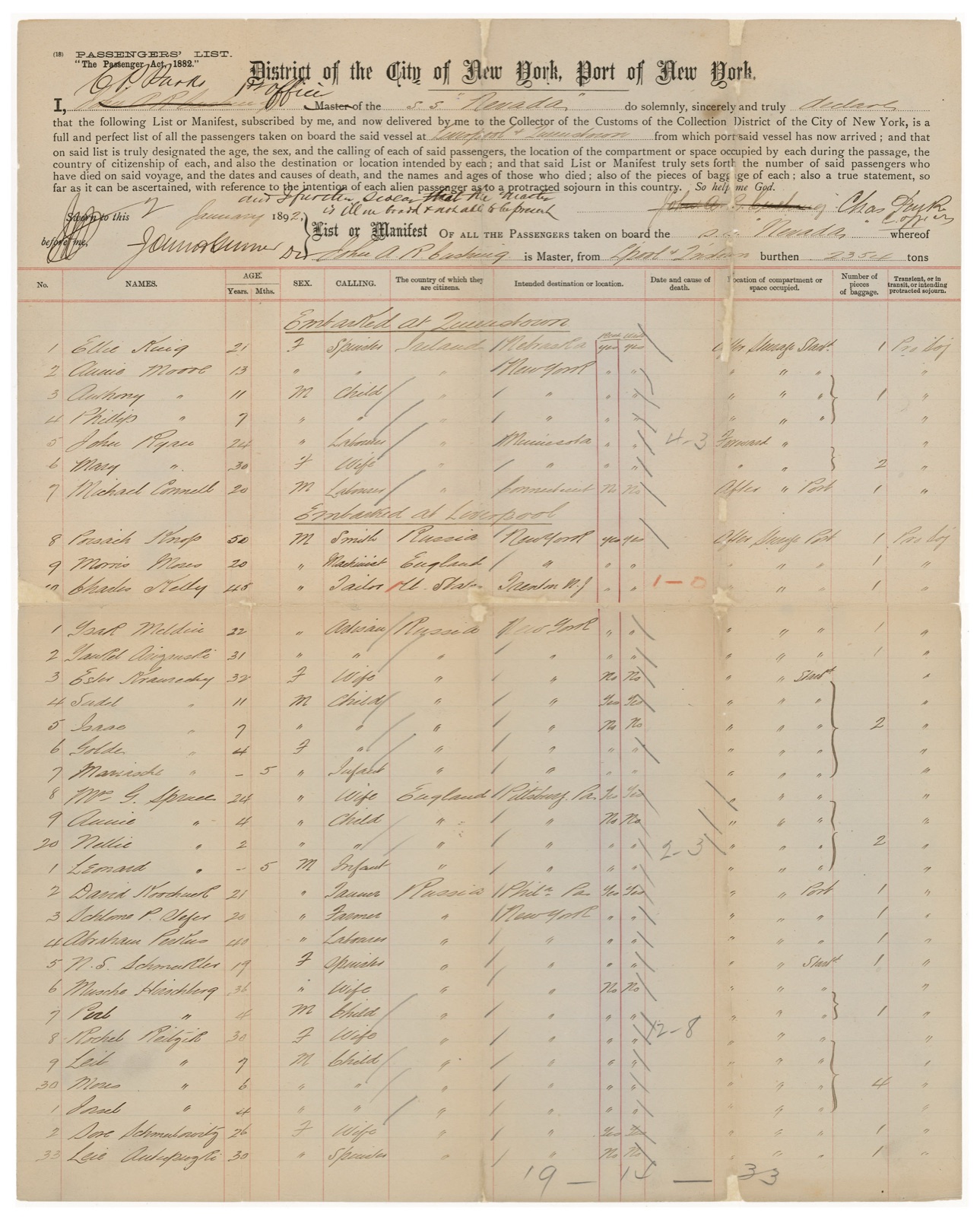
Start with the record that made her famous, the ship's list. The steamship Nevada had sailed from Liverpool, calling at Queenstown (now Cobh), and her passengers were listed on a printed form called the Passengers' List, required under "The Passenger Act, 1882." The form expects the ship's master to sign it, but on this one the master's name is struck out and the ship's first officer signed instead, adding by hand that the master was ill on board and could not be present. He swore to it on January 2, 1892, the day after Annie landed. Under the handwritten heading "Embarked at Queenstown," line 2 reads "Annie Moore," age 13, followed by her two younger brothers, 11 and 7, each a "Child." Most of her other entries are ditto marks: female, like the woman above her; "Spinster" as her calling, which on a list like this simply means an unmarried woman; country "Ireland." Her destination is written out: "New York." Two narrow columns added by hand ask "Read" and "Write," and the answers are dittos of "yes." A curly bracket joins the three Moore children to a single piece of baggage.
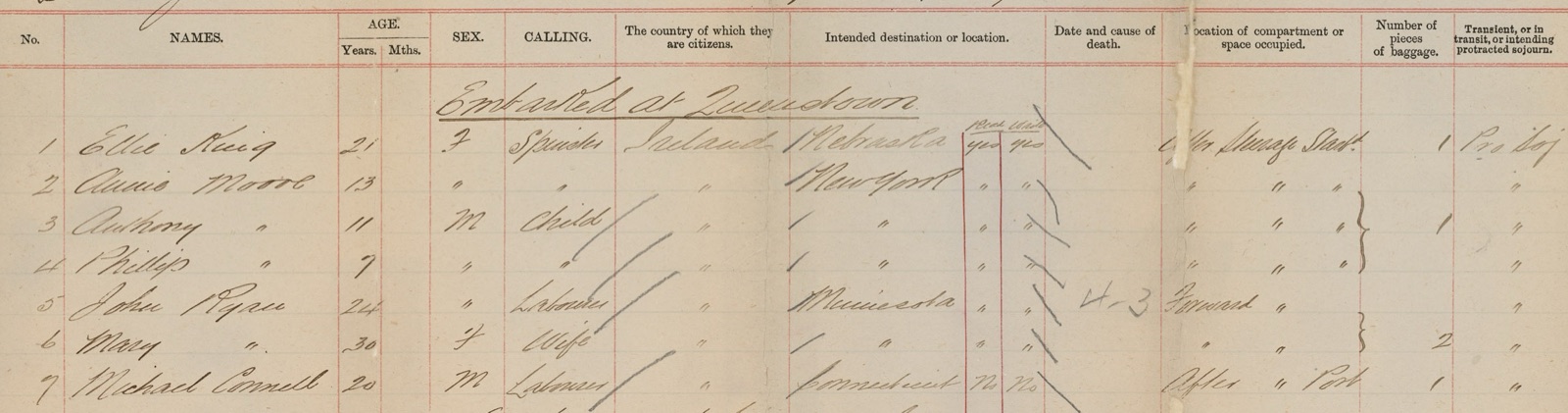
Notice something small: Annie is not on line 1. The first line belongs to a 21-year-old woman named King, bound for Nebraska. Readers of Megan Smolenyak's genealogy blog pointed this out in 2006, and she answered that the newspaper reports of the opening show Annie was the first person who actually entered, while some articles also mention the passenger listed first on the manifest. A manifest records the order people were written down on the ship, not the order they walked through a door.
Then there is her age. The manifest says 13. The New York Times of January 2, 1892, called her "a little rosy-cheeked Irish girl" of fifteen, and said she and her two younger brothers had come to join their parents at 32 Monroe Street. The Statue of Liberty-Ellis Island Foundation later wrote that she was 14 when she left Queenstown and turned 15 the day she landed. Her grave marker, placed in 2008, gives her birth date as April 24, 1874, which would make her 17. A History.com article says the New Year's birthday was not true and that she was not 15, adding that she may have given that age herself to save money on the passage. Four sources, four ages. Ages on records like these came from the travelers themselves, from reporters who heard them second hand, and from later writers repeating both.
Now the wrong turn. For years books and ceremonies told how Annie Moore went west, married a man named O'Connell, and died in a streetcar accident in Fort Worth, Texas. Genealogist Megan Smolenyak, researching her for a documentary, set out to document that life, and posted her evidence online in 2006. Here is what the records said about that woman.
In the 1880 census she was already living in Texas, more than a decade before the Nevada sailed, and her birthplace was given as Illinois. Smolenyak points out a trap here too: an index of that 1880 page lists the Irish-born parents as born in Indiana, but the page itself says Ireland. In 1900 the family was still in Hill County, Texas, the mother now widowed, and again the daughter was born in Illinois. A 1905 Hill County marriage record showed Anna Moore becoming Anna O'Connell. A 1907 birth record for one of her daughters answered "native" for the birthplace of both parents. The 1910 census in Clovis, New Mexico, gave Illinois once more, though that enumerator wrote that her husband was born in Ireland when, according to Smolenyak, he was born in Indiana. In 1920 a household in Clovis seemed to be headed by Pat O'Connell, but the sex column says female: it was Anna, using her husband's name after his death. Her Texas death certificate, from 1923, is so faint that two researchers had to read the microfilm directly; both thought the birthplace looked like Illinois.
Any one of those entries could be an error. Census takers made mistakes, and the 1910 page proves this one did. But Illinois appeared again and again, across four decades, and not one record Smolenyak found said Ireland. Smolenyak's conclusion was that this was a different Annie Moore, about the same age, with the same name and nothing else in common. She traced how the confusion began to a daughter who, in later life, came to believe her mother had been the Ellis Island girl. The family story was sincere. The records did not support it. Even the death date drifts: History.com puts the streetcar accident in 1923, matching the death certificate, while Wikipedia says 1924.
So where was the real Annie? According to Smolenyak's research, reported by History.com and The Irish Times, she never left New York. In 1895 she married the son of German immigrants and became Anna Schayer, and she lived on the Lower East Side, at one point on Rutgers Street. Here the secondary sources disagree again: The Irish Times in 2008 called him a baker, while Wikipedia and History.com say he worked at the Fulton Fish Market. She died of heart failure on December 6, 1924, at about 50, and was buried in Calvary Cemetery in Queens in an unmarked grave.
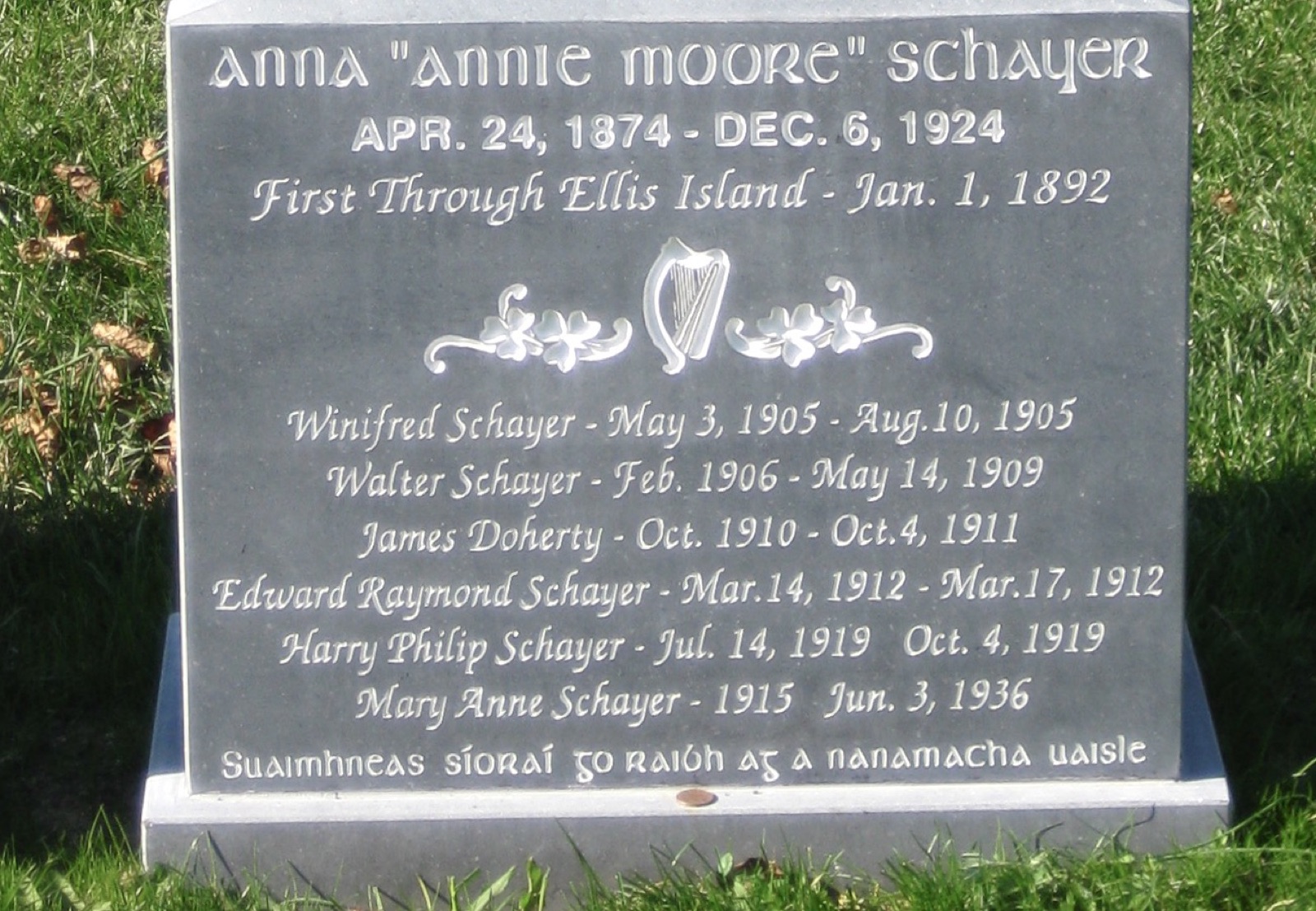
That grave now has a Celtic cross, unveiled by her descendants in October 2008. Its base reads "Anna 'Annie Moore' Schayer, Apr. 24, 1874 - Dec. 6, 1924, First Through Ellis Island - Jan. 1, 1892," and below are six more names. Five are small children who died between 1905 and 1919, the youngest at three days, the oldest at three years; one of them, a James Doherty, has a different surname that the stone does not explain. The sixth is a daughter who died as a young woman in 1936. Even here the sources do not quite agree: Wikipedia says eleven children, five surviving to adulthood, while History.com says at least ten, five of whom died before the age of three. A stone placed in 2008 is a modern record, worth checking against older ones, but it gathers in one place what the family and researchers had found.
The two Annies were never really hard to tell apart. One was born in Illinois and was in Texas by 1880. The other stepped off a barge at Ellis Island in 1892 and spent her life on a few blocks of the Lower East Side. The difference was written in the birthplace column all along. It just took someone willing to read every census, not only the first one, and to believe the pattern over the legend.
- Pull every census, not just one. A single odd birthplace can be a clerk's slip; the same answer across four or five records from different years is evidence.
- Always look at the page, not only the index. The 1880 index turned Ireland into Indiana; the original said Ireland.
- Expect ages to disagree. The manifest, a newspaper, the Ellis Island foundation and a gravestone gave Annie Moore four different ages; record them all and note who supplied each.
- Family stories deserve respect and testing. A sincere belief can still attach your ancestor to the wrong person with the same name.
- Use the order of a list carefully. Line 1 on a manifest is the first person written down, not necessarily the first person through the door.
- Annie Moore Arrival, passenger list of the S.S. Nevada (Wikimedia Commons, from the National Archives)
- Megan Smolenyak, Wrong Annie Moore (Megan's Roots World, Aug. 1, 2006)
- Megan Smolenyak, Wrong Annie Moore Photo Album (Honoring Our Ancestors)
- Megan Smolenyak, $1,000 Reward for Ellis Island's Little Orphan Annie, with comments (July 17, 2006)
- Annie Moore, with the New York Times article of Jan. 2, 1892 (Statue of Liberty-Ellis Island Foundation, archived 2010)
- Christopher Klein, Remembering Annie Moore, Ellis Island's First Immigrant (History.com, archived 2022)
- Barry Roche, Generation saga: Relatives of Annie Moore traced (The Irish Times, March 18, 2016)
- Lucy Kennedy, Ellis Island's first immigrant honoured (The Irish Times, Oct. 13, 2008)
- Annie Moore (immigrant), Wikipedia
- Annie Moore grave marker (Wikimedia Commons)
How to cite this page
Daily Ancestor. "Two Annie Moores." Stories from the Records. https://dailyancestor.com/stories/two-annie-moores. Last checked 2026-10-01.