 Daily Ancestor
Fourteen Births and Two Williams
Two stained pages from an Indiana family Bible hold a wedding, fourteen children, three children's deaths, a volunteer of 1861, and a puzzle about which William died.
Two loose, water-stained sheets at the Indiana State Library carry a printed heading, FAMILY RECORD, and a ruled grid of columns for Marriages, Births and Deaths. The library's catalog calls them simply the Barnes family Bible record and says they hold "genealogical information from a Bible belonging to the Barnes family." No family entry names a town. No parents are named beside any child. And yet, read slowly, these two pages hold one wedding, fourteen births, four deaths, a soldier, and a small puzzle about which of two men named William is being mourned.
Start where the family started: the Marriages column. It has a single entry: "William Barnes and Elisabeth Crossen was maried in October the 3 1833." Notice two things before you notice the names. First, the spelling: "Elisabeth," "maried." Family records were written by whoever held the pen, and spelling was personal, so search for Crossen under other spellings too. Second, the ink. This line is in a pale greenish ink, with the letters outlined by tiny dots, unlike anything else in the Births column beside it except one line we will come to shortly. Different ink is your first clue that an entry was not written at the same moment as its neighbors.
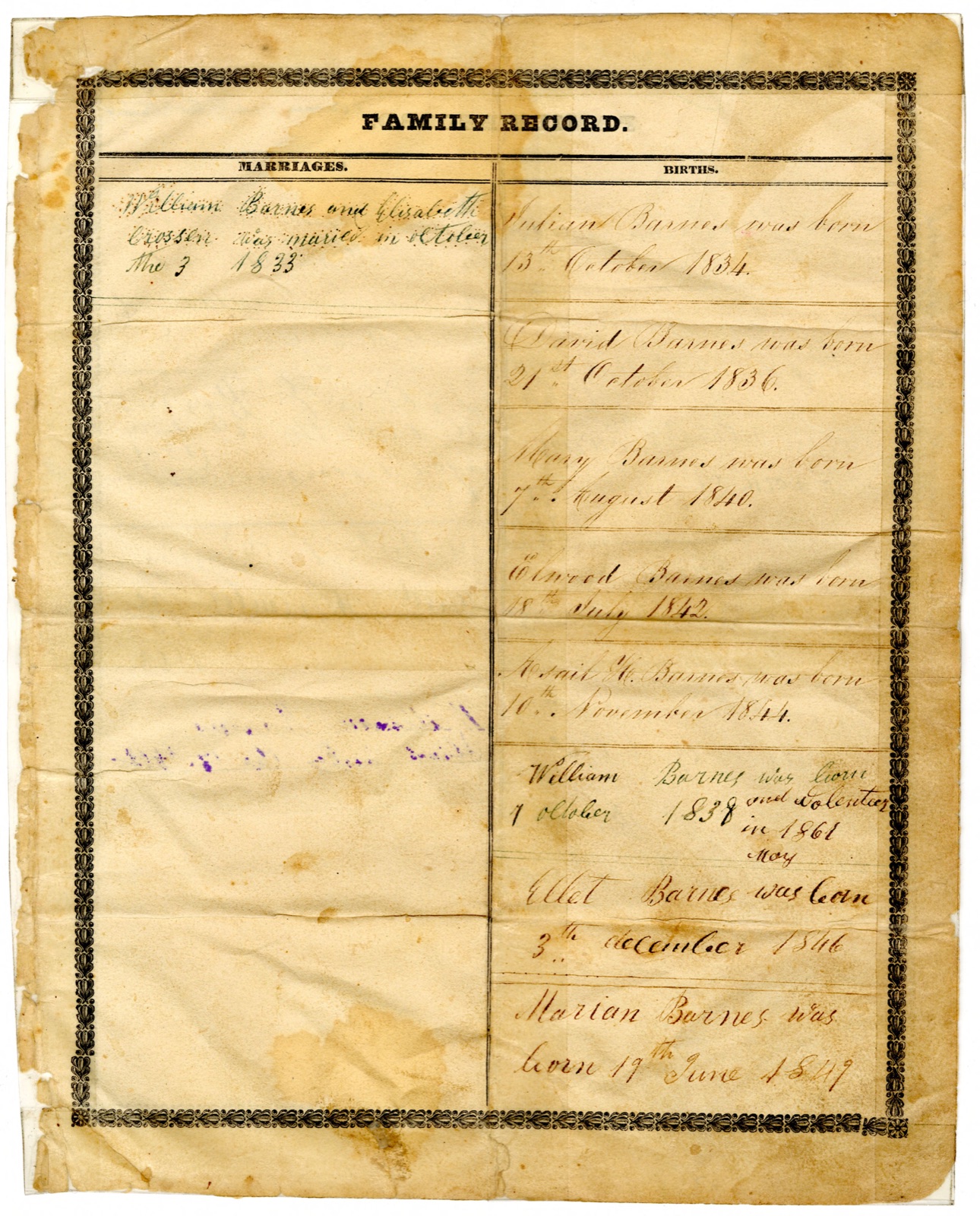
The Births column on the same page lists eight children. In order down the page: Julian Barnes, born 13 October 1834; David, 21 October 1836; Mary, 7 August 1840; Elwood, 18 July 1842; a child whose first name looks like Asail, with the initial H., born 10 November 1844; then William, born 1 October 1838 (the day could also be read as 7); Ellet, 3 December 1846; and Marian, 19 June 1849. The first five are written in one neat, even hand, each with "was born" and the day, month and year in the same pattern.
Look again at William. He was born in 1838, between David and Mary, but he is written below Asail, who was born six years later. His line is in the same greenish ink as the marriage entry. When a birth is out of order like this, the most likely explanation is that it was added afterward, perhaps when someone noticed the gap. And someone added more: after "1838" a brown-ink hand wrote "and Volenteer in 1861 May." The page tells you that this William volunteered in May 1861. It does not say for which side or which regiment, but it gives you a month and year to take to the service records. Ellet and Marian, the last two births on the page, are in other hands again, so the page was filled by several writers over the years.
The other sheet has a Births column and a Deaths column. Its births continue the family, again with no parents named: James Alen Barnes, born 17 March 1852; a boy written as "Washing" Barnes (probably short for Washington; the writer stopped there, and a fold runs through the line), born 8 August 1854, where the writer struck through a first attempt at the day; Morten Silvester Barnes (the middle name could also be read Selvester), 21 November 1855; John J. Barnes, 24 September 1857 (the middle initial is hard to read); Dillin E. Barnes, 29 April 1860; and Albert C. Barnes, 11 September 1862. These are in several different hands, some fresh and dark, one faint and shaky.
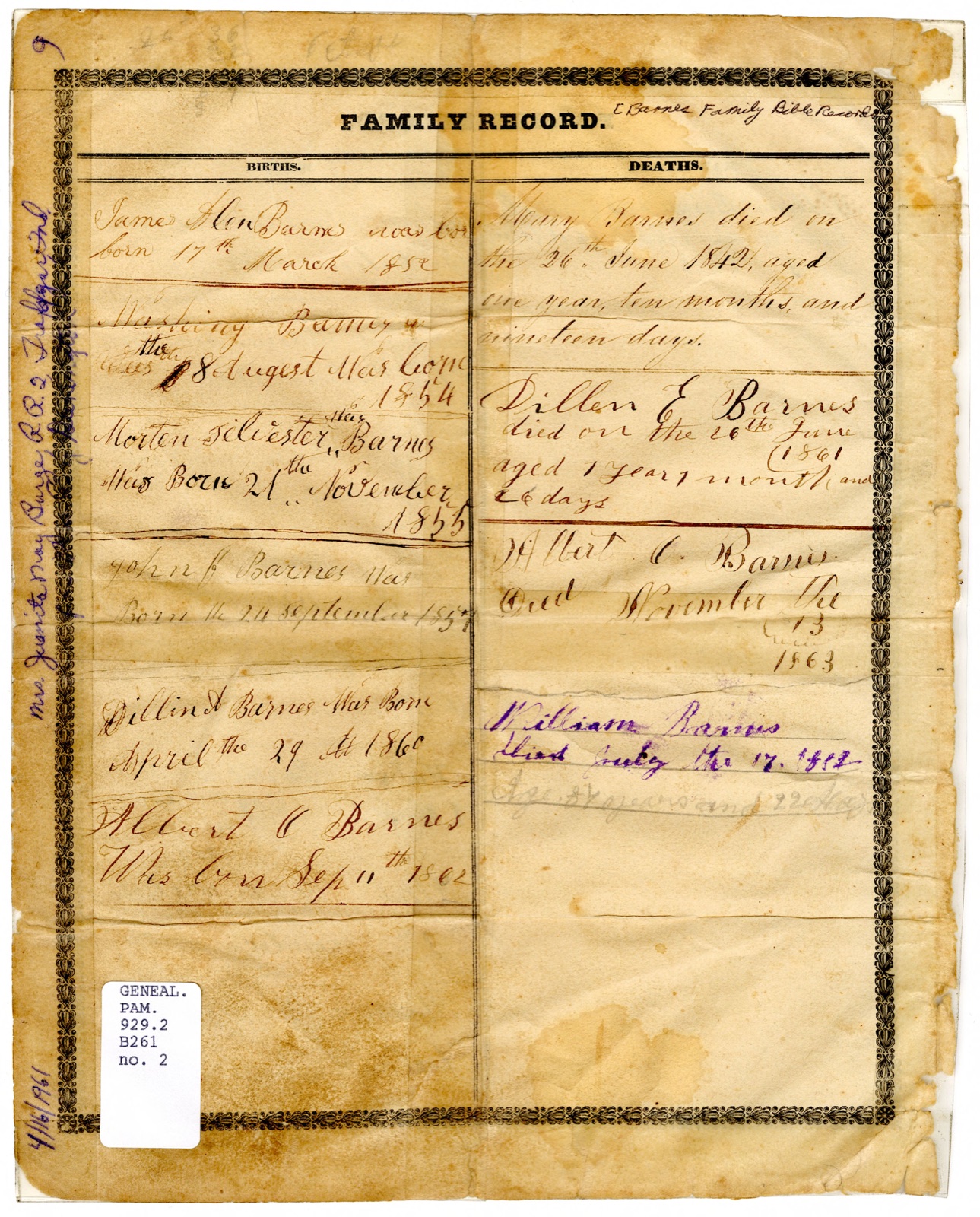
Fourteen births from 1834 to 1862 is a span of twenty-eight years. One couple could have had all fourteen if Elisabeth married young, and the births come about every two years from start to finish. But the record never says so. It is just as possible that a second wife, or a grown son's family, used the same Bible. Treat "all of William and Elisabeth's children" as a theory to test against census records, not a fact.
Now the Deaths column, which is where a family Bible earns its keep. The first entry reads: "Mary Barnes died on the 26th June 1842, aged one year, ten months, and nineteen days." You can check this against her birth on the other page. Start at 7 August 1840, add one year (7 August 1841), add ten months (7 June 1842), add nineteen days: 26 June 1842. It matches to the day. When an age at death agrees exactly with a recorded birth, that is good evidence both entries are about the same child. The pages also show, side by side, that her brother Elwood was born on 18 July 1842, twenty-two days after Mary died.
The second death is "Dillen E Barnes died on the 26th June 1861 aged 1 year 1 month and 26 days." Notice he is "Dillin" in the Births column and "Dillen" here; the same child can be spelled two ways on one sheet. Run the arithmetic: 29 April 1860, plus one year, plus one month, plus twenty-six days, gives 24 June 1861, not the 26th. Two days off. Perhaps the age was figured carelessly, or the last figure of "26 days" is really an 8: twenty-eight days would land exactly on 26 June. Small mismatches like this are normal. Note them instead of quietly picking one.
The third death is short: "Albert C. Barnes Died November the 13 1863." No age is given, but his birth on the same page, 11 September 1862, tells you he was fourteen months old.
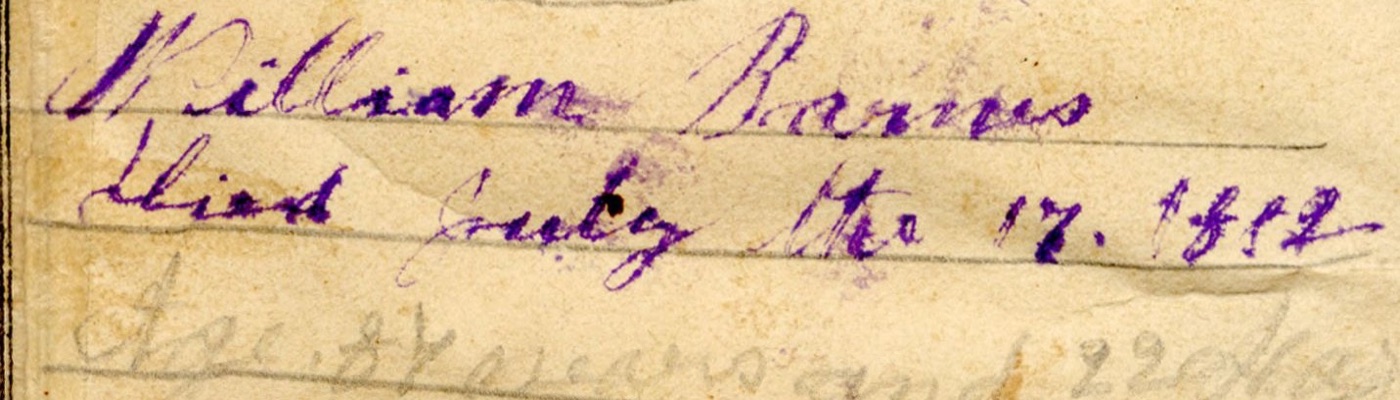
The last death is the puzzle. In purple ink, in a hand found nowhere else on either page, someone wrote "William Barnes Died July the 17. 18_2." The third figure of the year is hard to read: it is not shaped like the clear 8 beside it, and could be a 7, making it 1872, or something else. Read it yourself. Under it, in faint pencil, is a line that seems to say "Age 8_ years and 22 days", with the second digit of the age unclear. Which William? The entry does not say, and the writer added no Sr. or Jr., the usual way records tell a father from a son of the same name. But the pencil age settles it as well as anything can. The son born in 1838 would have been in his thirties or forties, not his eighties. And a man born in early October who died on 17 July would be some years and nine months old, never "years and 22 days." An age in the eighties points to the older William, the one who married Elisabeth in 1833. That is a deduction, so it belongs in your notes as one, with the reason written beside it.
Finally, look at the edges. Up the left margin, in blue ink from a much later time, someone wrote a name and rural route address: "Mrs. Juanita May Burge, R.R. 2," followed by what looks like "Trafalgar, Ind.", a second line too faint to read, and a date, 4/16/1961. A library label reads "GENEAL. PAM. 929.2 B261 no. 2." These marks belong to the record's later life, not to the Barnes family itself. The page does not say who Mrs. Burge was, so do not assume she was a descendant, but a name like this is often the thread that leads to whoever kept the Bible.
So what do two pages give you? A marriage date to the day, fourteen children with exact birth dates, a soldier with a month of enlistment, three young children's deaths you can date precisely, and an old man's death with an age that can be turned into a birth year. What they do not give you is just as important: no parents named for any child, no places in the family's own entries, and no proof that every entry was written when it happened.
- Check every age at death against the recorded birth. Mary's age matches to the day; Dillen's is two days off. Both results tell you something.
- Watch the ink and the handwriting. An entry in a different ink, or out of date order like William's 1838 birth, was probably added later, from memory or from another source.
- A family Bible rarely names a child's parents. Fourteen births on the same pages are a family group to test in the census, not proof of one mother.
- When two people share a name, look for any detail that separates them. Here a faint pencil age, and its odd count of days, are the clues to which William died.
- Read the margins too. Later notes, owners' names and library call numbers trace where the record traveled and can lead you to living relatives or other copies.
How to cite this page
Daily Ancestor. "Fourteen Births and Two Williams." Stories from the Records. https://dailyancestor.com/stories/the-barnes-bible-two-williams. Last checked 2026-10-01.