 Daily Ancestor
Solomon Johnson's Mark
A man who could not sign his name left one page in 1812, and it names his wife, three children, his livestock, and a man who owed him seventy dollars.
On the sixth day of February 1812, a man in Johnston County, North Carolina, had his last wishes written down on a single sheet of paper. He did not write them himself. At the bottom, where his name appears, there is no signature in his own hand, only a short hooked stroke with the words "his" above it and "marke" below. That one page is nearly all we know of Solomon Johnson. Read slowly, it tells us a surprising amount: who was in his family, what he owned, whom he trusted, and even which of the men around him could write.
The page survives on microfilm at the State Archives of North Carolina in Raleigh, and a scan of it is free to view on Wikimedia Commons. The quotations below keep the will's own spelling where it is clear; a few blotted or doubtful words are given in plain modern form.
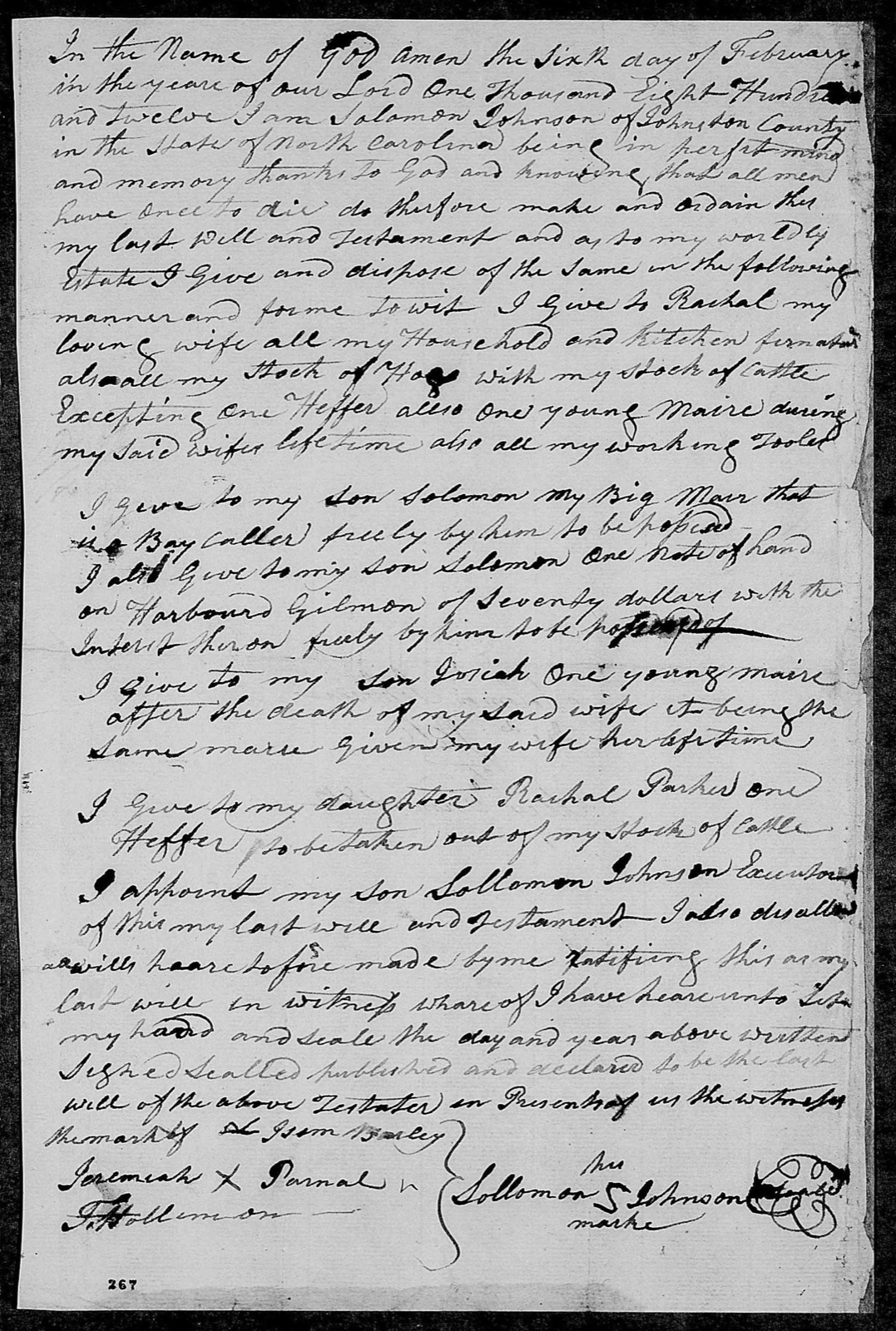
It opens with the formula found in thousands of wills of the period: "In the Name of God amen the Sixth day of February in the yeare of our Lord One Thousand Eight Hundred and twelve I am Solomon Johnson of Johnston County in the State of North Carolina being in perfect mind and memory thanks to God and knowing that all men have once to die do therfore make and ordain this my last Will and Testament." Don't skip past this preamble. It gives you the exact date, the county, and the full name, and "perfect mind and memory" is his statement that he was of sound mind, which a valid will required. Notice too what it does not say. Many testators wrote that they were "weak in body" or "sick". Solomon's will says nothing about his health either way, so the page alone cannot tell us whether he was ill.
Next comes "and as to my worldly Estate I Give and dispose of the same in the following manner and forme to wit". "To wit" means "namely", the same job done by the abbreviation viz. in other wills. It is a signal that the list of gifts begins.
The first gift goes to his wife: "I Give to Rachal my loving wife all my Household and Kitchen furniture also all my Stock of Hogs with my Stock of Cattle Excepting one Heffer also one young Maire during my said wifes life time also all my working Tooles." So we learn her name, Rachel (spelled Rachal), and we learn that she was alive in February 1812. We also get a quick picture of the household: furniture for the house and kitchen, a herd of hogs, a stock of cattle, a young mare, and working tools. In legal language all of these are chattels, movable property, and giving them away by will is to bequeath them. Watch the phrase "during my said wifes life time": it limits the gift. Rachel could use the young mare as long as she lived, but the will had already decided where the mare would go afterward.
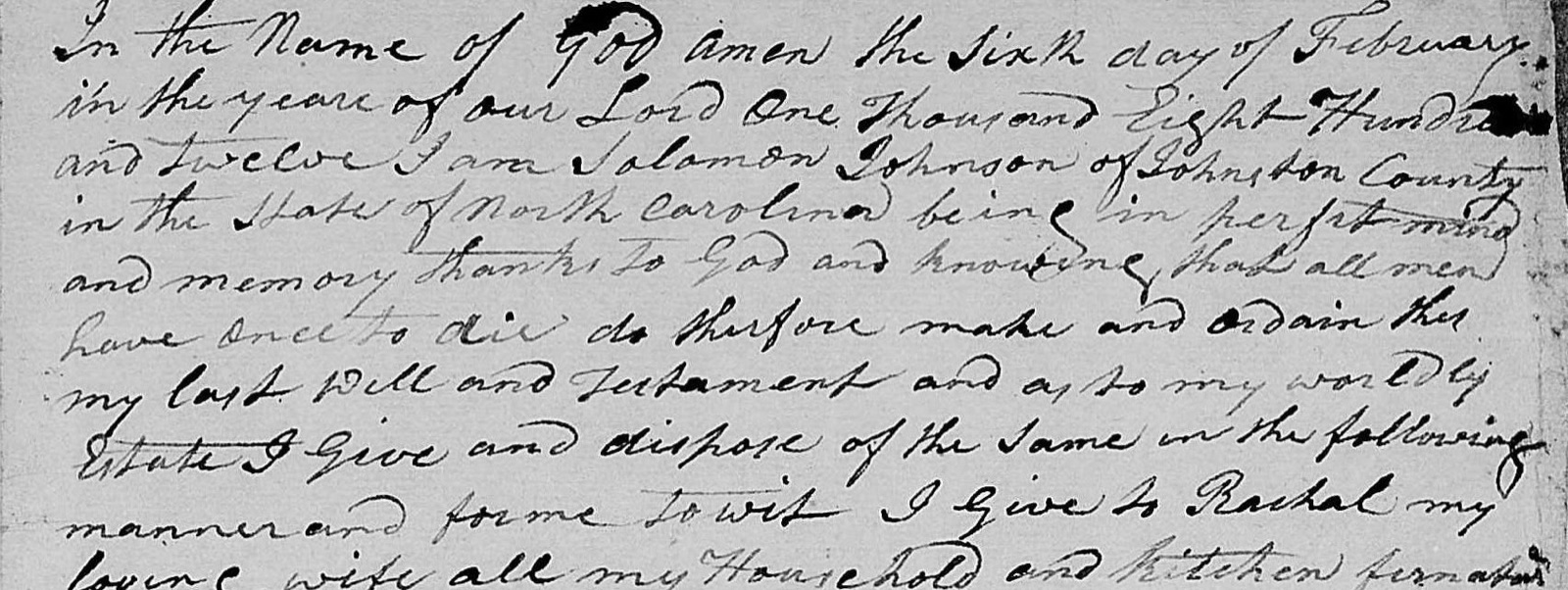
That answer comes a few lines down: "I Give to my Son Josiah One young maire after the death of my said wife it being the same maire Given my wife her lifetime." So Josiah is a son, and the same animal is promised twice, first to the mother for life and then to the son. Skim too fast and you might count two horses.
Between those two lines sit the gifts to the son who shares his father's name: "I Give to my Son Solomon my Big Maire that is a Bay coller freely by him to be possesed", a large bay-colored mare, and "I also Give to my Son Solomon One Note of hand on Harbourd Gilmon of Seventy dollars with the Interest thereon." A note of hand is a written promise to pay. In other words, a man named Gilmon owed Solomon Johnson seventy dollars plus interest, and the right to collect it passed to the son. The debtor's given name is hard to read; it looks like "Harbourd", but treat that spelling as a reading to check. Still, a debt is a wonderful clue. It names a man he did business with and points to court minutes or account books that may mention both men.
Then the daughter: "I Give to my daughter Rachal Parker one Heffer to be taken out of my Stock of Cattle." This explains the earlier "Excepting one Heffer": one young cow was held back from the wife's share so it could go to the daughter. Her married name, Parker, is the most useful single word on the page for a family historian. It tells you she had married by 1812, most likely to a man named Parker, which gives you a new surname to search.
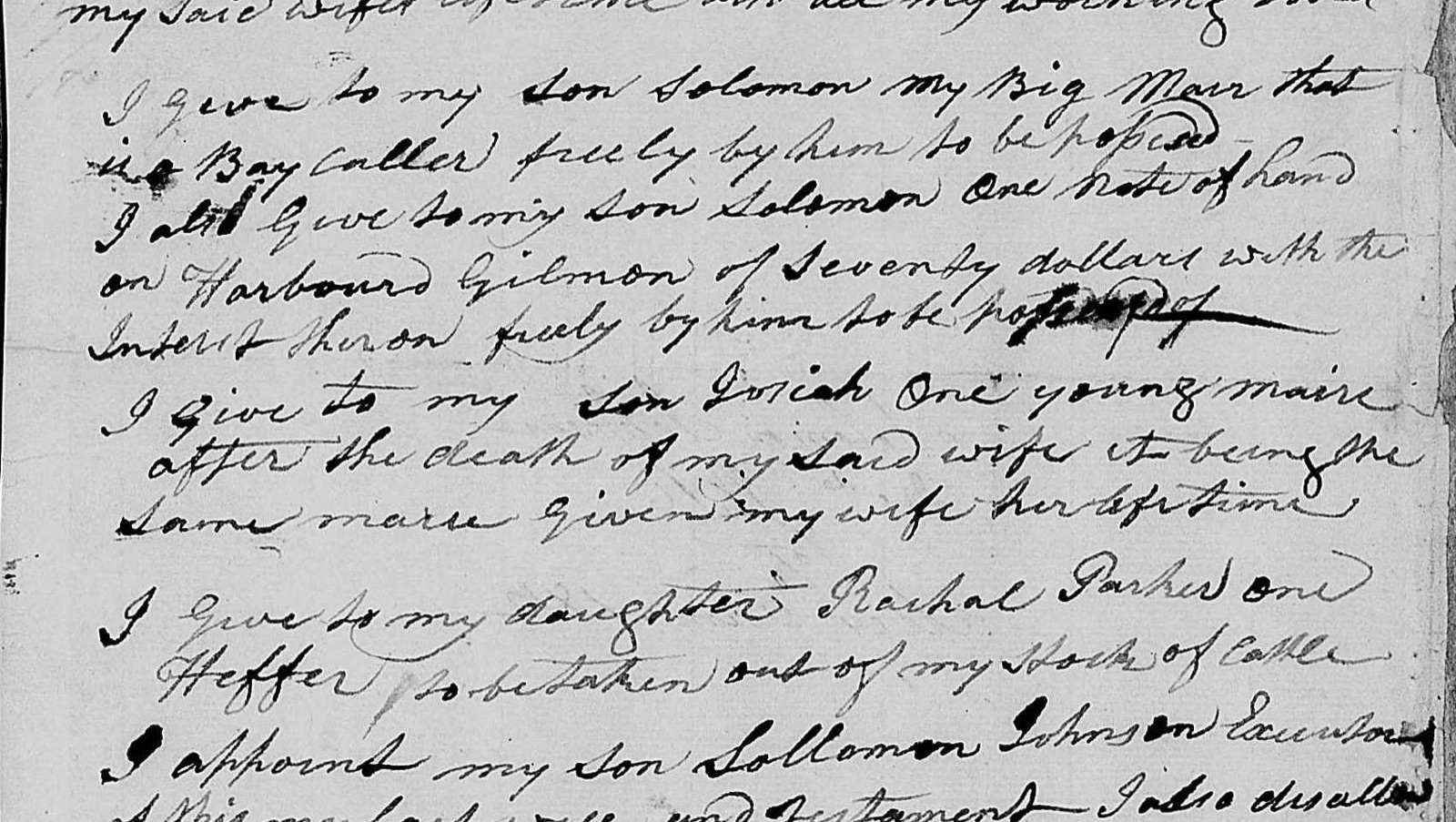
The will then names its executor: "I appoint my Son Sollomon Johnson Executor of this my last will and Testament I also disallow all wills hearetofore made by me Ratifying this as my last will." The executor was the person responsible for carrying out the will, paying debts and handing over the gifts. The line about disallowing earlier wills is standard wording, not evidence that an older will existed.
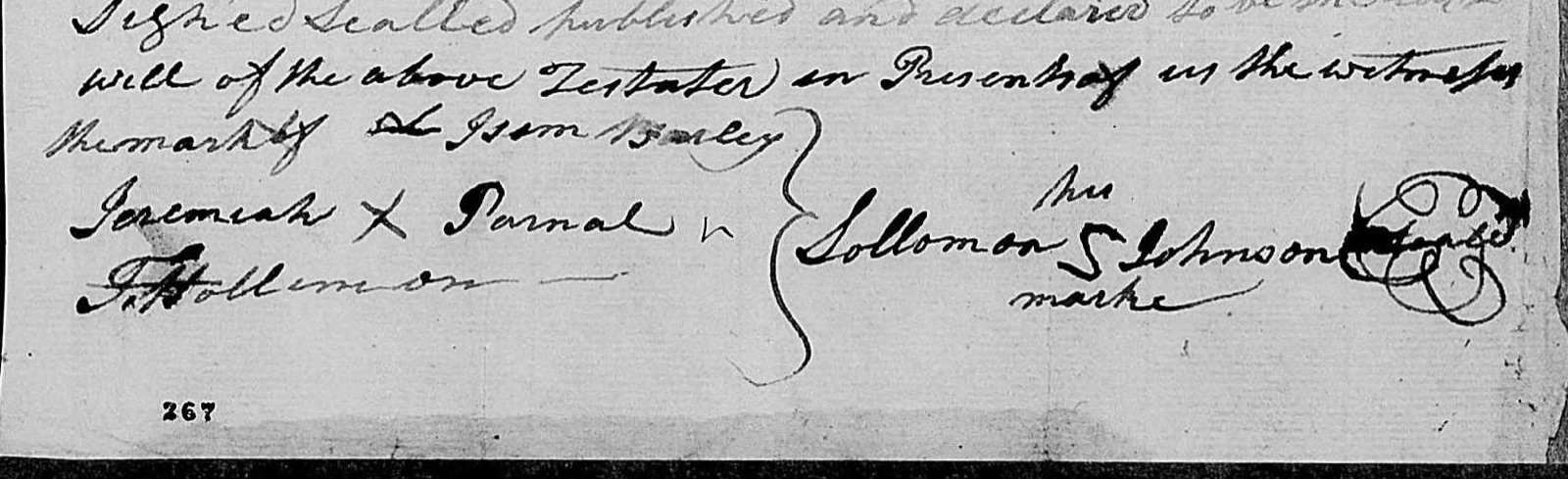
Finally the signing: "In witness whareof I have heareunto set my hand and seale the day and year above written. Signed Sealled published and declared to be the last will of the above Testater in Presents of us the witnesses." On the right is "Sollomon", a small hooked mark, and "Johnson", with "his" above and "marke" below, then a looping scrawl that stands in for a wax seal. The name was written by someone else; the mark between the two halves is the part credited to him. On the left are three witnesses who attest that they saw him make it. Isom Bailey also signed by mark ("the mark of" is written before his name), Jeremiah Parnal made an X between his first and last names, and only F. Hollimon's name stands with no mark beside it. So of the four men named at the bottom of this page, three made marks.
One caution about the mark. Wills were often copied into the county will book by a clerk, who drew a copy of the mark along with everything else, so in a copy the shape of the mark is the clerk's, not the testator's. Either way, a mark tells you he signed by mark, which usually means he could not write his name, though illness or poor eyesight could also be the reason. This scan looks like a loose original rather than a will book page, but the Commons description does not say, so treat that as an open question.
What happened next is not on this page. The Commons description, written by the person who uploaded the scan, says that the court proved the will at its May term and that Rachel, Solomon Jr., Josiah and Rachel Parker received their inheritance. That probate record would be the next thing to find, along with any inventory of the estate, which could list every hog and tool by value.
Notice, finally, what is missing. The will mentions no land at all. It bequeaths only movable property and never uses the word devise, which was used for gifts of land. That does not prove Solomon Johnson was landless. He might have sold or given land away earlier, or the land might simply have passed by law. It is a reason to check the Johnston County deed books before drawing a conclusion. A single page of a man who could not sign his name has given us his wife, three children, a son-in-law's likely surname, a man who owed him money, three witnesses, and a list of questions for the next trip to the archives.
- Read every gift twice: a phrase like "during my said wife's lifetime" can mean the same animal or object is promised to two people in turn.
- A daughter named with a different surname, like Rachal Parker, hands you her married name and a new family to search.
- Debts, notes of hand and witnesses name the people around your ancestor; follow them into court minutes, deeds and account books.
- "His mark" usually means the person could not write, but in a clerk's copy the mark's shape is not the person's own hand.
- A will that mentions no land is not proof of no land: check the deed books and the probate file before deciding.
How to cite this page
Daily Ancestor. "Solomon Johnson's Mark." Stories from the Records. https://dailyancestor.com/stories/solomon-johnsons-mark. Last checked 2026-10-01.