 Daily Ancestor
The Land Warrant That Never Came
Four lines in a small-town paper named a widow, her late husband and her hometown. A lost piece of government mail named her son.
On June 14, 1855, the Cynthiana News in Harrison County, Kentucky, printed a death notice of exactly four lines. It gives no birth date, no parents and no children. Yet within a year and a half the same newspaper would print a second notice about the same woman, and together with a few old books they open up three generations of her family. This is the story of Mary Veach, told only from what the printed records say.
Here is the first notice, word for word: "In Augusta, Ky., on the 6th inst., of Pneumonia, Mrs. Mary Veach, in the 57th year of her age, relict of the late David Veach, of this vicinity."
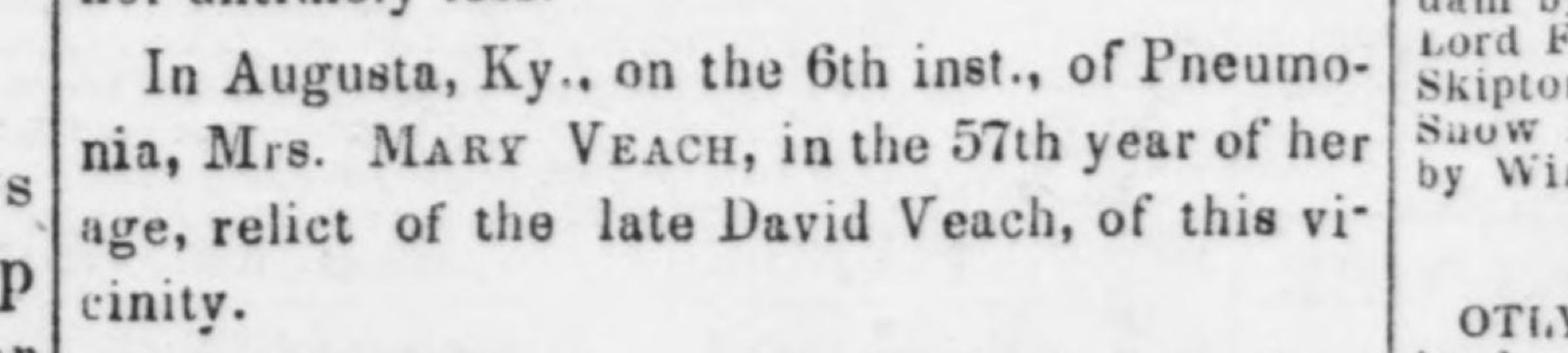
Every phrase in it carries a fact, so take it slowly. "Inst." is short for instant, meaning this present month. The paper is dated June 14, so "the 6th inst." is June 6, 1855. (Had it said "ult.", it would mean last month, May.) "In the 57th year of her age" means she had already passed her 56th birthday, so she was 56, not 57. Count back and her birth falls between roughly June 1798 and June 1799. "Relict" means the one left behind: she was a widow, and "the late David Veach" confirms her husband had died before her. Compare the word "consort", which in notices of this period usually meant a wife whose husband was still living. Finally, "of this vicinity" tells you the Veaches were known around Cynthiana, even though Mary died in Augusta, a river town in another county.
Directly under the notice the paper printed a long, warm tribute that begins "Again do we mourn." It praises a woman as a Christian and as "the loved and idolized center" of her family. It sits right below Mary's notice, but the part we can read never names its subject, so we will not lean on it. That is a good habit: a tribute printed next to a notice is not always about the same person.
Now jump ahead to the fall of 1856. The Cynthiana News carried a notice headed "Land Warrant Lost." It is worth reading in full, because it is far richer than the death notice. It says that Land Warrant No. 10,467, for 160 acres, was issued under the act of March 3, 1855, "in the name of Mary Veach, widow of David Veach," and was dated November 29, 1855. The warrant was addressed to the writer at Cynthiana, but it "failed to come to hand." Then comes the line a family historian dreams about: Mary Veach "is dead. She died whilst on a visit at Augusta, in Bracken county ... on the 6th day of June 1855 leaving one minor heir, a son named David Veach." The writer, signing as W. S. Haviland (the last letters are faint on the scan), says he will apply as agent or attorney for that son to the Commissioner of Pensions for a duplicate warrant in the son's name.
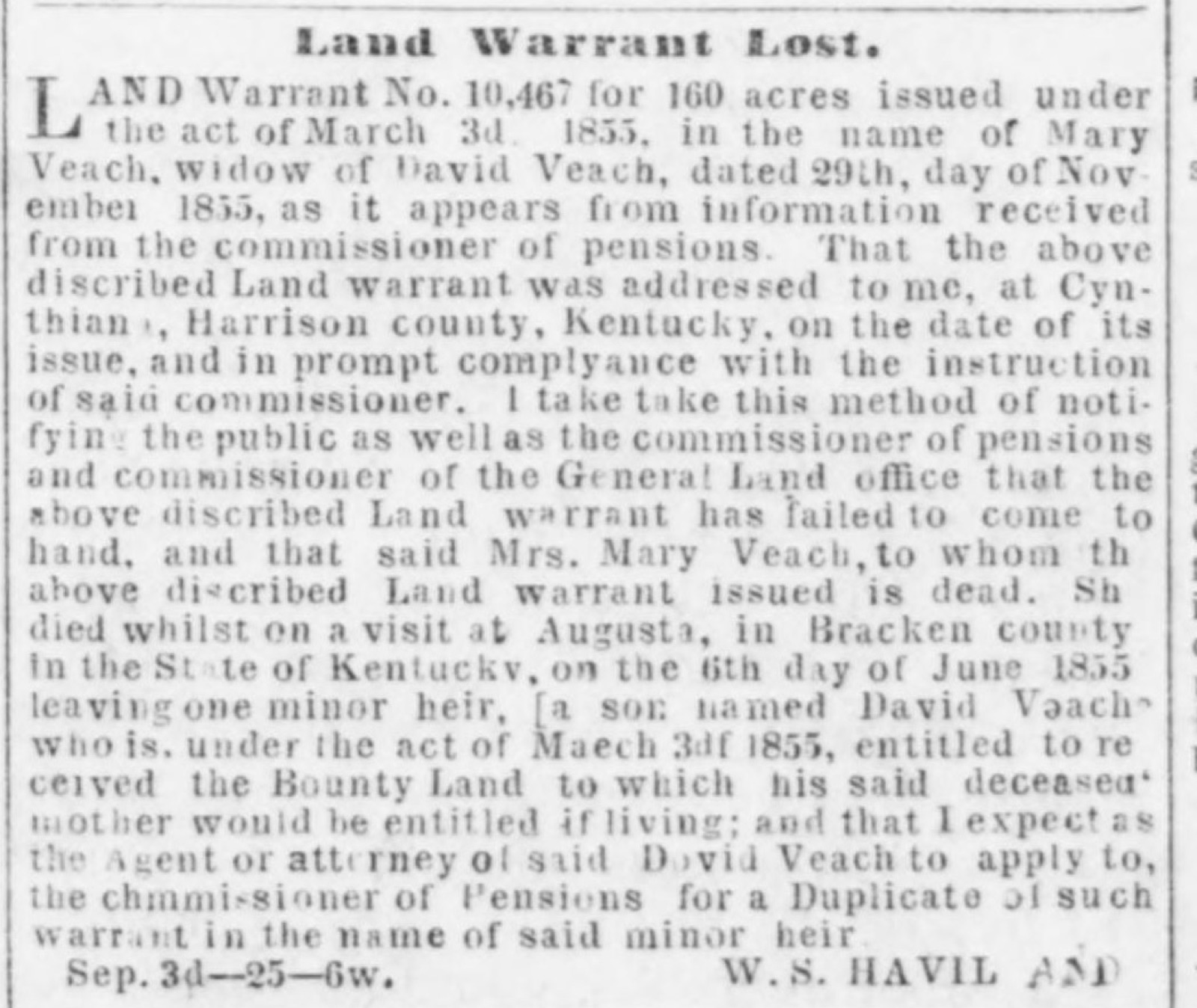
Look at what this one advertisement adds. It explains why Mary was in Augusta: she was visiting. It confirms the date of death independently of the first notice, and the two agree. It names a son, David, who was still under age in 1856. And it tells you that Mary had applied, as a widow, for bounty land under the act of March 3, 1855, a law that granted land to men who had served in America's earlier wars and to their widows. So her late husband David had military service of some kind. Notice one more puzzle: the warrant is dated November 29, 1855, almost six months after Mary died. The notice does not explain the gap. Bounty land application files are kept at the National Archives, and that file, not the newspaper, is where the answer would be.
Which war? The notice does not say, and here we must be careful. A roster printed in 1903 in Bennett H. Young's The Battle of the Thames lists a private named David Veach in Captain James Coleman's company of Colonel Richard M. Johnson's Kentucky regiment in the War of 1812. The same book describes a lieutenant of Coleman's company as being from Harrison County. That fits our David nicely, but a name on a roster is a lead, not a proof. The bounty land file is the record that could tie the soldier to Mary's husband.
To learn who Mary was before she was Mrs. Veach, we turn to two books. Neither one mentions the death notice. We connect them because the names, the husband and the town all match, which is strong evidence but not proof. In 1868 a large Peck family genealogy recorded that John W. Peck, living in Cynthiana in 1863, married Nancy J. Veach on March 2, 1843, "daughter of David Veach, Esq." The next sentence reads: "He was born in Harrison County, where he resided until his decease." Which man is "he"? The same family is described in a second book, Lucinda Boyd's Chronicles of Cynthiana (1894), which says John W. Peck was born in New York in 1819 and was still living when she wrote. So the man born in Harrison County who had died by 1868 must be David Veach, though the genealogy's wording leaves a little room for doubt.
Boyd's book then gives Mary her maiden name. "Her father was David Veach, who married Mary Broadwell. David Veach was a son of Thomas Veach, who came here from Scotland at an early day. The Broadwells came here from New Jersey, and settled on lands about three miles from this place." Elsewhere Boyd writes that Asbury Broadwell, born in Harrison County on May 29, 1791, and died December 11, 1843, a merchant, was the uncle of Mrs. John W. Peck. So Asbury was most likely a brother of Mary Broadwell Veach, though Boyd does not say so in those words. In that passage Boyd spells the name "Veatch", a reminder that spelling was not fixed, so search for every form.
The Peck genealogy also lists Nancy's children, who were Mary's grandchildren: Hiram D., born March 23, 1844; Mary E., born March 25, 1848, who died June 7, 1859; Lucy W., born April 19, 1853; and Lydia W., born August 7, 1856.
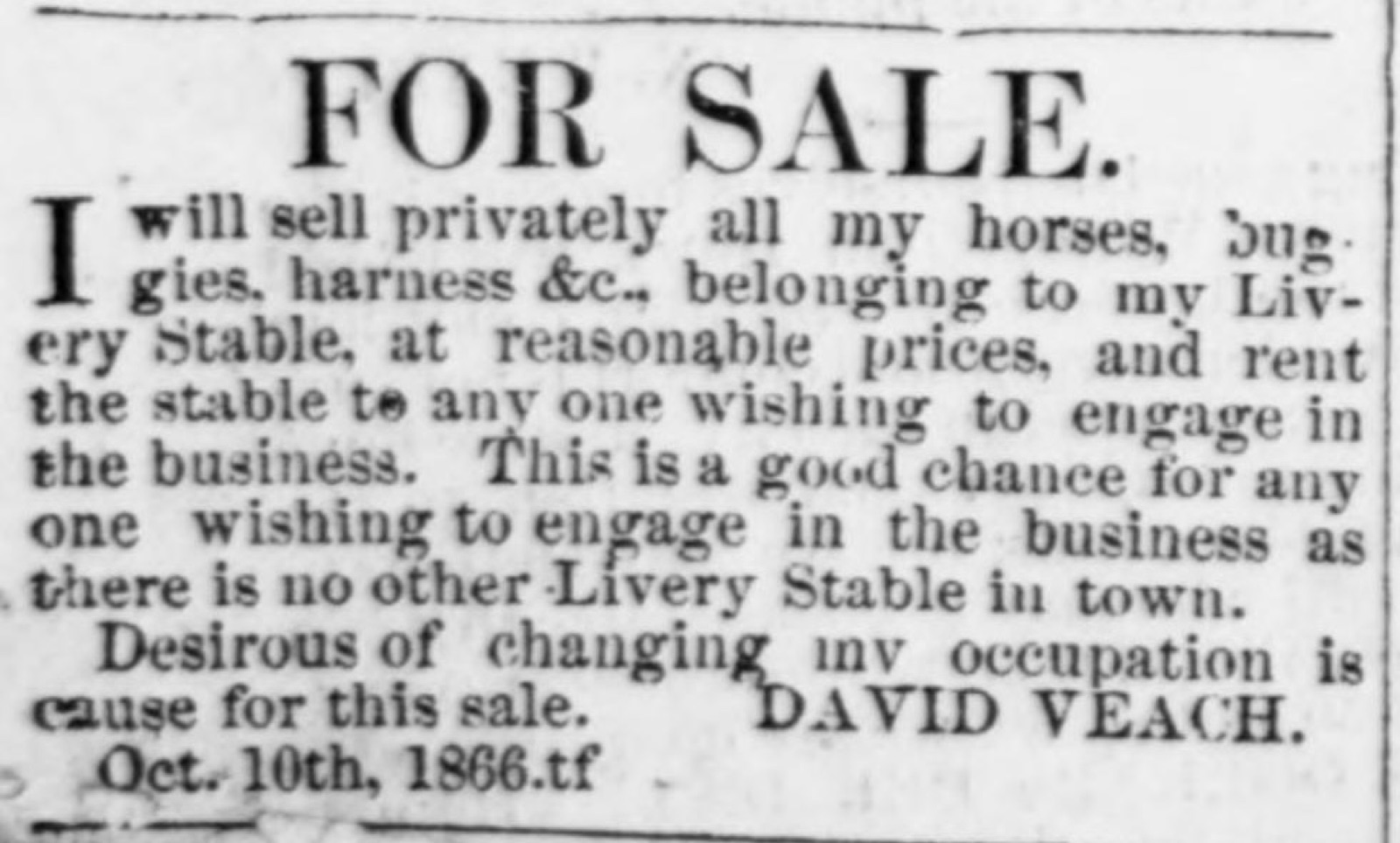
One last clipping shows how easily a trail can fork. In an advertisement dated October 10, 1866, and still running in the Cynthiana News that December, a David Veach offered to sell "all my horses, buggies, harness &c., belonging to my Livery Stable" and rent out the stable, adding that "there is no other Livery Stable in town" and that he wished to change his occupation. Was this Mary's son, now grown? The age would fit, but the advertisement does not say whose son he was, and more than one David Veach may have lived near Cynthiana. A careful researcher writes it down as "possibly the son" and goes looking for proof.
So four short lines, read closely, led to a son, a daughter, four grandchildren, a maiden name, a likely brother, a father-in-law from Scotland and a possible War of 1812 soldier. None of that was in the death notice itself. Each came from asking what the notice implied, and then going to look.
- Decode every phrase of a short death notice: "inst." fixes the month, "in the 57th year" means age 56, and "relict of the late" tells you the husband died first.
- Keep reading the same local paper for a year or two after a death. Legal notices, estate sales and lost-warrant notices often name heirs that the obituary leaves out.
- A widow's bounty land warrant means her husband had military service. Ask the National Archives for the bounty land or pension file to learn which war and to see the papers she signed.
- Search old county histories and family genealogies by every spelling (Veach, Veatch). They often supply a maiden name and parents, but check who "he" or "she" refers to in each sentence.
- A matching name in a roster or an advertisement is a lead, not proof. Write it down as "possibly" until another record ties it to your person.
- Cynthiana News, June 14, 1855 (death notice of Mary Veach), Internet Archive xt76dj58gc1r
- Cynthiana News, November 20, 1856 ("Land Warrant Lost"), Internet Archive xt7w3r0pvh9v
- Cynthiana News, December 20, 1866 (David Veach livery stable advertisement), Internet Archive xt7g1j977c2m
- Lucinda Boyd, Chronicles of Cynthiana and Other Chronicles (1894), pp. 37 and 46
- Ira B. Peck, A Genealogical History of the Descendants of Joseph Peck (1868), p. 110
- Bennett H. Young, The Battle of the Thames (1903), roster of Johnson's Regiment, Coleman's Company
How to cite this page
Daily Ancestor. "The Land Warrant That Never Came." Stories from the Records. https://dailyancestor.com/stories/mary-veach-and-the-lost-land-warrant. Last checked 2026-10-01.