 Daily Ancestor
Twenty-Two Years, Four Months and Three Days
A small printed funeral notice from a Missouri town in 1896, read next to an 1887 etiquette manual: what a Victorian family put on paper when someone died, and what it left off.
The card is small and plainly printed. The Missouri Historical Society keeps it, and its scan is free to use on Wikimedia Commons. Here is every word on the front: "Funeral Notice. Died, at her home in Oran, October 17th, 1896, Mrs. Mamie E. Allison, aged 22 years, 4 months and 3 days. Funeral from the residence of her parents to the Commerce Cemetery at 9 o'clock Monday morning, October 19th. Services at St. Paul's M. E. Church, South. Friends of the family invited to attend."
That is all the family chose to print, and it is a great deal. Oran and Commerce are both in Scott County, Missouri; Commerce is a village on the Mississippi. So the notice tells us where Mamie lived, where she would be buried, which church held the service, and that she was a married woman whose funeral would start from her parents' house, not her own. It does not name her husband or her parents. That is typical of these notices: they were written for neighbors who already knew who everyone was.
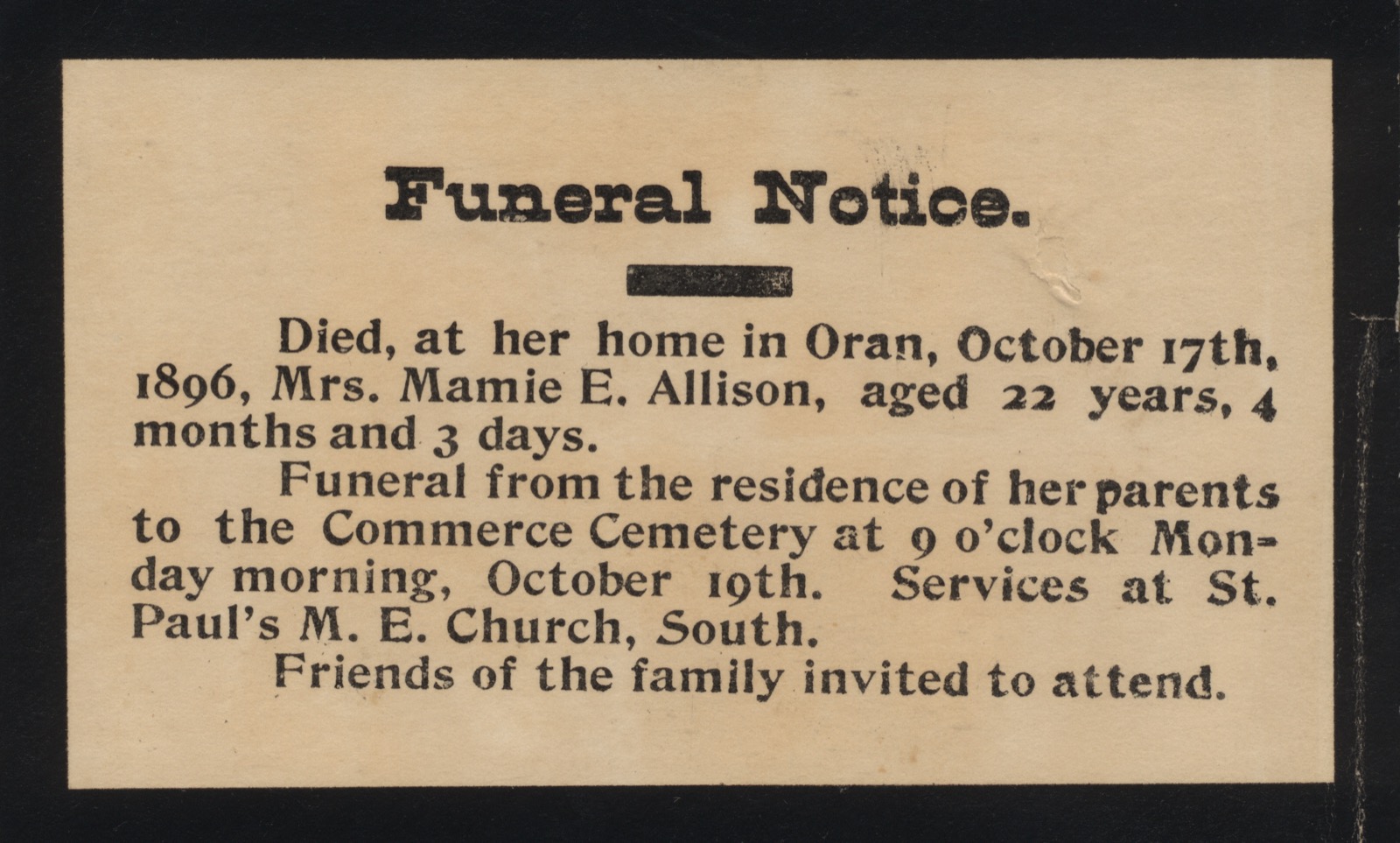
Look at the age. "22 years, 4 months and 3 days" is the Victorian habit of counting a life to the day, the same habit you see carved on gravestones. It is also a hidden birth date. Work it backward from October 17, 1896: take off 3 days and you reach October 14; take off 4 months and you reach June 14; take off 22 years and you reach June 14, 1874. That is the birth date the notice implies. It is a calculation, not a record of her birth, and it is only as good as the family's arithmetic, but it gives you a date to test against a census or a Bible record.
Then the church. "M. E. Church, South" was not a slip for M. E. Church. The Methodist Episcopal Church split in 1844 over slavery, and the southern branch kept its own name until the Methodist churches reunited in 1939. The word South tells you which church's records to look for.
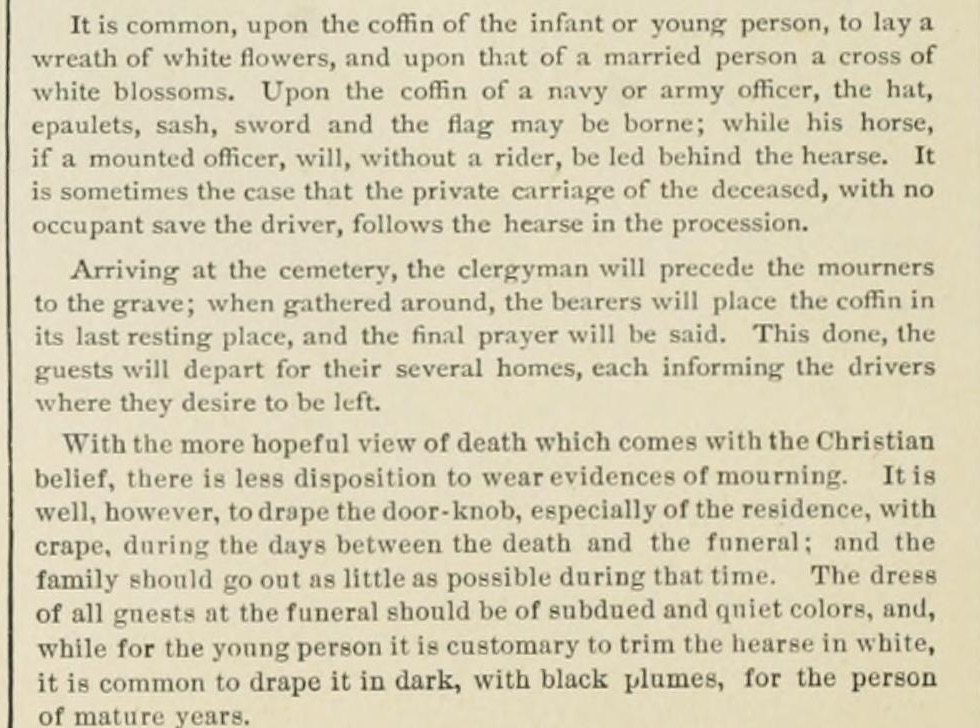
Why print a notice at all? An etiquette guide of the time, Hill's Manual of Social and Business Forms, explains it. In its 1887 edition, under "Etiquette of the Funeral," it says that "in the large city, where many friends and even relatives may not hear of the death, it is common to send invitations," and that "it is customary to have these invitations printed" and "to send them by private messenger." Oran was no large city, and the card does not say how it reached its reader. But its last line, "Friends of the family invited to attend," does the same job as the manual's printed invitations, in plainer words.
The same page of the manual lists the other customs of mourning that never made it onto paper. "It is well, however, to drape the door-knob, especially of the residence, with crape, during the days between the death and the funeral; and the family should go out as little as possible during that time." For the hearse, "for the young person it is customary to trim the hearse in white," while for "the person of mature years" it was draped dark "with black plumes." On the coffin, the manual says, it was common to lay a wreath of white flowers for an infant or young person, and "upon that of a married person a cross of white blossoms." Mamie was both young and married. Which custom her family followed, if either, the notice does not say, and no one should guess.
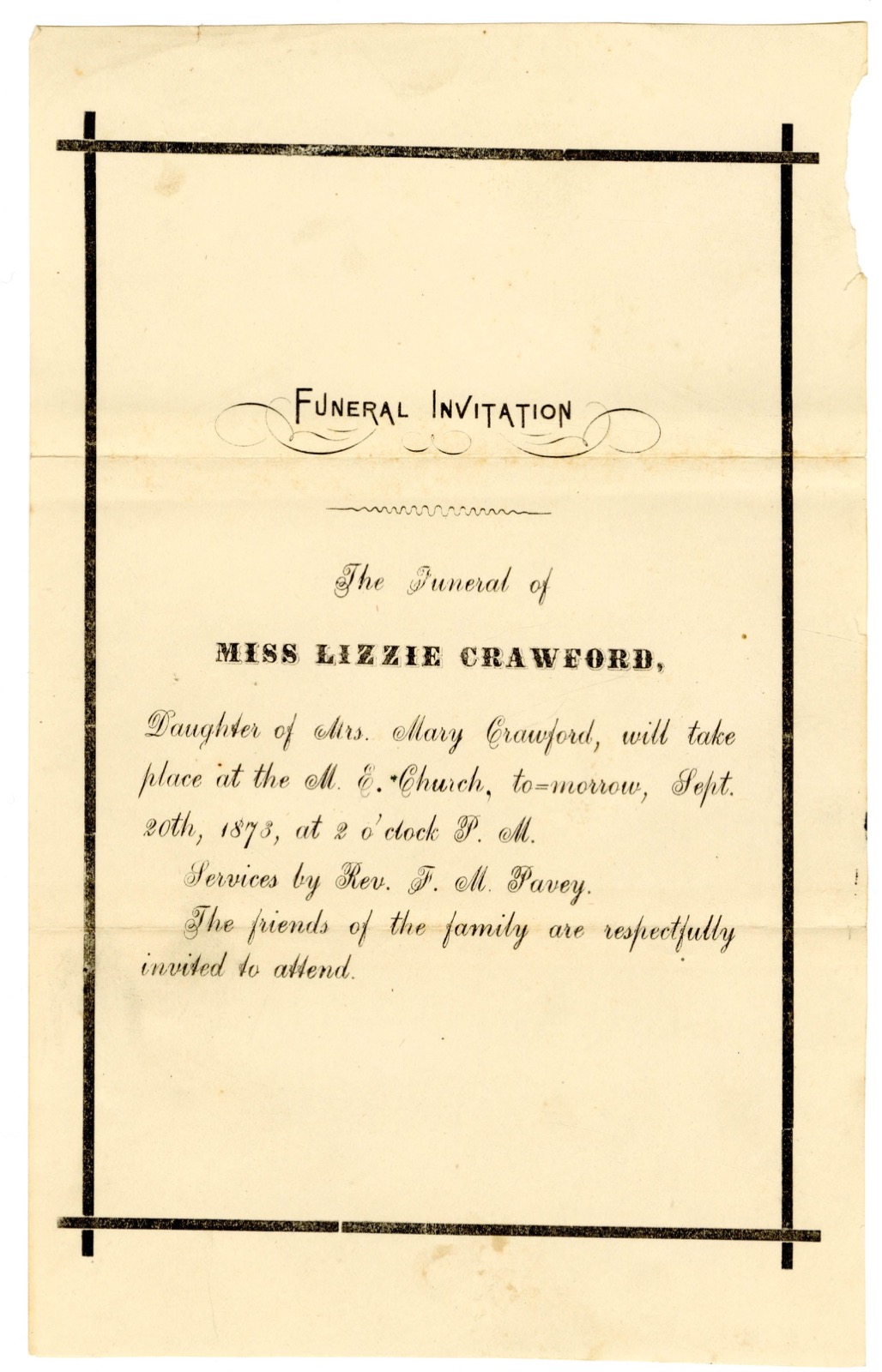
Set Mamie's notice beside an older one and you can see how the form had settled. The Indiana State Library holds a "Funeral Invitation" for Miss Lizzie Crawford, printed in a flowing script and framed in heavy black lines. It reads: "The Funeral of Miss Lizzie Crawford," then gives her mother's name, and goes on: "will take place at the M. E. Church, to-morrow, Sept. 20th, 1873, at 2 o'clock P. M." Then the minister's name, and "The friends of the family are respectfully invited to attend." Twenty-three years apart, the two cards share the same bones: who, which church, what hour, and an invitation to friends.
Lizzie's card also holds a warning about catalogs. The library's description, repeated on Commons, says she died September 20, 1873. The card says no such thing. It says her funeral would be held "to-morrow, Sept. 20th," which means she died before that date, on a day the card does not give. Somewhere between the card and the catalog, a funeral date became a death date. If you copied the description instead of reading the card, you would carry that error into your tree.
One more detail sits on the back of Mamie's notice: a penciled line naming the donor and the year of the gift, 1950. How the card passed from 1896 to that donor, fifty-four years later, it does not say. The catalog record notes that it was "formerly Alphabetical File," a collection filed by name. If your family lived in a place with a county or state historical society, ask whether it kept a file of funeral notices and memorial cards by name. A single card like this can give you a death date, an exact age, a church, a cemetery and the house where her funeral began: her parents'.
- A funeral notice or invitation can give an exact age at death. Count it back to a birth date, then label that date as calculated.
- Read the record, not just the catalog description. A funeral date is easy to mistake for a death date.
- Note the exact church name. "M. E. Church, South" and "M. E. Church" kept separate records until 1939.
- Etiquette manuals of the period explain customs like crape on the door and printed invitations, but a single family may not have followed them. Do not fill gaps in the record with what was customary.
- Ask county and state historical societies whether they keep alphabetical files of funeral notices and memorial cards donated by families.
- Funeral notice of Mrs. Mamie E. Allison, Oran, October 17, 1896, front and back (Missouri Historical Society, via Wikimedia Commons)
- Same notice, back: penciled gift note, 1950 (Wikimedia Commons)
- Lizzie Crawford funeral card, 1873 (Indiana State Library, via Wikimedia Commons)
- Hill's Manual of Social and Business Forms, 1887, page 170: Etiquette of the Funeral (Internet Archive)
- Oran, Missouri, Wikipedia
- Commerce, Missouri, Wikipedia
- Methodist Episcopal Church, South, Wikipedia
How to cite this page
Daily Ancestor. "Twenty-Two Years, Four Months and Three Days." Stories from the Records. https://dailyancestor.com/stories/mamie-allison-funeral-notice. Last checked 2026-10-28.