 Daily Ancestor
The Son Who Paid for the Flour
A Civil War mother's pension file from Indiana, and how four years of paperwork proved who kept the household fed.
Seth Hobbs was in the Union Army for about four months. He left behind no wife, no children and no letters that we know of. What he did leave is a thin bundle of paper in Washington, D.C., created because his mother asked the government for help. Twenty-three scanned pages, now free to read online, tell us who paid for the groceries in a small house in Canton, Indiana, and how long it took one widow to prove it.
The file is a mother's pension. Under the act of Congress of July 14, 1862, the mother of a soldier who died in service could draw a pension if he left no widow or minor child and if she had depended on him, wholly or in part, for her support. That last condition is what makes these files so rich: a mother had to show, with witnesses, how her son had kept her.
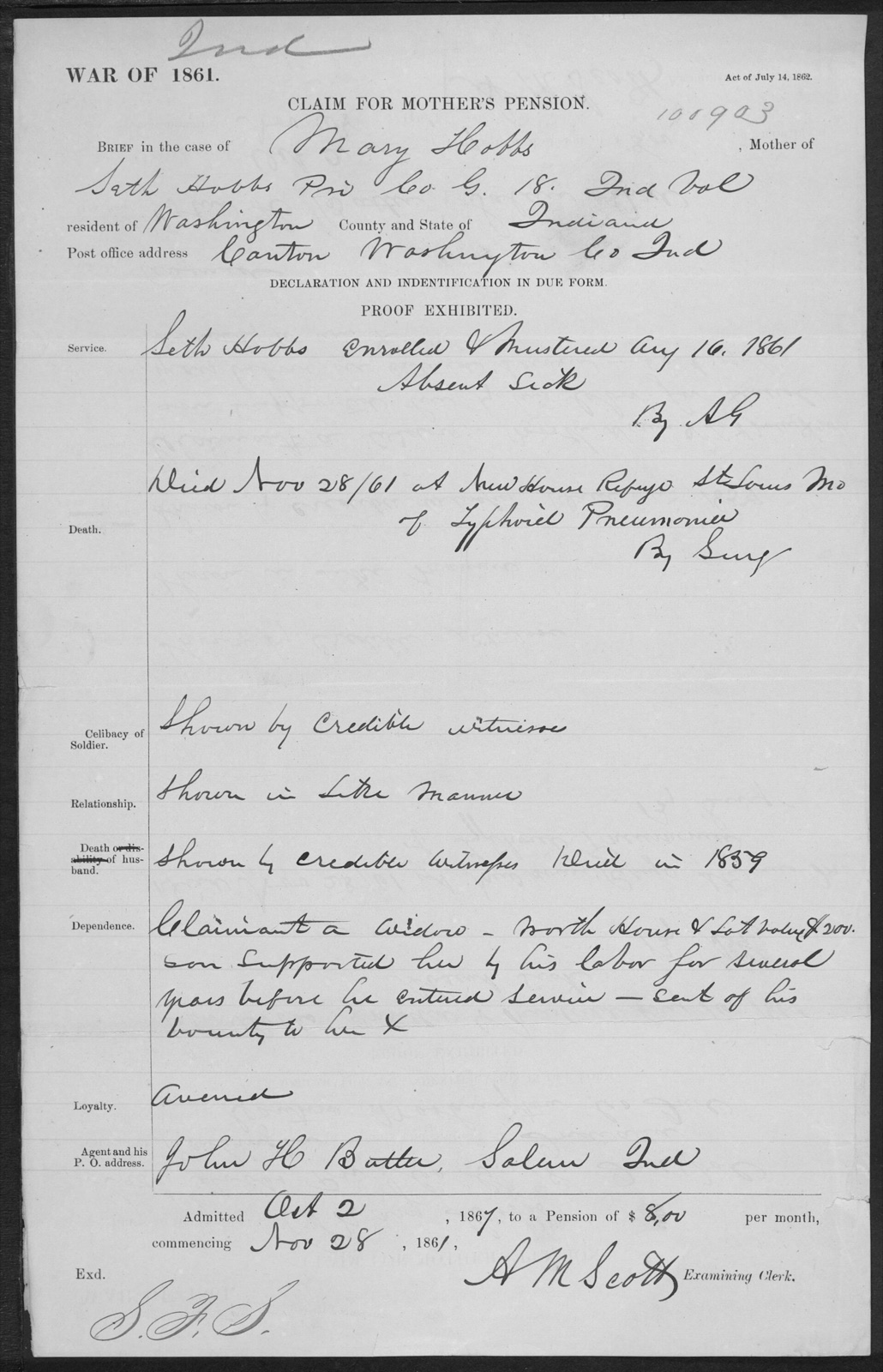
Start where the clerks started: the brief. It is a printed form headed "Claim for Mother's Pension" that sums up the whole case on one page. It names "Mary Hobbs, Mother of Seth Hobbs Pri Co. G. 18. Ind Vol," resident of Washington County, Indiana, post office Canton. Under Death: "Died Nov 28/61 at New House of Refuge St Louis Mo of Typhoid Pneumonia." Under Death of husband: died in 1859. Under Dependence: the claimant is a widow who owns a house and lot worth $200, and her son supported her by his labor for several years before he entered service. At the bottom, the outcome: admitted Oct. 2, 1867, to a pension of $8.00 per month, commencing Nov. 28, 1861. The brief is the answer key. Read it first, then read the papers behind it to see how each line was proved.
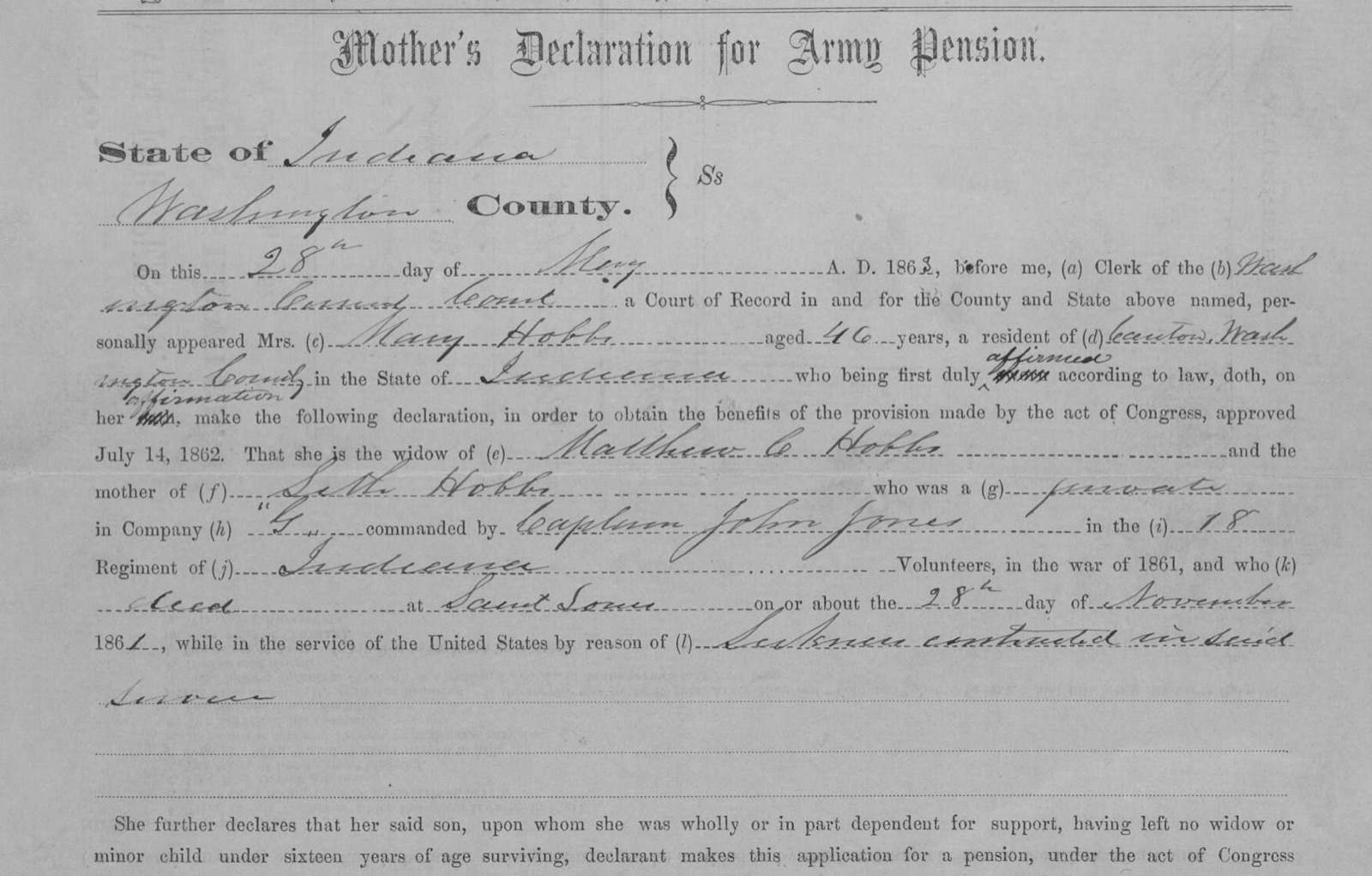
The first paper is Mary's own declaration, made on May 28, 1863 (the last digit of the year looks written over), before the clerk of the Washington Circuit Court. It gives her age as 46, her home as Canton, and her late husband's name: Matthew C. Hobbs. Seth, it says, was a private in Company G, commanded by Captain John Jones, 18th Indiana Volunteers, and died at Saint Louis on or about November 28, 1861, of "sickness contracted in said service." One small correction on the form is worth noticing: the printed word "sworn" is struck out and "affirmed" written above it, and "oath" is changed to "affirmation." Some people would not swear an oath and affirmed instead; the form does not say why Mary did. In the same paper she named John H. Butler of Salem, Indiana, as her attorney, giving him power to press the claim for her. Two men from Canton, John L. Anderson and Elbridge Calvert (his signature could also be read "Ellridge"), swore that they knew her and her son.
Next come the government's own checks. On June 6, 1863, the Pension Office referred the claim to the Adjutant General for proof of service and death. A small docket slip in the file logs what followed: a letter to attorney Butler asking for proof that Seth was her son and that she had depended on him (the year looks like 1864), then, on January 10, 1866, printed requests to the Adjutant General and the Surgeon General. The Adjutant General's reply, dated January 13, 1866, gives the enlistment details but adds a problem: Seth was reported "Absent sick" on the September and October 1861 rolls, the roll for November and December was "not on file," and there was "no evidence of death on file." On January 31, 1866, the office wrote to the attorney suspending the case for proof of dependence and of the death and its cause. The answer on the death came from the Surgeon General's Office on February 9, 1866: Private Seth Hobbs had been reported by Surgeon J. H. Bailey as having died November 28, 1861, at the general hospital in the New House of Refuge, St. Louis, of typhoid pneumonia.
Before those replies came in, Mary had started again. On November 11, 1865, she filed a second application, this time giving her age as 49 and the cause of death as "disease," with the note "particular disease not known by applicant." So the two sides knew different things: the mother knew her son had died of sickness in St. Louis, and it was the Army's hospital records that named the illness.
The heart of the file is the proof of dependence. Warren Wilson and James Penhale, both of Canton, swore a joint affidavit that Seth was Mary's son, that he died unmarried, and that Matthew C. Hobbs had died on or about March 27, 1859. Wilson also swore a separate affidavit that Seth "paid her bills for groceries" and that his wages were her "means of buying the necessaries of life." He put her property at nearly an acre in Canton worth one hundred fifty dollars, seemingly owned by Mary together with the heirs of Matthew Hobbs.
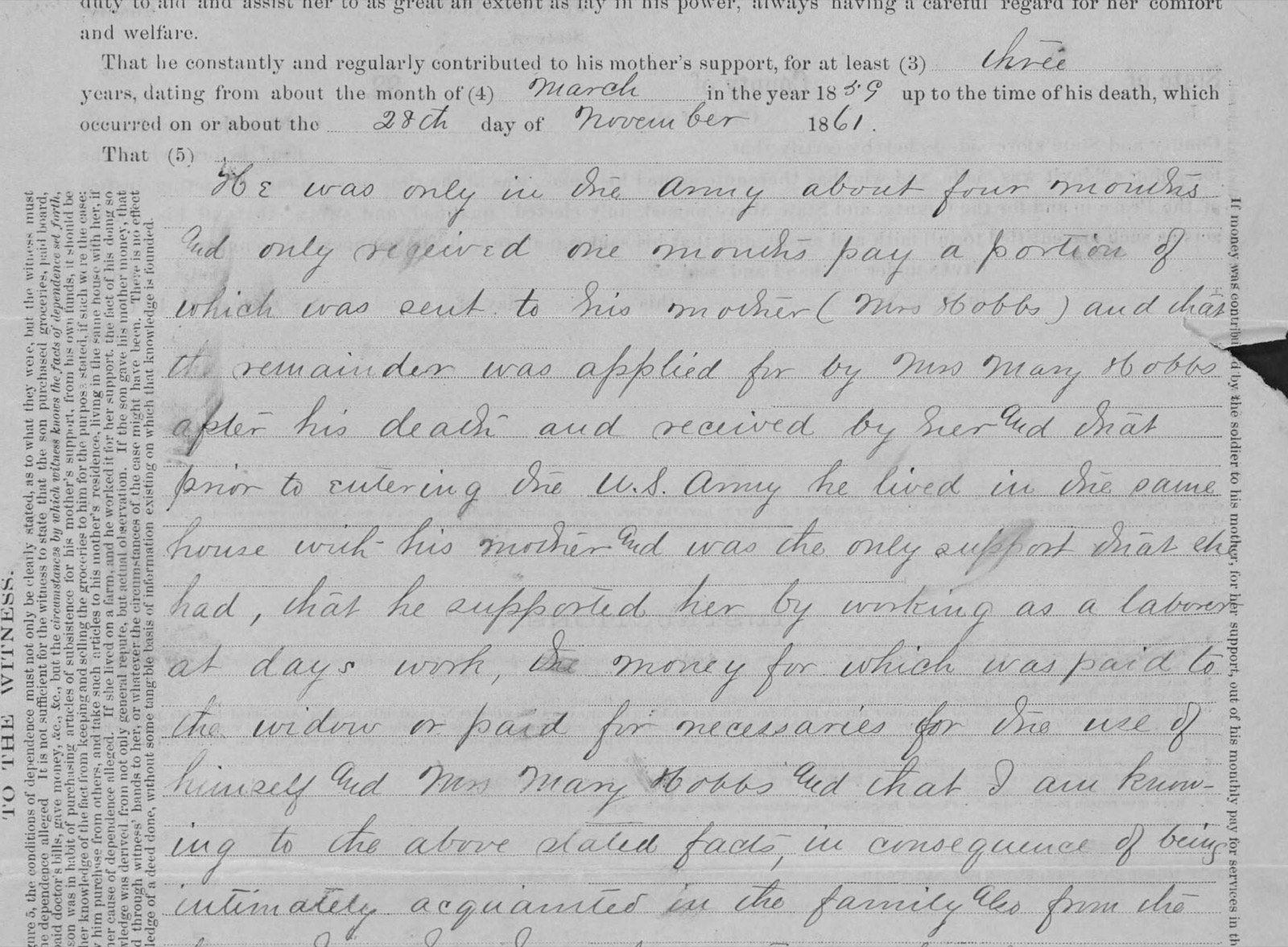
In September 1867, attorney Butler sent more evidence, writing that he was sending it "the third time" and that it was "the best that can be had." With it came one more affidavit, sworn September 25, 1867, before the court clerk. It says Seth "was only in the Army about four months" and received one month's pay, part of which he sent to his mother. Before he enlisted he lived in the same house with her and supported her "by working as a laborer at days work." The witness adds that Seth bought flour and meat from him for his mother and paid for it by working for him. Oddly, the witness's name on this form is written as Seth Hobbs, the same as the dead soldier, and it is signed that way too; another Hobbs, whose first initial is unclear, signed as a witness to it. The file does not explain it: it could be another man of the same name, perhaps a relative, or a slip that was never corrected. It is a puzzle to note, not to solve by guessing.
Butler also enclosed a letter from the Treasury Department, Second Auditor's Office, dated January 20, 1863. It told Mrs. Mary Hobbs that a certificate for $100 was payable to her "as the mother of dec'd" Seth Hobbs, for the bounty provided by the act of July 22, 1861. Pay and bounty owed to a dead soldier were handled by the Treasury, separately from pensions, so this letter is a second, independent record that the government already accepted Mary as Seth's heir.
Put the witnesses side by side and they do not quite agree. Wilson said Seth supported his mother for at least two years from March 1859; the 1867 affidavit says three. Wilson valued her place at $150; the 1867 affidavit calls it one acre worth $200, owned by Mary herself, and the brief went with $200. The file does not say which is right. The brief uses the later figure, $200, and does not explain why. The pension certificate jacket closes the story: certificate No. 100903, $8 a month from November 28, 1861, paid through the Indianapolis agency, sent to J. H. Butler at Salem. The back pay to 1861 meant the delay did not cost her the earlier months.
This file does not say when Mary Hobbs died; records of pension payments, kept separately, would be the place to look. But from four years of paperwork we know her husband's name and death date, her ages, her town, the size of her lot, her lawyer, her neighbors, and the plain detail that her son paid for flour and meat with his own day labor.
- Read the brief first. It is the clerk's summary of the whole claim and tells you which papers to look for behind it.
- A mother's pension file can name the soldier's father and his death date, because a mother had to prove she was a widow (or that her husband could not support her).
- Dependence affidavits are where everyday life shows up: who paid for groceries, what work the son did, how much land the family had. Read them slowly.
- Expect witnesses to disagree on years and dollar amounts. Record each version with its source and date instead of picking one silently.
- Look for side records the file points to, such as Treasury letters about back pay and bounty, and pension payment records for when payments stopped.
- Approved Pension Application File for Mary Hobbs, Mother of Seth Hobbs, Company G, 18th Indiana Infantry Regiment (WC100903), page 2 (brief); pages 1 to 23 read
- Same file, page 4: Mother's Declaration for Army Pension, May 28, 1863
- Same file, pages 6 and 9: Adjutant General's report (Jan. 13, 1864) and Surgeon General's report (Feb. 9, 1866)
- Same file, pages 15, 18, 20 to 23: Treasury bounty letter (Jan. 20, 1863), joint and single affidavits (1865, 1867)
- Same file, page 10: pension certificate jacket No. 100903
How to cite this page
Daily Ancestor. "The Son Who Paid for the Flour." Stories from the Records. https://dailyancestor.com/stories/mary-hobbs-mothers-pension. Last checked 2026-10-01.